An illustration depicting Viewpoints Editor Isabella Gresham split between public and private school is shown. From kindergarten to seventh grade, Gresham attended St. Joseph Catholic Parish School and disliked its education structure. “The small class sizes and tight-knit school community pushed the students and teachers closely together but led to a drama-filled and unhealthy atmosphere,” Gresham wrote. Illustration by Sylvia Robinson
Viewpoints Editor Isabella Gresham discusses her experience attending a Catholic private school and how it impacted her.
For seven years of my life, I walked into a classroom at 7:45 a.m. each weekday with the same 12 kids I had seen every day in school since kindergarten.
I attended St. Joseph Catholic Parish School, a 150-student private Catholic school, from the ages of five to 12. The small class sizes and tight-knit school community pushed students and teachers together but also led to an unhealthy atmosphere that promoted incredibly strict values.
When every wall contained a crucifix and every student was in the same clean-cut uniform, individualism wasn’t exactly appreciated. With a specific focus on teaching Catholicism through designated religion classes, required school-wide church services every Friday morning and a ritual of prayer every day, students were taught two things: follow Catholicism and live by its set rules.
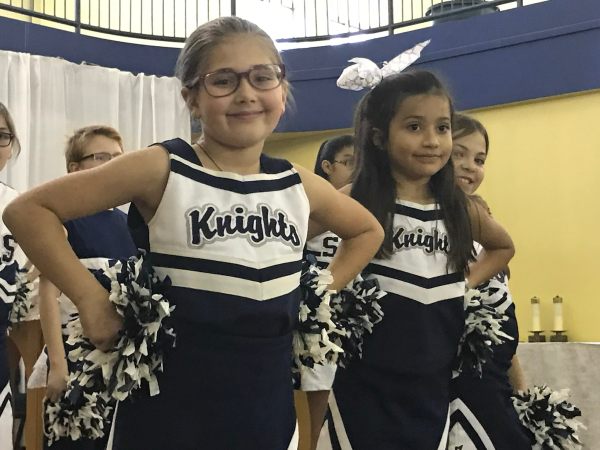
Viewpoints Editor Isabella Gresham poses in her cheer uniform at St. Joseph Catholic Parish School for a basketball game on Nov. 15, 2018. SJS greatly impacted Gresham through her seven years of schooling. “SJS, through the struggles I experienced there, still helped me. Because of the rigorous coursework I had undergone, schoolwork came particularly easily to me, which prepared me for my upcoming school years,” Gresham wrote. Photo courtesy of Maria Ruiz
At such an impressionable age, this notion stuck with me for a while until I was able to figure out for myself, once I reached seventh grade, what my religious beliefs were. By the start of sixth grade, my days were filled with confusion about my religious beliefs and identity.
Ultimately, I decided that my faith didn’t lie with Catholicism or the ideals it so strongly represented. Finally, after stating my struggles to my parents seemingly a million times, they allowed me to transfer to a much larger public school, Clarke Middle School, after seventh grade.
A slideshow highlights four key differences between public and private schools. Viewpoints Editor Isabella Gresham attended St. Joseph Catholic Parish School for seven years before switching to Clarke Middle School at the beginning of eighth grade. “While CMS was vastly different from SJS, it was a much-needed change in environment. Now, in 10th grade, I have never felt more secure in myself,” Gresham wrote. Graphic by Isabella Gresham
This switch allowed me to better understand who I wanted to surround myself with, how I wanted to physically present myself and my plans for the future. I could finally see how I wanted my high school and future career to go and had the ability to join clubs, pick the classes I wanted and find my place, which was otherwise unheard of in such a tiny school like SJS.
Though my experience wasn’t ideal, the struggles I endured at SJS shaped me for success. Because of the rigorous coursework I had undergone, schoolwork in the public education system came particularly easily to me. This prepared me for my upcoming school years in high school and higher education.
With a specific focus on teaching Catholicism through designated religion classes, required school-wide church services every Friday morning and a ritual of prayer every day, students were taught two things: follow Catholicism and live by its set rules.
While CMS was vastly different from SJS, it was a much-needed change in environment. Now, in 10th grade, I have never felt more secure in myself.
I’m grateful for the private school experience but am forever thankful to be where I’ve felt like I could belong: public school.