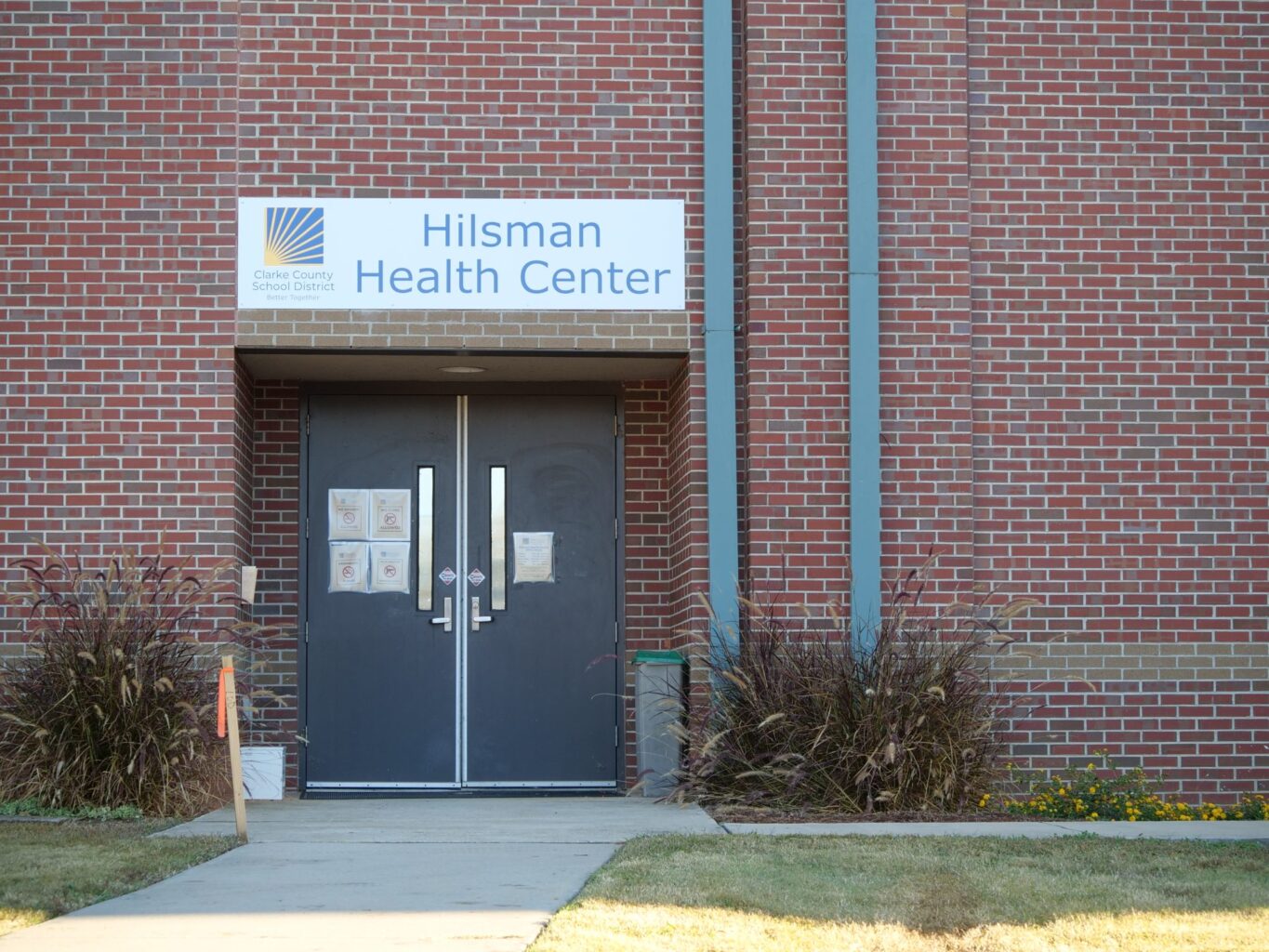
The entrance to the Hilsman Health Center, located at 870 Gaines School Road is shown on Nov. 4. In 2019, the Clarke County School District began to establish four School-based Health Centers in locations near many CCSD schools to provide affordable access to healthcare for all CCSD students and faculty. “With over 1,500 Title I schools in Georgia, easy and equitable access to healthcare for every student is crucial,” Viewpoints Editor Isabella Gresham wrote. “The SHBCs provide more opportunities for families and better health coverage in a time when the community needs it most.” Photo by Cooper Jones
The CCSD has installed four School-based Health Centers across the district to provide equitable healthcare services for the underprivileged, a great stride towards healthcare accessibility for every student.
There are 3,122 families living below the poverty line in Athens-Clarke County, according to a 2023 study done by the National Institute on Minority Health and Health Disparities.
And with over 1,500 Title I schools in Georgia, easy and equitable access to healthcare for every student is crucial.
To fight for this, the Clarke County School District began an initiative to establish School-based Health Centers (SBHCs) beginning in 2019, with locations at Hilsman, Clarke and Coile Middle Schools, as well as Classic City High School being built throughout the years. In an exceptionally underprivileged community, this accessibility is everything.
According to the CCSD website, “CCSD strives to enhance the well-being, health and academic success of all students by providing accessible, comprehensive and high-quality healthcare services directly within the school environment.” The SBHCs prove to be a strong step in the right direction, providing affordable, accessible healthcare for all CCSD students and staff.
Being a Title I school, it is vital for Clarke Central High School students to have access to accessible healthcare. From dental care and physical examinations to mental health resources and more, the SBHCs accept multiple common forms of payment to accommodate as many families as possible.
“I believe in universal health care,” Suzanne Lester, Medical Director of the Athens Free Clinic and Clarke Middle Health Center, said. “I think that, especially in the school setting, (being) able to offer services where there’s no copay and no bill means that the school nurses feel more comfortable sending people our way. It makes care more accessible.”
A map shows the locations of the four School-based Health Centers within the Clarke County School District. The CCSD built the SBHCs to provide students and staff with equitable access to healthcare for free or by accepting most major health insurances. “From dental care and physical examinations to mental health resources and more, the SBHCs accept multiple common forms of payment to accommodate every family,” Viewpoints Editor Isabella Gresham wrote. Graphic by Isabella Gresham
The SHBCs provide more opportunities for families and better health coverage in a time when the community needs it most. According to the Athens-Clarke County Pathways to Prosperity, roughly 40% of school-aged children live in poverty, which prompts the thought of expansion.
“We would love to be anywhere that our services are needed. We are really proud of the fact that we provide our services for free because any charge for many of our patients is too much of a charge,” Lester said. “(However), there (is) a number of surrounding rural counties that do not have School-based Health Centers down the road, (so) we think it would be great to expand into those regions.”
Although there are no current plans to create a fifth SBHC, the present four are a good start, as they allow most CCSD students to take advantage of their services. The SBHCs are more than just a place to get a check-up–they prove to be a great stride in the right direction for the fundamentally disadvantaged CCSD community.