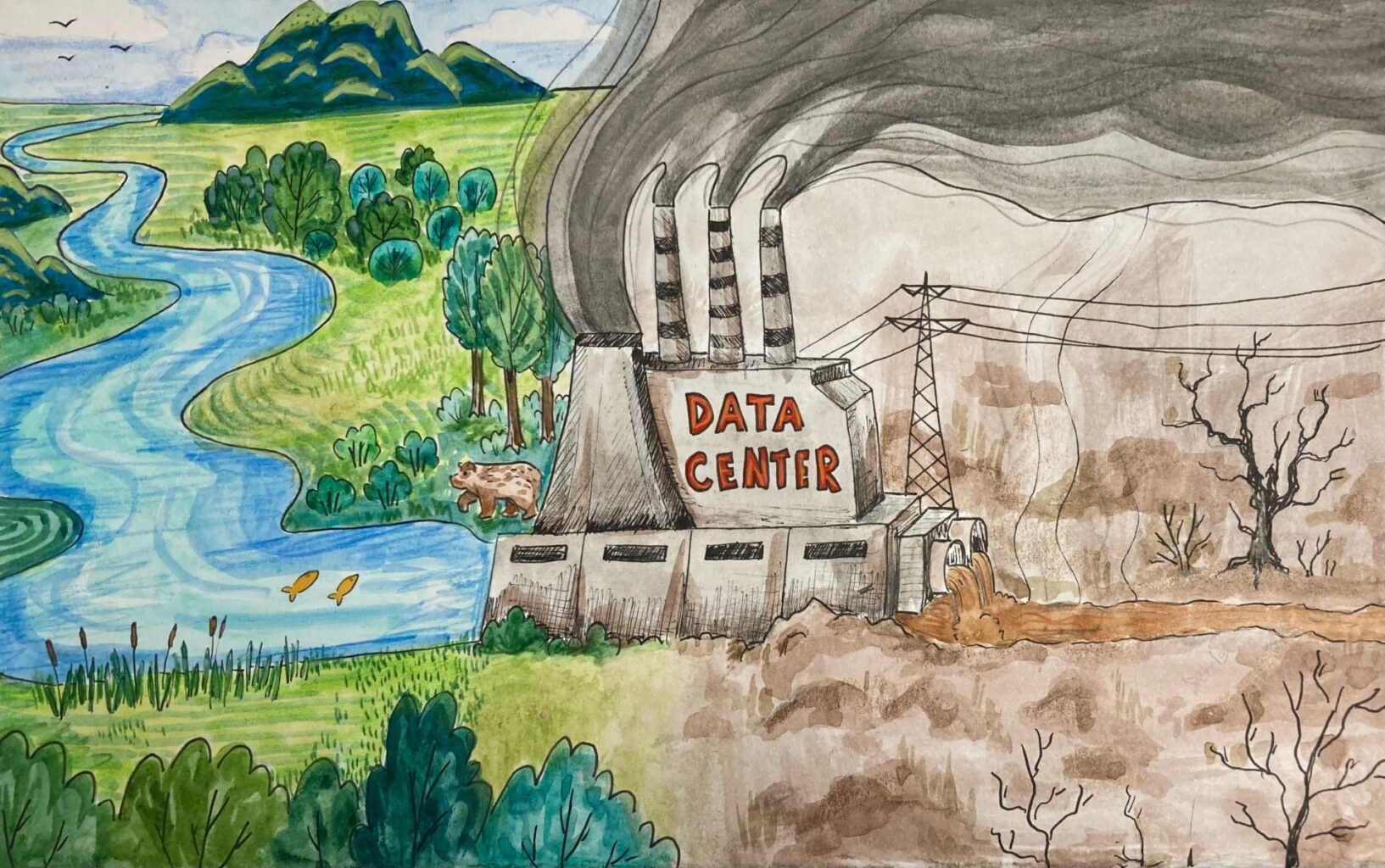
An illustration depicting the effects of data centers amid the artificial intelligence boom is shown. Variety Editor Adah Hamman wrote about the impacts of data centers on local communities and ecosystems. “Nowhere is this more evident than in the Southeast, where data centers have begun popping up like weeds,” Hamman wrote. “Both state and local governments can prevent further harm to the environment by enforcing stricter water-usage guidelines, requiring environmental impact studies, and encouraging data centers to use more renewable methods of powering and cooling their servers.” Illustration by Tess Wagtendonk
The infrastructure that AI technology relies on must be regulated, or it could pose a severe threat to the environment.
In years past, when people thought of the term “artificial intelligence,” several things may have come to mind: self-driving cars, talking virtual assistants and maybe even evil robots hell-bent on destroying the world.
Now, though, AI is used merely out of convenience, powering the tools people use every day for work, school, and entertainment.
However, this convenience comes at a cost. The development of AI technology largely depends on data centers, which, if not regulated properly, can have grave consequences, particularly for the environment.
According to Dictionary.com, a data center is “a facility equipped with or connected to one or more computers, used for processing or transmitting data.” There are several types of data centers, including hyperscale data centers, which have become increasingly popular in recent years for their ability to house advanced computer servers capable of handling large processing workloads.
Sound familiar?
Well, these “large processing workloads” often include training and running AI-powered applications, such as language models, facial recognition software and programs like ChatGPT that can generate text and images, which now receives around 2.5 billion prompts every day, according to its developer, AI research and deployment company OpenAI.
“These data centers take a ton of water. Either they’re pulling it from surface water, or they’re pulling it from some aquifer underground to cool all the heat that’s generated from all those queries, which is really energy-intensive,” University of Georgia Odum School of Ecology PhD student Bryson Hilburn, who studies fisheries and wildlife, said.
The development of AI technology largely depends on data centers, which, if not regulated properly, can have grave consequences.
According to a study by the Pew Research Center, data centers in the United States used about 17 billion gallons of water in 2023, with hyperscale facilities accounting for 84% of that amount. By 2028, that number is expected to have skyrocketed, with estimates ranging from 16 to 33 billion gallons for hyperscale data centers alone.
Although these numbers may seem insignificant to some, after all, data centers only accounted for around 0.04% of U.S. water consumption in 2024, their impacts are felt by local communities and ecosystems.
Nowhere is this more evident than in the Southeast, where data centers have begun popping up like weeds. One such project was planned for Bessemer, a town located less than 15 miles from Birmingham, a major metropolitan area in Alabama.
However, there was a problem: the Birmingham darter, a rare species of fish only found in and around the land allocated for the data center. Environmental activists argued the fish wouldn’t be able to survive if the center was built, as they require very specific conditions to carry out their life cycle.
Fortunately, after efforts from local environmental agencies, the data center was moved to another location. Other places, though, aren’t as lucky.
A more sustainable path forward is possible, but it requires stronger oversight for data centers. Both state and local governments can prevent further harm to the environment by enforcing stricter water-usage guidelines, requiring environmental impact studies and encouraging them to use more eco-friendly methods of powering and cooling their servers. Without these measures, data centers threaten to inflict irreversible damage on local communities and ecosystems.