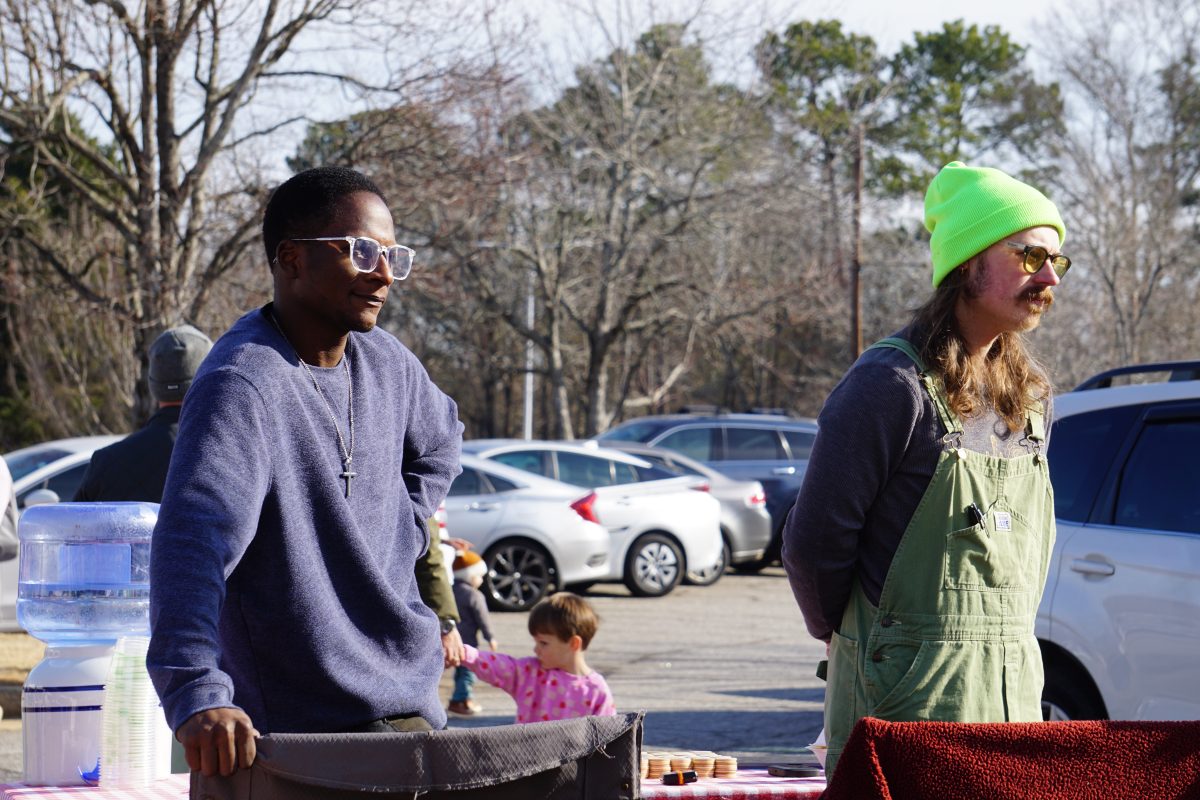
Athens Farmers Market Manager Gunnar Tarsa (right) stands with an Athens community member at the Athens Farmers Market at Bishop Park, located at 705 Sunset Drive, on Feb. 14. Tarsa took over the role of AFM Market Manager in February, where he works alongside Market Director Esther Kim to ensure smooth operation of the market. “(During) the day-to-day at the markets, we’re there (for) anything (vendors) need. (We) run their booth if they need (and) help them set up if they’re running late,” Tarsa said. “We’re there to serve them. It’s a cool relationship to be involved with 70 plus businesses at any given moment. Photo by Peter Atchley
Athens Farmers Market Director Esther Kim and Manager Gunnar Tarsa discuss inclusive aspects and accessibility of the AFM.
Diversity and Representation Editor Samaya Ellis: How have you worked to make the Athens Farmers Market an inclusive, accessible space for all?
Athens Farmers Market Director Esther Kim:(Doubling Supplemental Nutrition Assistance Program benefits has) always been a big thing for us. We usually double (Electronic Benefit Transfer) dollars in SNAP doubling, but we used to be able to double (it) no matter how much you spent at (AFM). This month, we had to cap that off at $40 or $50 per household per day because (of) grant funding. Grant funding has been hard to get in the past couple of years, so this is something Wholesome Wave Georgia had to do to prolong the program.
SE: What challenges come with the SNAP doubling benefit?
EK: We used to get a lot more SNAP participants showing up at (AFM), but since (2025), it’s been spotty. We’ve had a lot of hiccups with SNAP and that’s deterred a lot of people from coming. There was a point in time where we couldn’t take any EBT transactions. But before that, a lot of new EBT participants were showing up excited that they could come and double their dollars because that’s a huge deal, especially in this economy. (SNAP has) been really beneficial, and I hope it goes back to the point where we can double SNAP for however much (customers) spend.
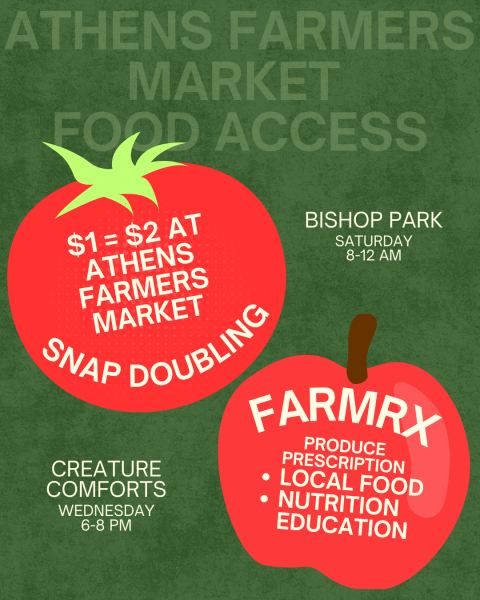
A graphic shows food access resources that the Athens Farmers Market provides for the community. The Athens Farmers Market has worked to foster an accessible community within the market through offered resources and guidance. “We want the market to feel more like a community, where people can come and hang out, meet their friends, take a class, or get produce,” Farmers Market Director Esther Kim said. “When you’re coming to the farmers market, you’re supporting not only the market itself, but all the farmers, makers and vendors (who) come out.” Graphic by Samaya Ellis
SE: Beyond SNAP, what other steps does the market take to make fresh food accessible to the community?
EK: We were also doing the Farm RX program, (which) was designed to help families that had chronic diet-related health issues. They could join this program (and) get Farm RX dollars they could use for fresh fruits and vegetables, (which) we were teaching them how to cook or garden. Last year, we hosted 75 different Farm RX families, and the year before that it was (around) 100, but we had to dwindle down because of grant funding. This year, we’re trying some new programs, such as a donation-based fitness class that we’re starting every Saturday at (AFM). We’re hosting different studios from around Athens to have these fitness classes.
SE: How does the market work to support not only the shoppers but local farmers and small businesses?
Athens Farmers Market Manager Gunnar Tarsa: Each year, we go through an application process of accepting businesses (to be vendors). For the last 18 years, a lot of the same faces keep showing up, which is awesome, (but we also) constantly have room for new vendors. We have bylaws that indicate who can sell. For example, if you’re a farmer, you have to be certified organic. If you’re a craftsperson, you have to be making everything by hand. We’re creating curated (vendor booth) layouts in hopes to get people to walk through the entirety of (AFM) and experience a wide variety of local businesses. It’s cool to be involved with 70-plus businesses at any given moment.
SE: What are some long-term goals for making the Athens Farmers Market more accessible to the community as a whole?
GT: One of the things we’re trying to do this year is specialty markets. Hosting events bring out a different crowd and a different set of vendors. We started a series last year called, “Crafts and Drafts.” We’re hoping to do more of those than we did last year. (During) the application process for the spring market, there are a lot of veteran vendors who will continue to be there, so the spaces that open up will be limited. Having these specialty markets, where people can apply to be a part of (it) is nice for them to get a connection with us and also sell their goods.
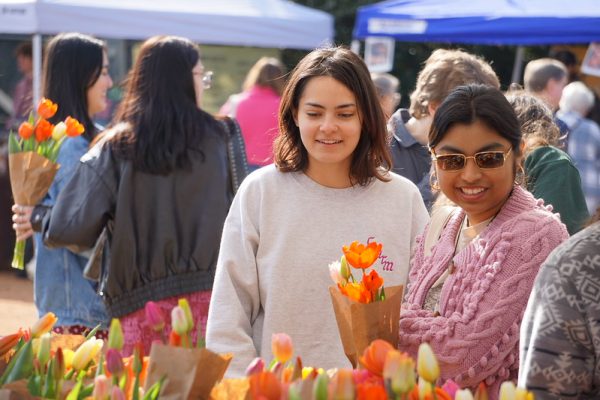
Athens community members attend the Athens Farmers Market at Bishop Park, located at 705 Sunset Drive, on Feb. 14. AFM Market Director Esther Kim began her career at the market in 2022, prior to her career as a professional chef. “It truly is a unique opportunity to have, because otherwise there would be no other way for us to get to know all these people,” Kim said. “It is really rewarding because we are helping so many different businesses grow. A lot of businesses that start at the farmers market grow to open a brick and mortar.” Photo by Peter Atchley
SE: If you could remove one barrier to food access in the community, what would it be?
GT: I don’t have a solution, but the cost of goods in general is too high. We live in a very low-income area in Athens-Clarke County. This goes without saying across the entire country: the cost of goods is too high. When you have large corporations that can produce goods, especially fresh produce, and sell them for cheaper than fresh produce at the local farmers’ market, it’s a hard industry to exist in. If I could change anything, I would subsidize the health of our country. People need to eat better in a way that is affordable.
SE: Why do you believe that farmers’ markets matter in conversation about community?
GT: I think community is dying with the growth of social media. People are becoming more isolated across the country. There’s not places where people are going for community interaction. I think farmers markets, breweries (and) large venues (are) spaces where things can be hosted specifically for local businesses and local (community members) to gather. It’s not all just about the community aspect of socializing. It’s a place where you learn. It makes me happy that every city in Georgia is hopping on board having their own farmers’ markets.
If I could change anything, I would subsidize the health of our country. People need to eat better in a way that is affordable.
— Gunnar Tarsa,
Athens Farmers Market Manager
SE: When do you feel the most proud of the work you are doing?
EK: I feel the most proud when we’re at a market and everything is going smoothly, (because) it’s when you can see the vendors thriving. Our job is to make sure our vendors are taken care of. That’s why I find so much importance in it. We are able to uplift these vendors and give them a platform to sell their stuff and to grow. I think that’s really beautiful.