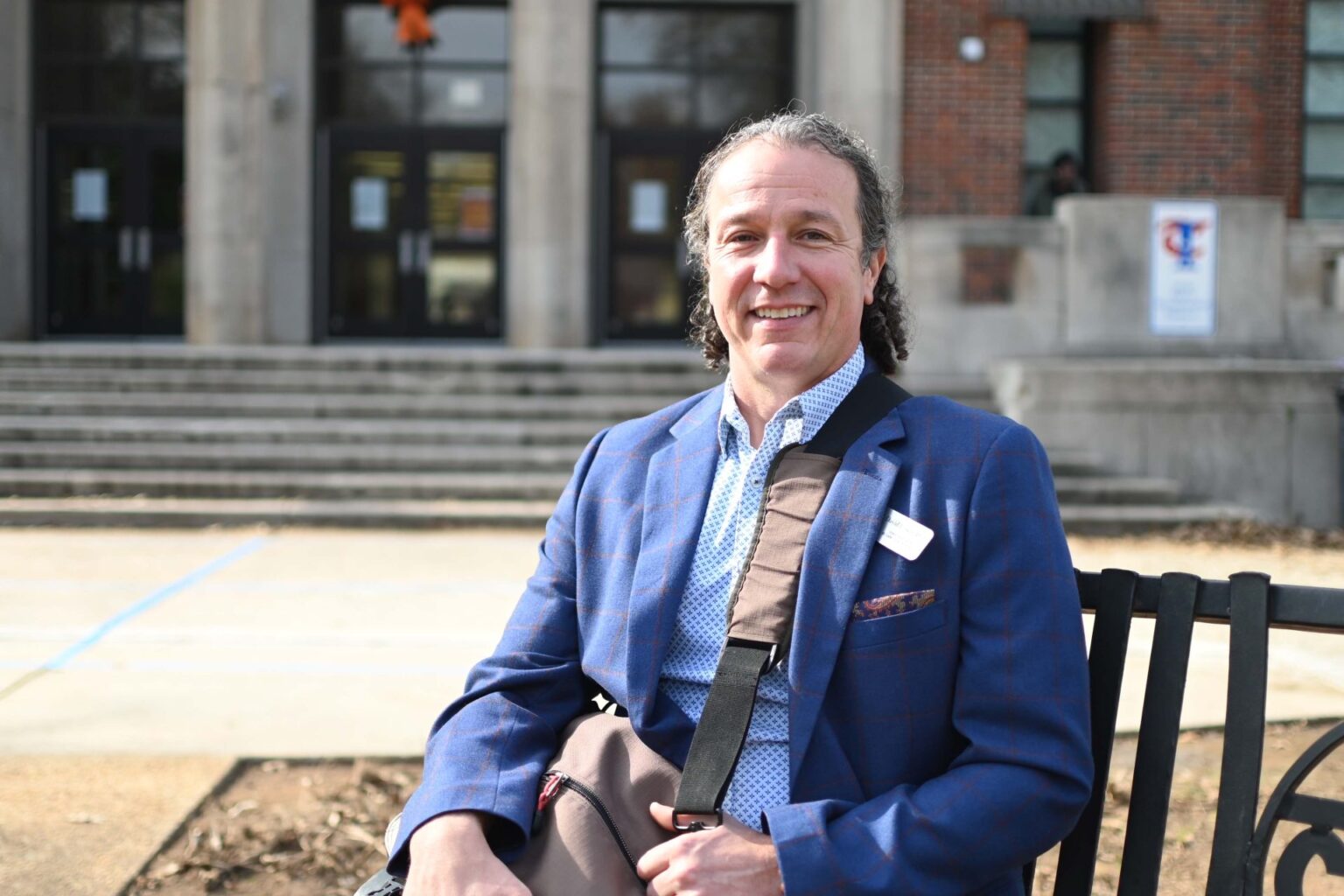
Clarke County School District Coordinator of English Language Learner Programs Dr. David Forker sits in front of the Ceremonial Entrance of Clarke Central High School on Jan. 8. CCHS ESOL department teacher Carrie Emerson has found that witnessing her students graduate is a poignant moment as an ESOL teacher. “I (feel) that we made that possible for them. (Graduation is) meaningful (because of) the opportunities they’ll have because they graduated from high school, and that’s not always easy to figure out. Knowing all the challenges they have to get to graduation makes it really meaningful that they actually manage to do everything they needed to do to graduate,” Emerson said. Photo by Iliana Tejada
Since 2001, CCHS’ ESOL program has grown significantly along with the population of ELs in Athens.

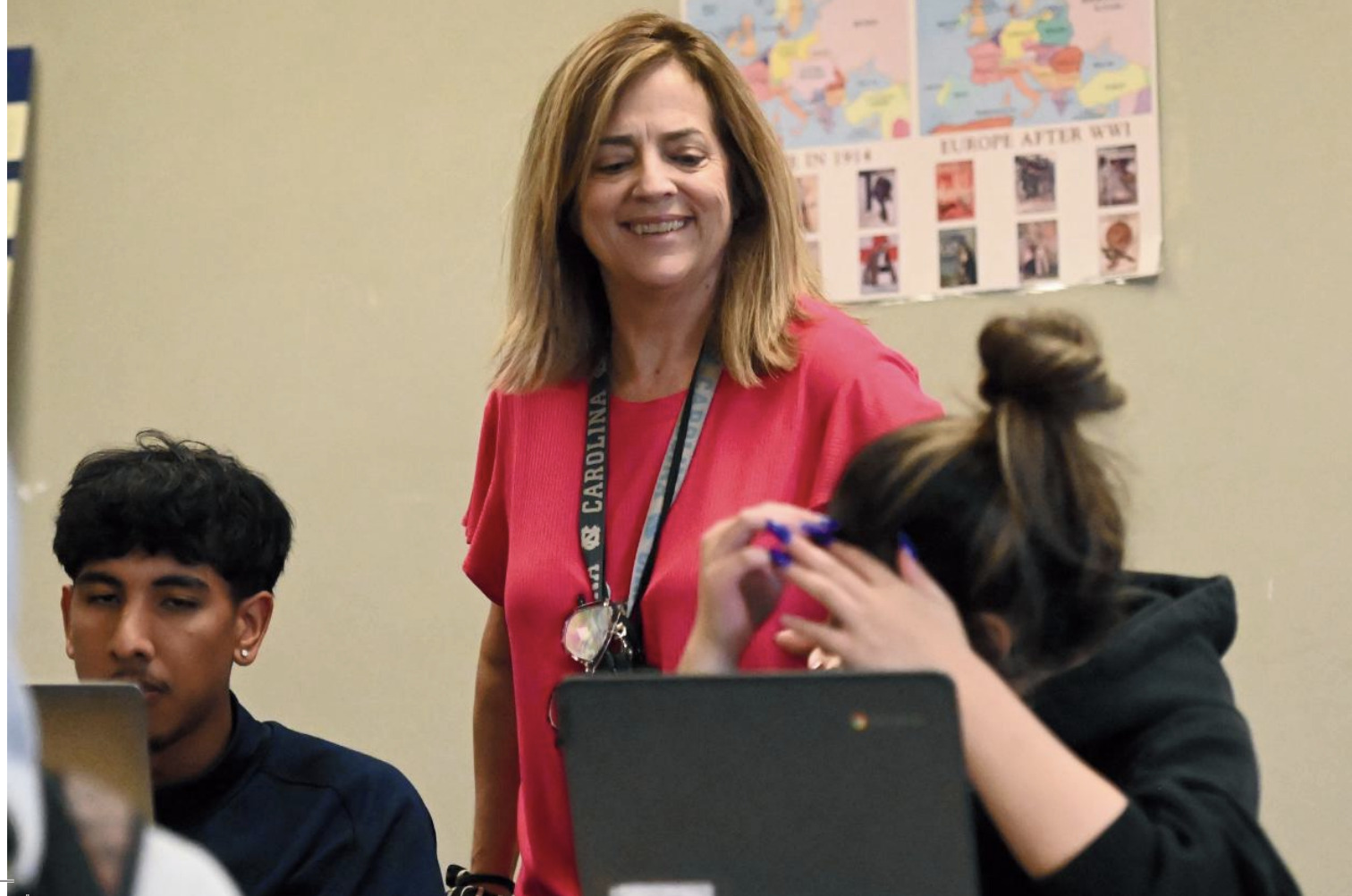
Clarke Central High School English for Speakers of Other Languages department teacher Cathy Erickson helps a student in Room 221 on Dec. 15. With fast-paced high school curricula, ESOL department teacher Carrie Emerson still took time to engage with every student and make sure their learning was uninterrupted since starting in the 2022-23 school year. “In high school, there’s so much content that all the students are expected to learn. It’s that much harder for students learning English to access that content and basically do all the same things that regular students are expected to do,” Emerson said. Photo by Iliana Tejada
Over the last 20 years, Clarke Central High School’s English for Speakers of Other Languages department, which focuses on preparing emergent bilinguals for CCHS’ English-based curricula, has expanded to meet growing needs.
Enacted in 1985 under Title III, ESOL is a state-funded program in the United States defined by the Georgia Department of Education as “a language instruction educational program provided to help English Learners (ELs) overcome language barriers and participate meaningfully in schools’ educational programs.”
When ESOL department teachers Jodi Bolgla and Kathy Erickson took over CCHS ESOL in 2001, they represented the full faculty of the ESOL department.
“It was small. We just had our own classes. It was kind of nice that way to start off because we got to know our students very well,” Erickson said. “It wasn’t difficult, because anything we were teaching them was helping them learn (English).”

A graph shows the growth in the number of English for Speakers of Other Languages students in the Clarke County School District from 2005 to 2025.
The program has grown exponentially since its inception. Since 2001, the CCHS ESOL department has grown from 40 to 211 ELs. This parallels the Clarke County School District’s growth from 347 to 3,002 students in the last 20 years.
To account for more ESOL students, the program has grown from two to nine teachers, with six added in the past five years.
“The number of ESOL teachers is incredible to me,” Erickson said. “We kind of sprout out and go to our departments that we work with, but we also come back together and have our ESOL talks and see what’s working (and what) could be improved upon. It’s crazy, but we get it in somehow. (The program’s growth is) striking.”
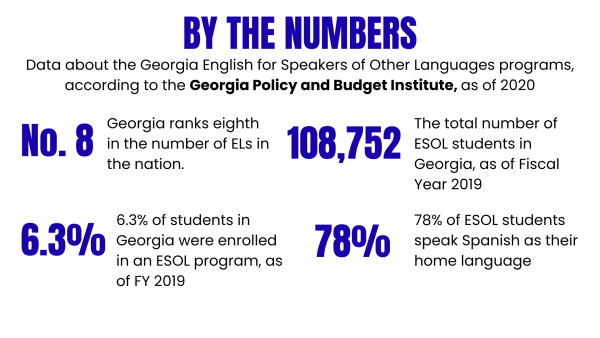
A graphic shows data about Georgia English For Speakers of Other Languages programs, according to the Georgia Policy and Budget Institute. Graphic by Lea D’Angelo
However, this new growth has its fair share of challenges as well. As the ESOL department’s student enrollment and course offerings expanded, its faculty needs grew, too, causing challenges on the district level.
“You’re always trying to figure out how many (teachers) you need, how many kids you have, but the planning is always a year out when the kids aren’t there yet,” CCSD Coordinator of English Language Learner Programs Dr. David Forker said. “We work really hard to have the right number of teachers to support students. (It’s) always a challenge to make sure that we’re supporting students with sustainability.”
At the school level, the influx of students has challenged the ESOL faculty’s capacity to form personal relationships with students, something Erickson believes is a vital part of her teaching success.
“(Knowing about students’ backgrounds) helps us because ELs are just like every student in the school,” Erickson said. “We’re told to get to know the student because it’s hard to teach a student that you don’t know, but if you go the extra mile and figure out what’s going on, that helps them feel comfortable.”

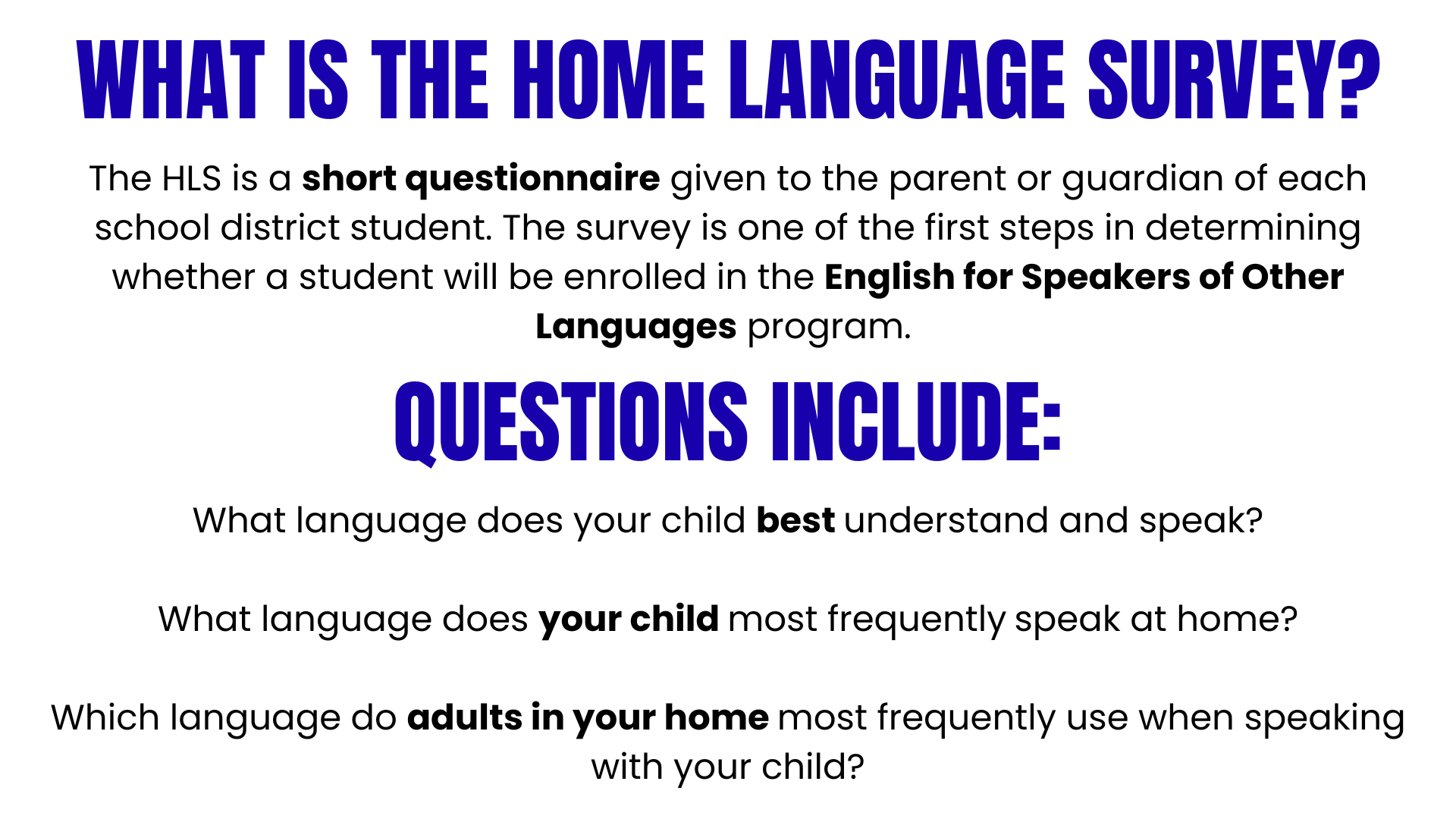
A graphic gives information about the Home Language Survey. Graphic by Emlyn McKinney and Lea D’Angelo
Language barriers can create dissonance between teachers and students, an issue that the ESOL department seeks to solve. ESOL department teacher Carrie Emerson views her role in the ESOL department as being a liaison between her students and the rest of CCHS and teaches with an emphasis on interpersonal connections.
“ESOL teachers are advocates for the students and make sure they get the support they need. There’s a lot of positive things that come from having the ESOL program, like community (and) good (teacher-student) relationships,” Emerson said.
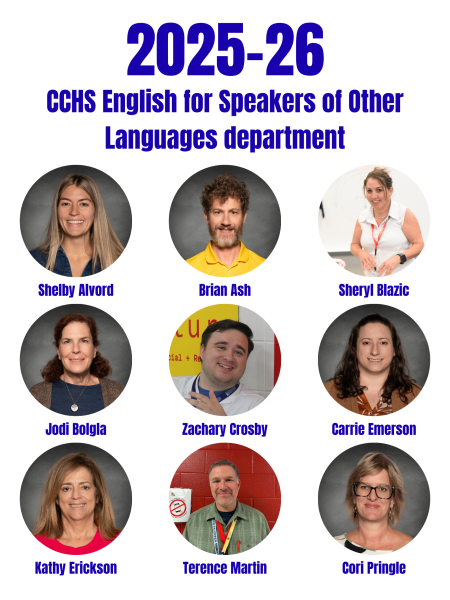
A graphic shows the 2025-26 Clarke Central High School English for Speakers of Other Languages department teachers. Graphic by Lea D’Angelo
The CCSD primarily employs two ESOL program delivery models at the high school level: push-in, when an ESOL department teacher co-teaches with a general education teacher, and sheltered content, when an ESOL department teacher delivers specific course content to an exclusive group of ELs. Currently, the CCHS program uses a majority of push-in or collaborative classes, with the only sheltered class being taught by Bolgla. Students are placed in whichever class will best fit their accessibility needs.
“(ESOL is) a way of supporting students who did not learn English as their first language (and) finding ways (for) them to be successful in their classes, because they have the same graduation requirements as everybody else,” Emerson said. “I view my role as making the curriculum accessible to (emergent bilinguals).”
In a state where immigrants comprise 11.6% of the total population, there were 1.7 million ELs in Georgia public schools as of May 2025. In Georgia, an EL’s eligibility for ESOL is determined by a series of intake questions from the World-Class Instructional Design and Assessment evaluation, which is given to students who indicate a primary language other than English on the Home Language Survey that all district enrollees take. The WIDA judges the student’s English proficiency to determine the best language learning support for the student.
CCHS junior “Jane Doe”* is an ESOL student who took the WIDA after enrolling in the Clarke County School District as an eighth grader. Doe, whose first language is Spanish, views her participation in ESOL as a significant factor in her language growth.
“In the beginning, it’s difficult because you start in a new school, (with a) new language, but if you take ESOL classes, (you get) more comfortable, because the (other ELs) there have the same situation (as) you,” Doe said.
All nine ESOL teachers co-teach in push-in classes and Bolgla teaches the only sheltered content class. CCHS sophomore “Richard Roe,”* who is in ESOL, has experienced both sheltered and collaborative scenarios.
“On both sides, there are benefits. When I am in a class of (ELs), I have more confidence, can express myself and my opinion,” Roe said. “I don’t feel nervous to ask a question because my classmates and I are all learning.”

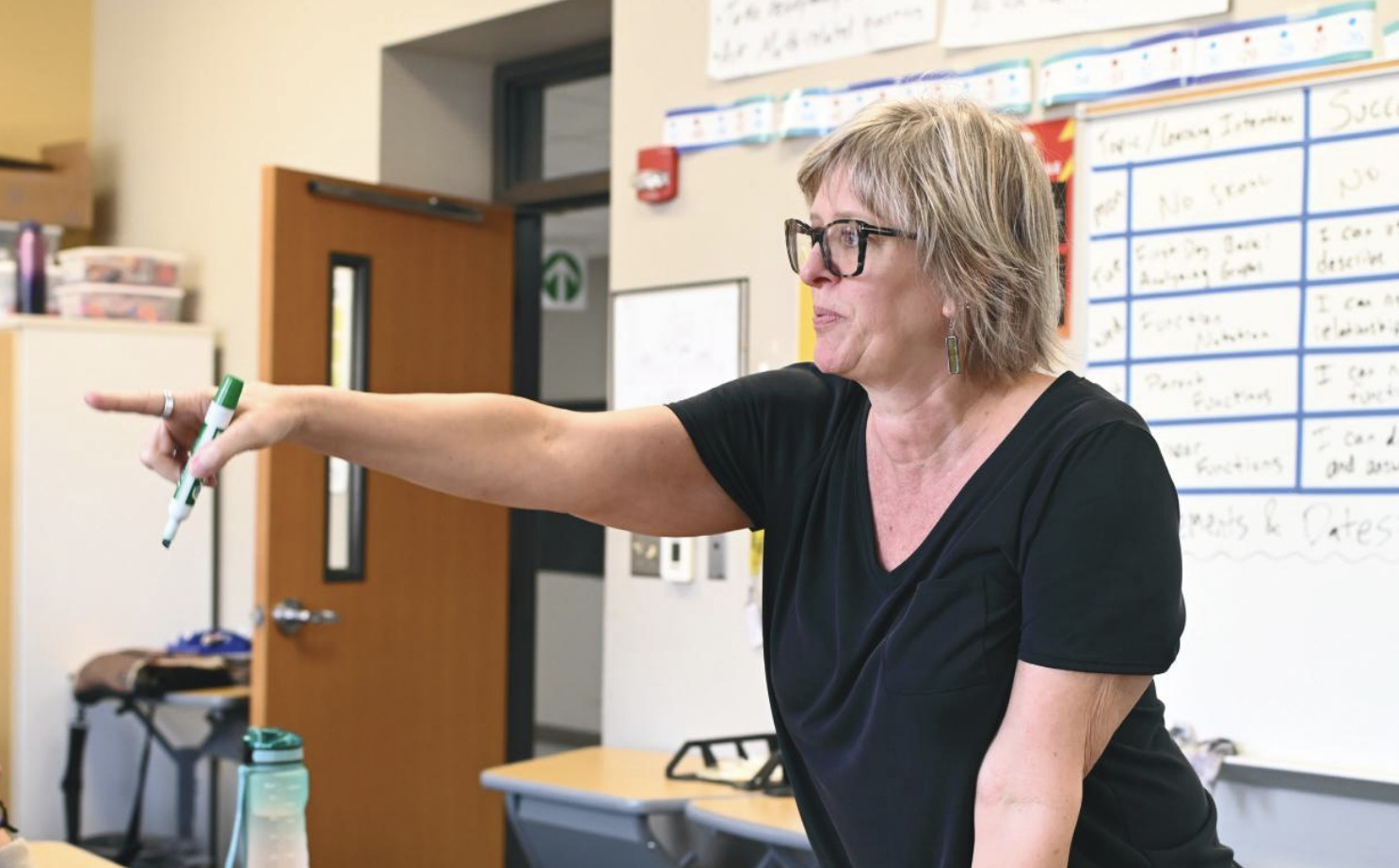
Clarke Central High School English for Speakers of Other Languages department teacher Cori Pringle teaches in Room 313 on Jan. 8. CCHS junior “Jane Doe” joined the ESOL program as a freshman and has attended both collaborative classes, which have ESOL and non-ESOL students, and sheltered classes, which only have ESOL students. “I grew with ESOL. (After) I was with Ms. Bogla (in the sheltered) class my freshman year, I came away knowing more English. In middle school, my mom told me about ‘You need to learn English,’ (so) now I speak more English than when I was in freshman (year),” Doe said. Photo by Iliana Tejada
National trends may threaten the future of ESOL. On June 30, the Trump Administration announced that it withheld $6.8 billion in educational funding, including Title III funds, for the 2025-26 school year, according to Education Week, a news publication covering changes within schooling. Though the funds have since been released, this shows how potential legislation could affect ESOL programs.
“In a red state, legislators (are) not friendly to people who don’t look like them. I think (Georgia legislators) are going to follow the national trend of defunding language programs,” Bolgla said. “Why would you take education away from children? I think our funding is (at risk for) the next four years.”
“ESOL teachers are advocates for the students and make sure they get the support they need. There’s a lot of positive things that come from having the ESOL program.”
— Carrie Emerson,
ESOL department teacher
Whether or not these fears will be realized remains to be seen. However, despite these concerns, the ESOL program presses on, serving students, families and teachers. ESOL continues to foster ELs’ connections with their communities through language and more.
“ESOL helped me understand the language and communicate with the people I want to communicate with,” Roe said. “It helped me grow academically, (get) my grades up and (socialize) more with teachers, so that they could understand me and let them know what I wanted to tell them.”
*A pseudonym has been assigned to these students to protect their identities in accordance with the Society of Professional Journalists’ principle of minimizing harm.
More from Cooper Jones
More from Sasha Barkan
Package by Lea D’Angelo