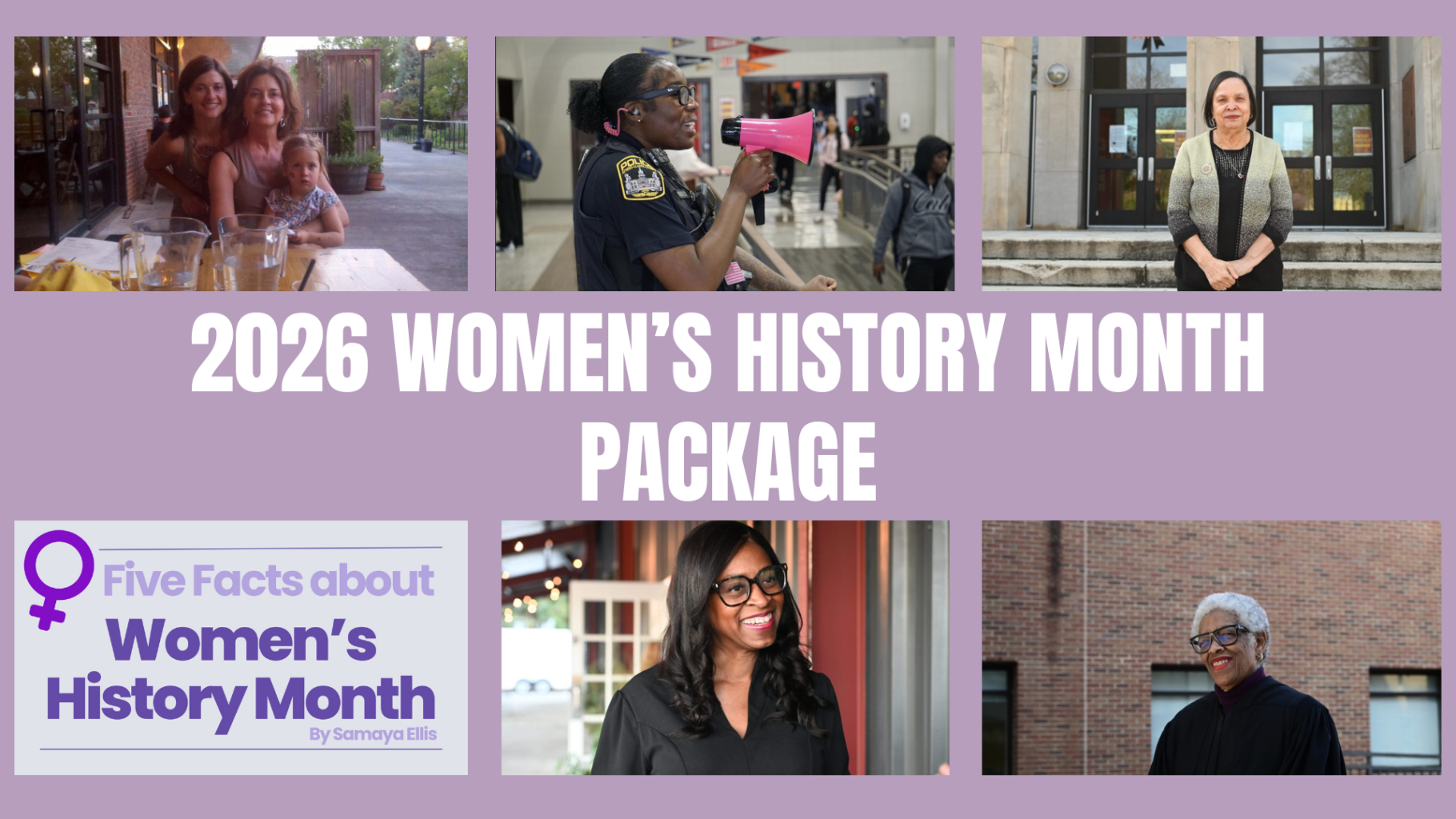

A slideshow lists five facts about Women’s History Month, which honors and commemorates women throughout March. The celebration of Women’s History Month originated from a week-long celebration in Santa Rosa, Calif. in 1978, honoring women’s contributions to society, history and culture. “The theme for Women’s History Month 2026, according to the United Nations, is ‘Rights. Justice. Action. For ALL Women and Girls,’ calling women to action to eliminate discrimination against women’s rights,” Diversity and Representation Editor and Journalism I Facilitator Samaya Ellis wrote. Graphics by Samaya Ellis
Diversity and Representation Editor and Journalism I Facilitator Samaya Ellis shares five facts about Women’s History Month, discussing aspects of the month from its origin to its honored figures.
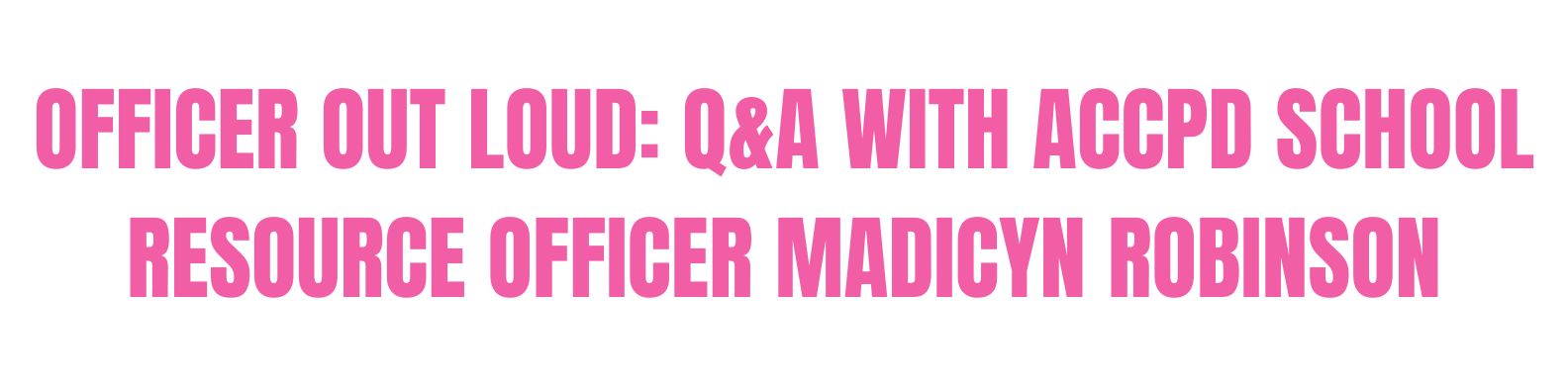
Athens-Clarke County Police Department School Resource Officer Madicyn Robinson speaks into her pink megaphone in the Clarke Central High School Dr. Miller W. Jordan Jr. Memorial Food Court on March 3. Robinson started working as an Athens-Clarke County police officer in 2023 on the night shift, which ranged from 6 p.m. to 6 a.m. the next day. “There is a good side of Athens and there’s a bad side. I don’t want to see any of my students on the bad side of Athens, getting caught in a mess, that’s my biggest fear,” Robinson said. “I care about all of (my students). All (of them) are my babies. So, my biggest fear is seeing my babies in trouble. That would disappoint me and hurt my heart.” Photo by Peter Atchley
CCHS Athens-Clarke County Police Department School Resource Officer Madicyn Robinson discusses being a female police officer in a male-dominated field and the attitude she brings to the job.
Managing Editor Peter Atchley: What inspired you to pursue a career in law enforcement?
Clarke Central High School and Athens-Clarke County Police Department School Resource Officer Madicyn Robinson: Growing up, I wanted to be a pediatrician. I wanted to help people. I just didn’t know which direction, as far as (whether to go into) public safety or health care. Towards the end of my high school career, I took an interest in law enforcement. The end goal is to be a detective, but you can’t kind of just graduate from college and be a detective; you have to get some experience (first). So, that’s what I’m doing now, just getting some experience being a patrol officer first for a little bit now (as a) School Resource Officer.
PA: How do you think your experience has been different as a police officer than your male counterparts?
MR: Being a female in general, it’s hard to naturally get respect from other people. Unfortunately, some people are stuck in their ways. They don’t feel like females should be out on the road. They don’t feel like females should be police officers. We also have those few who try to make slick comments, try to hit on you. (there) are pros and cons of (being a female police officer). (It can be difficult) overall demanding respect. Whether I’m a female, whether I’m a male, at the end of the day, I’m an officer, I wear the same uniform as everybody else, and I demand respect. I always tell people, I will put you in pink handcuffs really quickly.
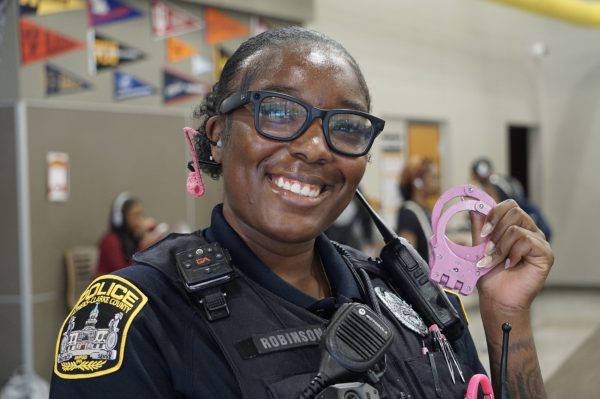
Athens-Clarke County Police Department School Resource Officer Madicyn Robinson shows her pink handcuffs in the Dr. Miller W. Jordan Jr. Memorial Food Court in Clarke Central High School on March 3. For Robinson every female trainee should have a female trainer because of the relatability. “Everybody has their own experience. It has not necessarily been a bad experience, but as a female, sometimes we have to do stuff a little bit differently. Think smarter, not harder,” Robinson said. “Because obviously I’ve had to talk (a grown man) into the handcuffs. Don’t get me wrong, I can throw hands down, but every day I don’t want to be fighting.” Photo by Peter Atchley
PA: What strengths do you feel that being a woman brings to the job?
MR: The main (strength) is dealing with kids. I remember (my team and I) were waiting on the (Department of Family and Children’s Services) for hours; they are very slow. Essentially, I had to babysit (some) kids until (DEFCS) came in about four hours. I’m not a mother, but in my personal opinion, females naturally just have a motherly instinct. Having a female, the kids were able to open up to me. (In) sexual assault (cases), it’s common that most victims naturally open up to female officers. That was kind of my job while I was on (the night shift), any call I went to was mostly sexual assault. My (male) co-worker may have gone and gotten nothing versus (if) I’m going, I’m able to (get them to) open up, relate with the victim, and I’m able to get information. And it’s not just about getting information, but being able to relate. I definitely think (female officers) are needed in this profession.
PA: How did having a female police officer as your trainer during the training stage to be an officer impact you?
MR: After we get out of training, they ask us, “What do you think about (your training)?” And “What can we do better?” I did recommend that all female officers should have a female trainer, because there’s certain things (a female should tell you). Not to say a male can’t tell you how it is, but it’s just certain stuff that I feel like would be better accepted, or you’ll be able to understand a female talking to a female. When I was (in training), I was like, “Hey, how does getting pregnant work with being a police officer? How does that work?” Not to say that’s my plan, but you just never know those types of questions. Not to say a male wouldn’t be able to answer, but kind of weird asking him that.
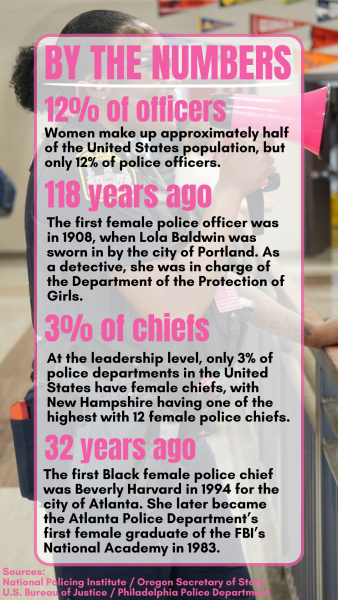
A graphic shows data about female police officers in the United States. Graphic by Peter Atchley
PA: Have you seen the role of women in law enforcement change over time?
MR: I think (law enforcement is) starting to make it more of a priority that a female trainee gets a female trainer. As well as (having) a community where we support each other, females in law enforcement. Specifically at (ACCPD), we meet probably once every three or four months, (as a) support system (to say,) “Hey, you’re not alone.” (This county) has a big agency, we have a lot of females, it’s about 30 of us, just females. I’m the only female SRO. So, even though there are 30 of us, we’re scattered everywhere. Every few months, we have an event where we can all get together to decompress.
PA: I have noticed that in your pack a lot of your items like your megaphone, scissors and handcuffs are pink. How is it important to you to express your femininity in this way?
MR: I wanted to portray some type of femininity in (my) uniform, because it’s so boring to me. Looking at me, you can tell I’m female. But I’m like, “No, I need something feminine.” I was starting to look online (for) my police gear, (asking,) “What can I get that I can still do my job, but make it feminine at the same time?” I saw a lot of pink stuff. I started with the pink cuffs. Then, slowly got the scissors. I wanted some type of feminine energy on my uniform. I’m a very bold and likable person. I wanted something to stand out. I call myself a trendsetter because it’s going around the (ACCPD) department. One of my good friends, (her gear color) is purple. We have someone (else), his color is yellow. I don’t want to say it’s never been done, because my female (police) trainer had pink handcuffs, but I’m the first person to go all out.
PA: Why do you think it’s important for students to see someone like you, presenting however you want, but still taking on this job and doing it well?
MR: I think it’s important because, really, relatability. Clark Central is predominantly Black. I’m a Black, African American female. Just being a role model, and the kids are able to relate to me, like, “Hey, you look like me. You’re somebody with authority.” Whether they want to be a police officer or not, it’s something that they can see outside of Athens. Or it’s bigger than just coming to school, just someone being successful that looks like them and can relate to them as well. I help with track as well, so I told my track girls, “I was where y’all are at juggling. I was an (Advanced Placement) and honor roll student on top of school sports like you, (I) ran track.” Aside from me being a Black female, I can relate to all students, AP, and honor roll. I know how that feels when your parents pressure you to get all A’s. That’s me as a student athlete. I know how that feels, being a Black female. I know how that feels, being middle-class. I know how that feels.
PA: What would you say to a female student if they came up and said, “Officer Robinson, I want to be a police officer, too?”
MR: I’ll be so intrigued and wrap them around my arms and give them everything that I have, as far as Do’s and Don’ts. I don’t want to say a cheat code, but if I know the tools or what you need to be successfulReading back why would I let you fall on your face? If I can try to help you avoid it. I’ll give you a little cushion. You may still fall, but at least you got a little cushion underneath. I just like to help any way I can. That goes for anybody, whether you’re ready for law enforcement or not. I tell my track girls, “If you’re considering college, I am a college graduate. I know how that process goes.” Some people don’t have that support at home, so in any way I can be a support, I try to be. Obviously, some people aren’t interested in college, so I try to tell them about technical school, getting a certification, (or) cosmetology, whatever they want to be.
Whether I’m a female, whether I’m a male, at the end of the day, I’m an officer, I wear the same uniform as everybody else, and I demand respect. I always tell people, I will put you in pink handcuffs really quickly.
PA: What do you think that would have done if there was an Officer Robinson when you were a high schooler? How do you think that would have impacted you?
MR: I don’t even remember seeing a female officer growing up, or at least not in my hometown (of Lowndes County). If I had met (one) in high school, I would have made various better decisions. I’m a tough-love type of person. I won’t even call myself a mom, I’m not that much older than y’all. (I’m) your coach and a big sister. Seeing someone confident, bold, walking down the hallways with the pink. That’s why I try to be on everybody’s behind. Tough love is the best. I see all of y’all as my kids. I want the best for y’all, so I get on to everybody. If I see you doing wrong, if you need to be corrected, you will be corrected.

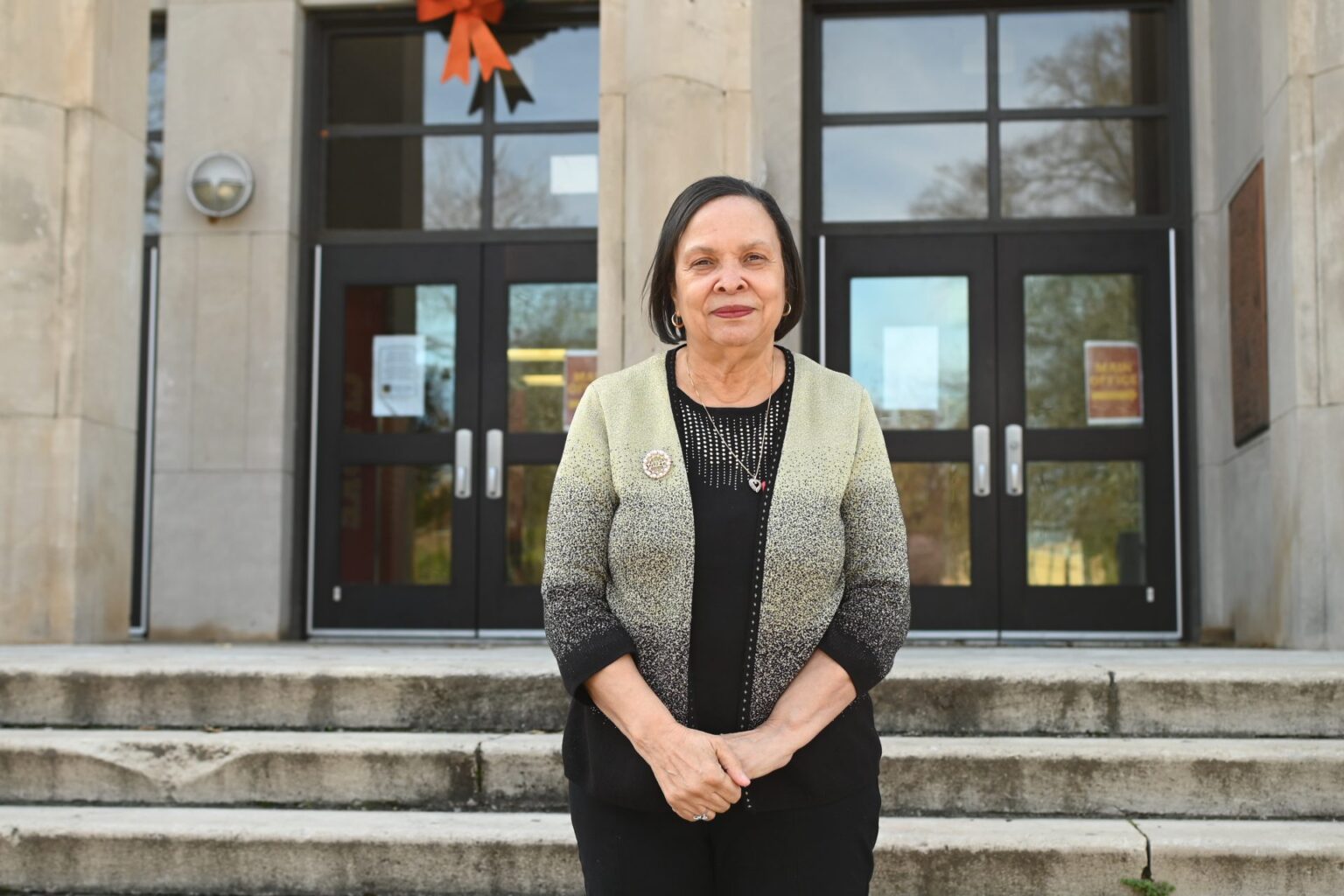
Athens community member Fannie Smith stands in front of the Clarke Central High School Ceremonial Entrance on Jan. 12. Smith was one of the first Black students to attend CCHS, then-Athens High School, in 1963, one of her many experiences with the Civil Rights Movement as a child, including her family’s involvement with the National Association for the Advancement of Colored People. “As a little girl, I attended our (NAACP) meetings at our church, and our church had hosted the meetings. My brother, at age seventeen, became the vice president of the Athens chapter (of the NAACP),” Smith said. “All of my interests were different from what a regular teenager’s were. And I thought it was the norm, that you went to (NAACP) meetings, and that you listened (to and) watched (the) news every day.” Photo by Iliana Tejada
From the experiences she witnessed during the Civil Rights Movement to her time as a student and teacher, Fannie Smith has combatted discrimination with determination.
A 17-year-old Fannie Smith sits on a patch of grass in Downtown Athens next to her younger sister and brother.
It’s 1963 and the siblings have just been arrested after taking part in a protest against the recent Birmingham, Ala. Children’s Crusade. But, as Smith was carted off to jail, it wasn’t fear she felt. It was determination to fight against the injustices being committed against Black people for as long as she’d been alive.
Smith was born in Oglethorpe County, Ga., but moved to Athens when her father, Rev. James Sims, a farmer, became determined to give his children a better education than he had received. That determination is what caused him to ask Smith to be part of the group of Black students who would be the first to attend the all-white Athens High School.
At school, Smith faced more isolation than discrimination from fellow students, but found joy in books gaining the education her father had wanted for her.
“When I taught my students, I defended them. I said, ‘Nobody messes with my students. I don’t care what race you are, I want our kids to get treated right,’”
— Fannie Smith,
Athens community member
Smith’s determination was fueled by information. She watched the news daily, seeing Black people throughout the South protesting and facing acts of violence that she had never seen in Athens, a city seemingly sheltered from violence.
Until she was walking home one day and saw a police officer beating a Black man. She stopped, the words “Why are you doing that to him?” leaping out of her mouth. The officer told her to move along, and she did, but with the sense that she wanted to do more.
That determination to help is what came to define Smith as a business teacher, a career she began in 1993 at CCHS and continued throughout the Clarke County School District until she retired in 2015.
“When I taught my students, I defended them. I said, ‘Nobody messes with my students. I don’t care what race you are, I want our kids to get treated right,’” Smith said.

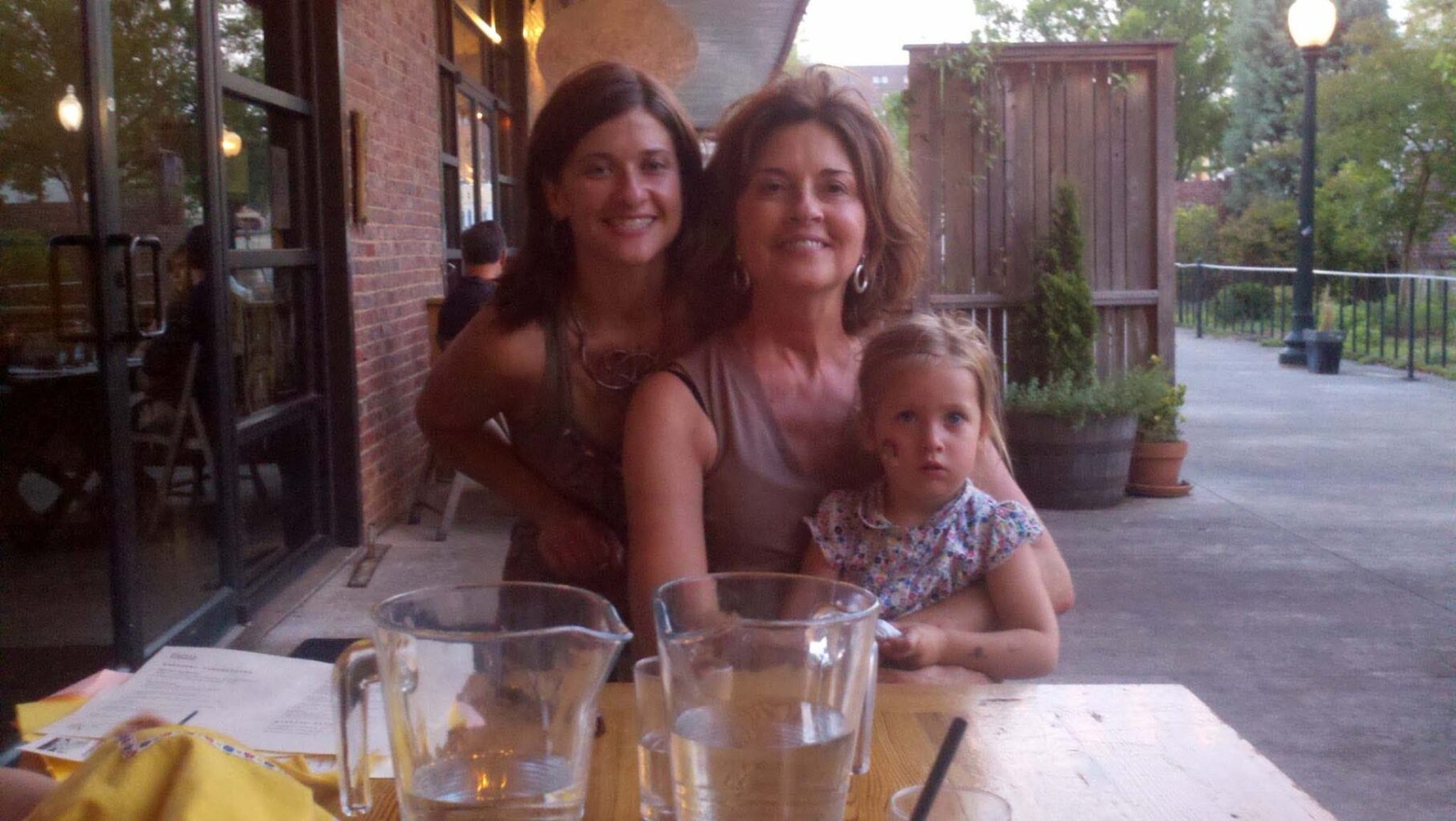
A photo shows Print Editor-in-Chief Liza Larson with her mother, Ashley Larson and grandmother, Patricia Larson. Through observing the women in her family, Larson has learned valuable lessons. “What I admire most about the both of them is that they don’t easily fit into the narratives we usually assign to ‘influential women.’ They’re neither public figures nor polished success stories. They taught me that you don’t wait for permission to make a life you want,” Larson wrote. Photo courtesy of Ashley Larson
Print Editor-in-Chief Liza Larson explains her relationship to the women in her family and what they have taught her.
When I try to trace where my sense of purpose comes from, I always end up in the same place: the women in my family.
My mom and Gigi, my maternal grandmother, didn’t set out to be “inspirational figures,” but their lives have shaped mine in ways that go far beyond family ties. Their influence isn’t wrapped in grand speeches or dramatic gestures, it’s in the way they’ve moved through the world.
My Gigi grew up in an era that didn’t offer many choices to women. She learned that if she wanted something, she’d have to find her own way to get it. I’ve always been struck by how matter-of-fact she is about the obstacles she faced. She never romanticizes them, and she doesn’t see herself as a hero.
But in the details of her stories, you catch a glimpse of her resolve.
My mother’s version of strength looks different. She is unwavering in her principles and morals. Growing up, I watched her hold my world together through financial stress, career changes and moments when everything felt unstable.
Outside of looking like them, I see them in how I do work, in how I respond to pressure, and even smaller things like how I approach situations. Their influence on me isn’t about legacy in the traditional sense. It’s about continuity.
She never pretended things were perfect, which might be the most valuable lesson she has given me, that strength isn’t about pretending not to struggle, but about choosing to keep showing up.
What I admire most about the both of them is that they don’t easily fit into the narratives we usually assign to “influential women.” They’re neither public figures nor polished success stories. They taught me that you don’t wait for permission to make a life you want.
As I’ve gotten older, I’ve started to recognize the ways I carry them with me. Outside of looking like them, I see them in how I do work, in how I respond to pressure, and even smaller things like how I approach situations. Their influence on me isn’t about legacy in the traditional sense. It’s about continuity.
The idea that what they built, even in small unseen ways, allows me to stand a little more firmly in the world.

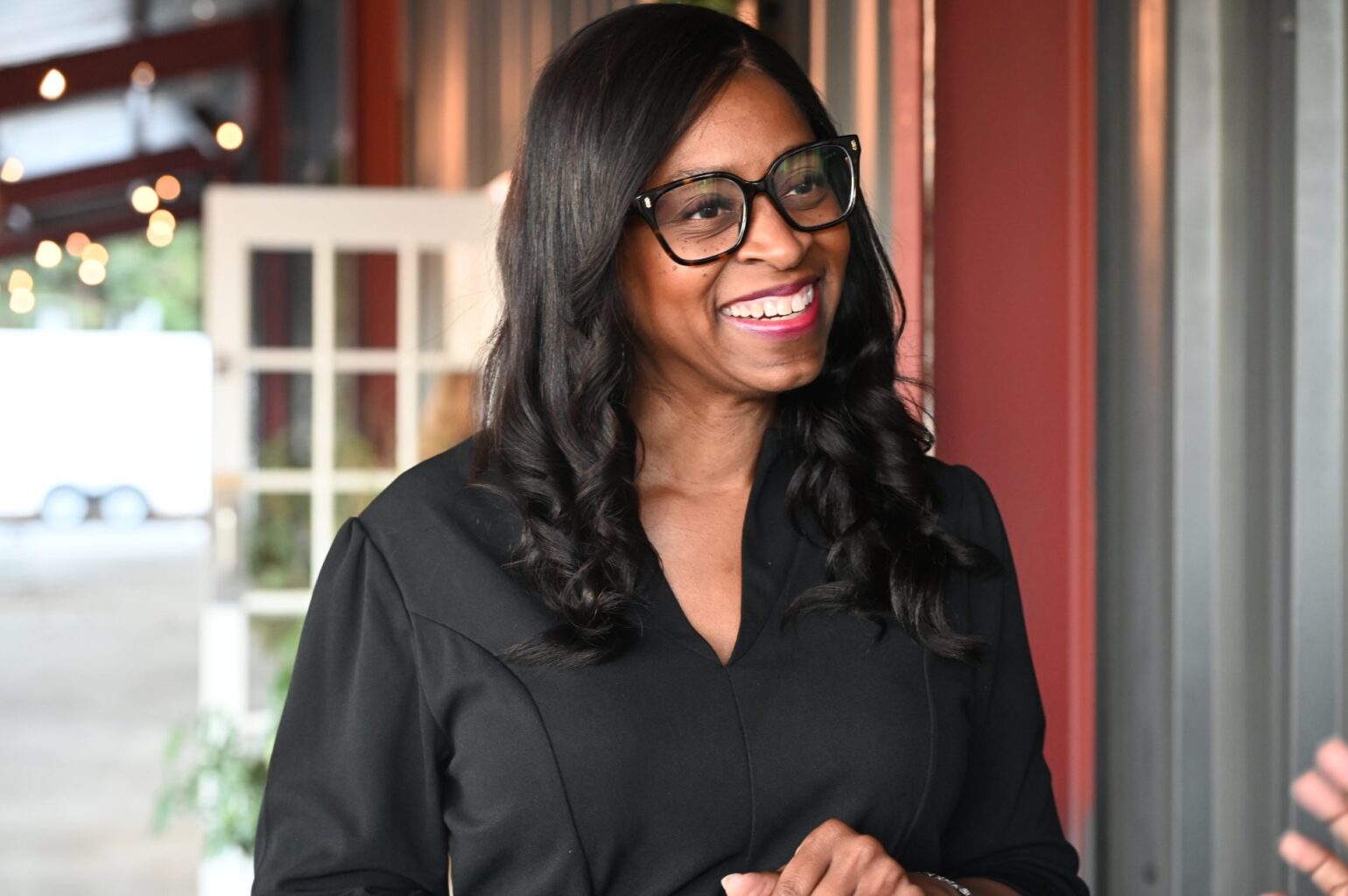
Clarke County School District Interim Superintendent Dr. Jennifer Scott speaks at the Teacher and Support Professional of the Year awards banquet on Oct. 23, 2025. One thing that drove Scott to pursue the Interim Superintendent position was the opportunity to promote and sustain student excellence. “Ultimately, we are preparing students to become citizens and adults within our community,” Scott said. “You want to be able to feel confident that the individuals that are graduating from our school district are prepared to serve in various spaces within the community, whether it be workforce (or) community engagement.” Photo by Maypop Wren
Dr. Jennifer Scott has worked in the CCSD for nearly 27 years in several different positions, from teaching at Timothy Road Elementary School to working as a CCSD Executive Director of Leadership Development. After being appointed the Interim Superintendent, effective July 1, 2025, she aims to help the district’s students, staff and schools thrive.
Click through the slides to learn more from Scott.
Click through the slides to learn more from Hooker
Click through the slide to learn more from Elder
Click through the slides to learn more from Anderson
More from Emlyn McKinney
More from Graphics by Lea D’Angelo
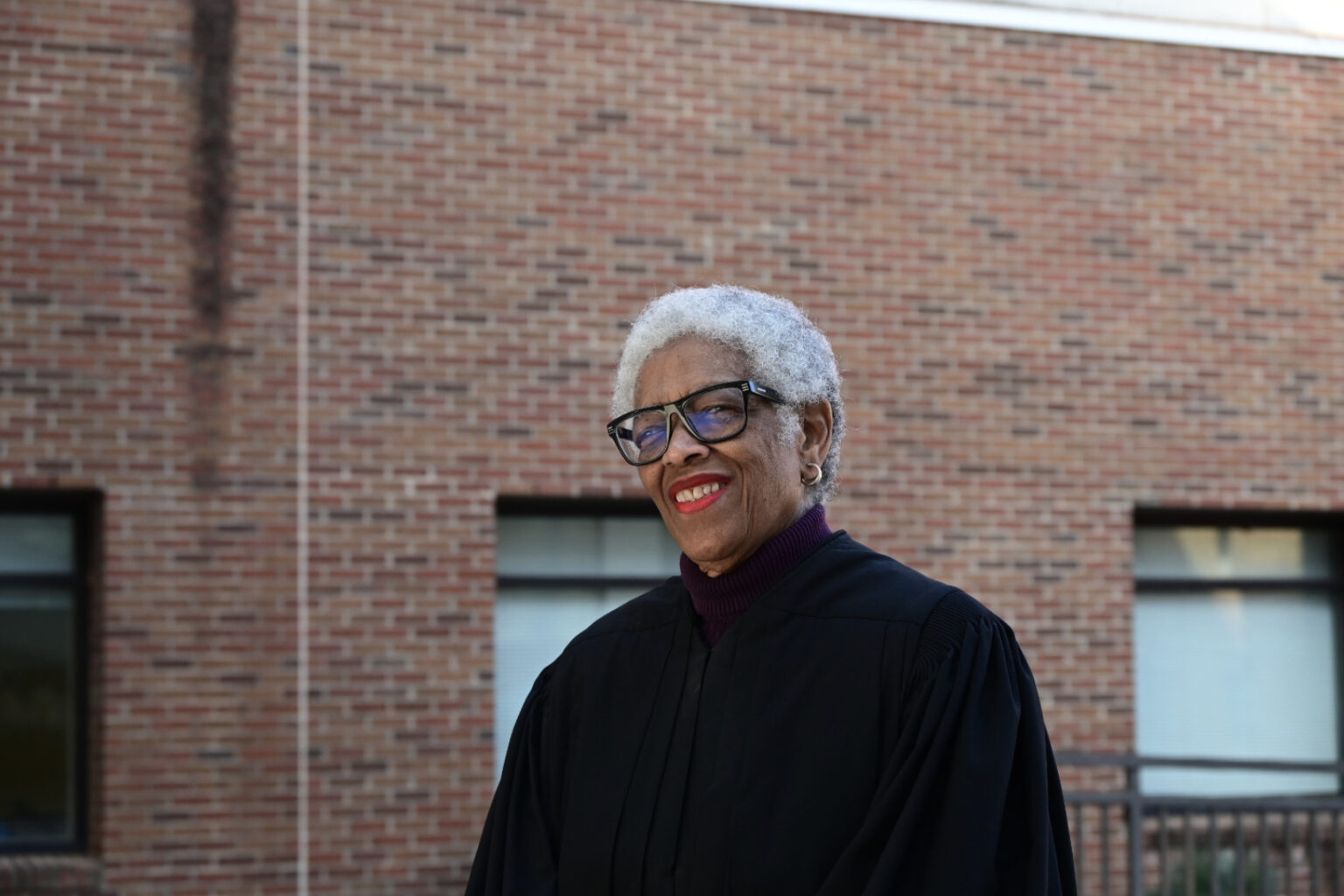
Former Athens-Clarke County Chief Court Magistrate Patricia Barron stands in the Clarke Central High School Media Center Courtyard on Feb. 9. Barron was a civil law judge for 22 years in Athens, and had made several accomplishments then. “What I sought from an early age was to be good at whatever I chose to do, and I’ve given my best to every profession I’ve ever had. I have written a children’s book about the law because it’s important to me that children understand the law” Barron said. Photo by Grady Dunston
Former Athens-Clarke County Chief Court Magistrate Patricia Barron shares her experience as a Black judge in the South.
Journalism I student Olive Forrester: Could you talk about your accomplishments and what made you decide to become a judge?
Former Athens-Clarke County Court Chief Magistrate Patricia Barron: I was (in) seventh grade when I decided to become a lawyer. We were studying history, and I understood African Americans were enslaved, (and) that really touched my heart. I was very young during the Civil Rights Movement, but that made me more wanting to become a lawyer. (I) practiced law for 22 years before I became (a) judge. It’s really important to me to help young people understand education, to do well in school, and to be clear about what (their) goals are. I’ve loved every minute of (my job). I tried to do my best, whether I was on the bench or practicing before other judges before I became a judge.
OF: You mentioned how the Civil Rights Movement made you want to become a lawyer. Could you talk more about that?
PB: My first hero was Shirley Chisholm, (who was) the first African American woman in the United States Congress. I was (in) 10th (or) 11th grade when I first recognized who she was and how important it was for her to be in Congress and to give a voice to those who weren’t able to speak for themselves. Then, the first African American judge on the Supreme Court, of course, was Thurgood Marshall, he’s my hero of all time. Not only was he a civil rights lawyer that did really good in terms of desegregating the school system, but once he became a judge he made sure that the laws in this country were fair to all concerned. That’s been really important to me, for my heroes to be people who not only exemplify excellence, but use their careers to be of service to other people, too.
OF: What does success look like to you?
PB: Success means to me doing your very best. I see a lot of young people nowadays who take education for granted. That’s something that’s required, but not something that they take to heart. It’s important that you learn while you’re in school, but also it’s important that you learn the world around you, that you understand not just what goes on in school, but what goes on in your community. Success means being of service to the community and making sure at all times that you look out for the fellow human being. Because we’re all the same, no matter how we look or how we speak, we’re all the same in God’s eyes. Success means that we take care of each other, that we look out for each other, that we don’t bully or demean each other, but that we actually take care of each other.
OF: You won the Georgia State Magistrate Award of the Year in 2015. Could you talk about your feelings towards this accomplishment and what it took to achieved it?
PB: A lot of what I did was mentor young judges. We have a Council of Magistrate Court Judges, (which is) a statewide program, and that’s the organization that gives the award. They look at judges who not only excel in their legal profession, (and) do a good job in the courtroom, but help train younger judges. I spent 22 years as a practicing lawyer, so I knew a lot about the law in a lot of different areas. Once I became judge, I could help some of the younger judges understand the law and how to implement the law. A lot of young judges who may not have had as much experience as I had, would rely on me in certain instances to help them understand certain laws. That’s why I received the award.
OF: What kinds of struggles did you face as one of the few Black attorneys in Athens?
PB: I wasn’t the only Black attorney in town when I got here. There were probably about five or six ahead of me, Michael Thurmond being one of them. I met him when I first came to Athens. I’d been a lawyer for 10 years before I came to Athens, and so I was able to connect with (him) and learn from (him), and that was important to me. There was only one African American judge before me, that was Steve Jones. So, I was the second one, (but the) first female African American judge here in Athens. I’m well respected by the (Georgia) Bar Association and by the lawyers and the judges in town. I do what I can to help the community.
OF: How do you think that that experience shaped you into a better attorney?
PB: To be a good attorney, you have to believe in what you’re doing. It’s important that I (stayed) up to date on the laws, because they change the legislature. A good attorney (stays) abreast of the law and (has) the ability to communicate with clients. In order to be a successful lawyer, I not only had to know the law, but to know courtroom procedure, what I could and could not do in the courtroom, how judges think and how they rule, and how they write their decisions. It was important to me to learn all of those areas so that I could be a successful lawyer.
Success means being of service to the community and making sure at all times that you look out for the fellow human being. Because we’re all the same, no matter how we look or how we speak, we’re all the same in God’s eyes. Success means that we take care of each other, that we look out for each other, that we don’t bully or demean each other.
OF: At one point, you were not allowed into the Georgia Bar Association, could you talk about that experience?
PB: That was in Americus, Ga. I graduated law school in 1979 and my first law practice was in South Georgia in Americus, Sumter County. When I first arrived, there was an active bar association that met at the country club. African Americans were not allowed in the country club, rather than move the bar association, they just disbanded the bar association altogether, so that they wouldn’t have to face me going. They never had a bar association meeting the five years I was in Americus and as soon as I left, then they had the bar meeting.
OF: During that time when you were denied access, how did you remain determined and still strive to achieve excellence?
PB: My goal was to serve my clients. I worked for Georgia Legal Services, which is a statewide program, and we had lawyers in our main office in Columbus. Ga.. There were two lawyers: me, and one other lawyer in Americus, then we got a third lawyer at some point, and we had a couple of paralegals. We covered five counties, (and) we had lots of work to do. We were mentored by lawyers and other offices outside of Americus. So, it wasn’t a handicap for me, because I could do my job that I was sent there to do: to serve the low-income community of Sumter and surrounding counties. I was able to do that without the assistance of the (Georgia) Bar Association.
OF: Could you talk about your children’s book?
PB: It was about more than 10 years ago now. There was a family friend, (and)she was curious one day about what judges do. I thought, “Why don’t we write a book together?” She was 9-years-old at the time. She came to the courthouse to visit me, and we actually put on a mock trial for her so she could see what a trial was like in the courtroom. At a young age, she had an opportunity to feel what it was like to become a judge, what the courtroom scene was like. She got to meet some of the other lawyers that were in court that day. We also spent some time in the community. She got an opportunity to see a judge as a human being serving the community, as well as the judge on the bench ruling in the courtroom. (My book is) in every school here in (the Clarke County School District). I use that book to teach young people about the law and how important it is for them to follow the rules.

A slideshow lists five women in history who have been the first to achieve notable feats. Melanie Rutledge, one of the women featured on the infographic, was one of the first women to become a part of the Athens-Clarke County Police Department. “As many Germans immigrated to the U.S. in the 18th century, the tradition shifted to starring a similar animal: the groundhog.” News Staffer Lucca Fleenor wrote. Graphics by Lucca Fleenor
News Staffer Lucca Fleenor shares five women who achieved notable feats in honor of Women’s History Month.