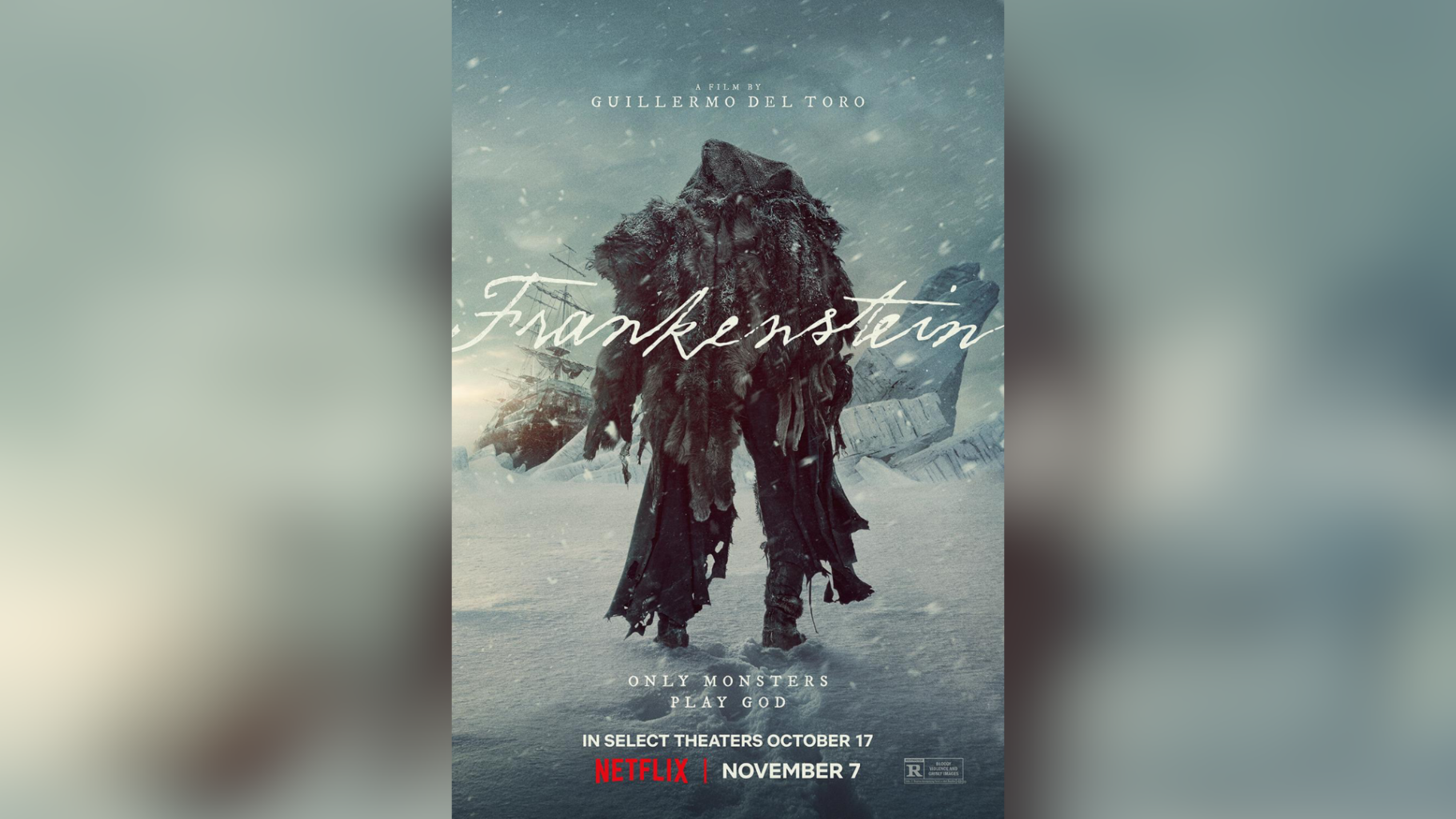
The poster for “Frankenstein” is shown. The movie, an adaptation of author Mary Shelley’s 1818 novel, was released to Netflix on Nov. 7, and delivers a heartbreaking tale through the lens of Shelley’s science fiction creation. “The movie beautifully depicts every scene with extreme precision, adding heavy gothic and steampunk elements in its architecture, technology and costuming that really bring viewers into the world,” Journalism I Facilitator Angel Tejada wrote. Photo fair use of IMDb
Released to Netflix on Nov. 7, “Frankenstein,” offers a compelling adaptation of Mary Shelley’s 1818 novel.
“Frankenstein,” released on Netflix on Nov. 7, is an adaptation of Mary Shelley’s 1818 novel of the same name, creating a visually-stunning and heartbreaking tale.
Directed by Guillermo del Toro, the almost three-hour R-rated film contains gory horror and violence, which may be upsetting to some viewers.
The story is split into two main chapters: “Victor’s Tale” and “The Creature’s Tale.” The first chapter follows Victor Frankenstein (Oscar Issac), the son of renowned surgeon Leopold Frankenstein (Charles Dance). The chapter narrates Victor’s upbringing in an abusive relationship with his father to Captain Anderson, the head of a Danish naval ship, who rescues Victor from the Arctic, where the film starts.
This transitions into Victor’s reasoning for the creation of the Creature (Jacob Elordi), or Dr. Frankenstein’s iconic monster, who starts the second chapter by retelling his story after the events of the creation and how Victor and his creation ended up in the Arctic.
“Frankenstein” highlights the sci-fi genre Shelley pioneered exceptionally well and encapsulates the atmosphere perfectly.
The movie beautifully depicts every scene with extreme precision, adding heavy gothic and steampunk elements in its architecture, technology and costuming that really bring viewers into the world. These visuals correspond perfectly with the haunting orchestral soundtrack by Alexandre Desplat that makes every scene more emotional.
The central themes Toro brings into the film also emphasize its complex nature. The failure of nurturing one’s child and the cycle of abusive parenthood is shown to be the true monstrosity of the film, not the creation of life.
This plays into question where the line between what is human and what is monstrous converges, making watchers empathize for the Creature and see that many of the humans display monster-like qualities, more so than the creature itself.
For this new iteration of Frankenstein, delving into multiple complex and intricate themes, “Frankenstein” highlights the sci-fi genre Shelley pioneered exceptionally well and encapsulates the atmosphere perfectly.