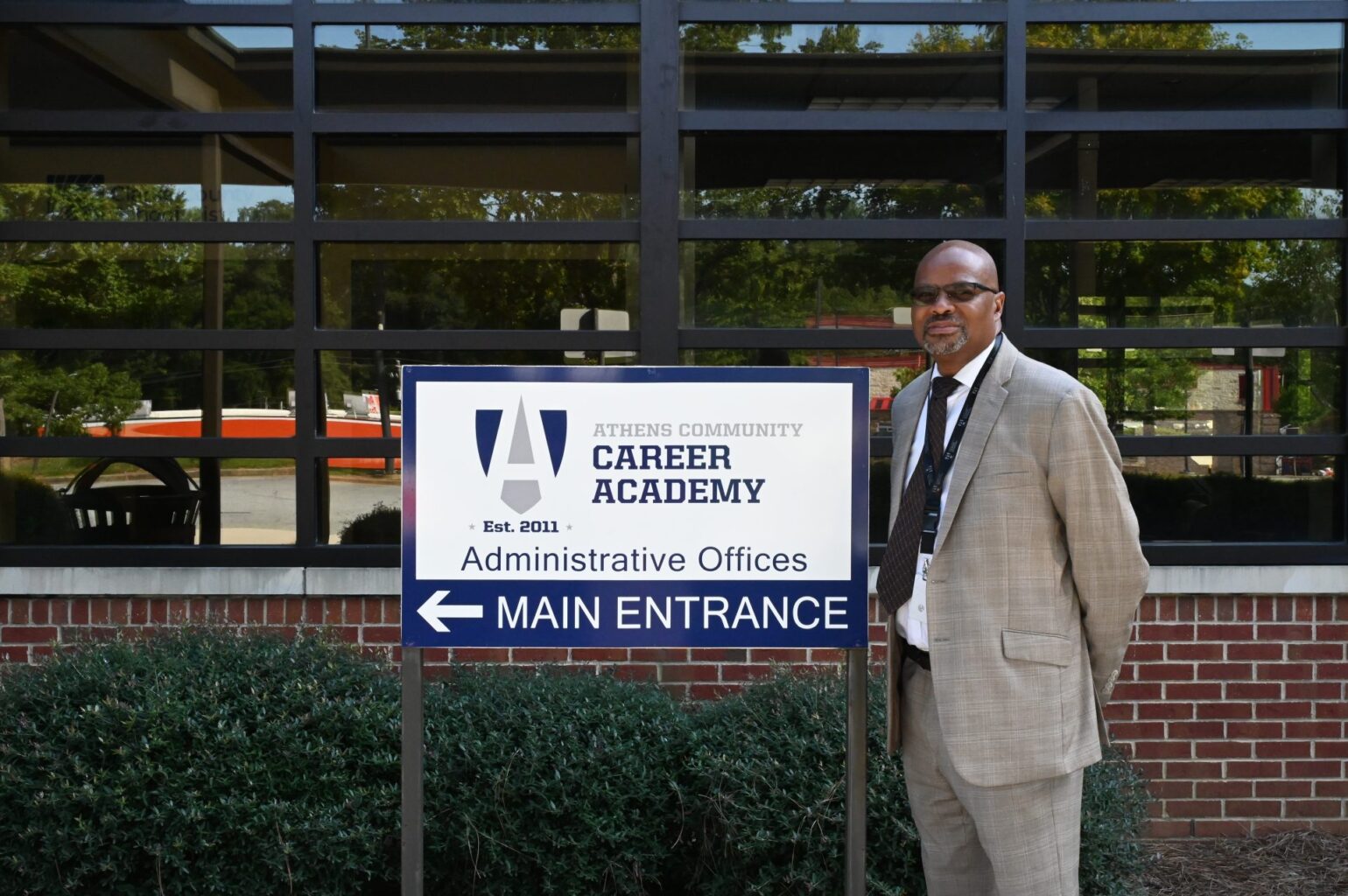
Athens Community Career Academy Director Reginald Thomas stands beside a Main Entrance sign at the ACCA building on Sept. 8. Over the years, ACCA has grown as a program and improved their accessibility, something Thomas wants the public to know. “(ACCA has been) trying to (get) more human resources in our building to be able to serve a wide variety of students,” Thomas said. “This year, we are able to do that better than last year, and last year better than the year before, so I consider that growth in the area I want to see (it) in.” Photo by Maypop Wren
Athens Community Career Academy Director Reginald Thomas discusses the ACCA’s mission and what it offers to students.
News Staffer Lucca Fleenor: What does your role as the Athens Community Career Academy director look like?
Athens Community Career Academy Director Reginald Thomas: To me, it’s (about) guiding our students. The students who are here are here because they chose to be. They have applied to come to school here, and they have been accepted. My job is to continue to encourage them and make sure that they are comfortable, safe and able to learn at the ACCA. I (make) sure that they feel welcomed, and that the instructors are giving them instruction that is going to be beneficial and useful to them moving forward in life.
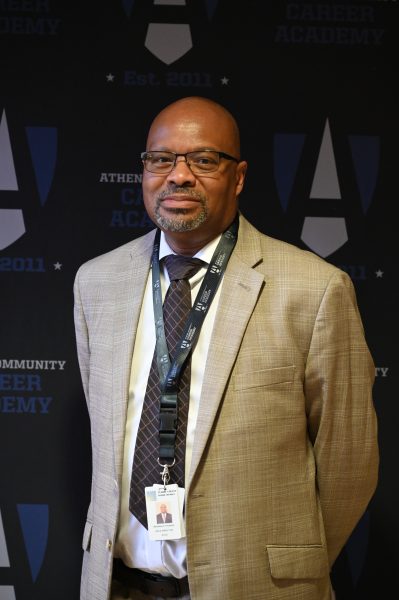
Athens Community Career Academy Director Reginald Thomas stands in front of a backdrop in the ACCA Facility on Sept. 8. The ACCA has served in Athens as a space for learning and a door for opportunities that weren’t available to students previously. “(The ACCA) was created in 2011, (because) it’s hard to put (things like) a (biotechnology) lab in Cedar (Shoals High School) and one in (Clarke) Central (High School). You’re doubling everything,” Thomas said. Photo by Maypop Wren
LF: What is the Acca’s mission and how do you carry that out?
RT: Our mission is to make sure students are prepared to succeed in (their) next step, whether that might be college or the workforce. (The ACCA talks) about employability skills, (which is) what employers look for in potential workers. (Usually, we focus on), “Are you dressed appropriately (and) in class on time?” I look at it as “Are you employable for college or more school? Are you disciplined enough to be able to interact with your classmates? Are you able to be a leader, provide service (and) collaborate?” That’s what we want them to leave here with, whether they’re (going to) college, work, a trade school or to the military.
LF: What are some of the pathways that are offered for ACCA students?
RT: There’s Culinary Arts, (and) that’s about learning how to cook different things. We have a state-of-the-art kitchen that has pizza ovens, a barbecue smoker and ovens. (Biotechnology) is a newer pathway, (and) that one’s a little more advanced, but anybody can take it. We have the manufacturing and the welding part of it. We have Teaching as a Profession, teaching students to be teachers. We have Cosmetology and Film, (which) is the one path where it starts at (high) schools, then parts two and three are taught here. There is Healthcare, (where) you can get your Certified Nursing Assistant license, (or, as) a phlebotomist, learn to draw blood. There’s Entertainment, Sports and Event Management, (which) deals with marketing and managing events. We also teamed up with the Athens-Clarke County Fire Department, and (the) instructor is actually an instructor for the Fire Department, so our students leave here with a lot of the skills.
We just want people to know that we (exist, and) are a program that welcomes our students in. Our expectation is that the students come in with the self discipline and the desire to raise their standards (and) meet the standards of the ACCA.
LF: What makes the ACCA different from other programs connected to CCHS or Athens?
RT: Our program is unique because it is a partnership, externally as well as internally. Internally, we work with (Clarke Central, Cedar Shoals and Classic City High Schools) to navigate how to get the most students here and work their schedules out. The outside part of it is that these pathways are aligned with industries in Athens. For instance, (the) Culinary Arts and Entertainment, Sports and Event Management (pathways) tie in with the Classic Center. (For the healthcare pathways, students) partner with (Piedmont University), and the manufacturing (students) work at Caterpillar Inc.. (The ACCA’s) unique in that our students are able to get training and licenses.
LF: What is something that you want people to know about the ACCA’s programs?
RT: We just want people to know that we (exist, and) are a program that welcomes our students in. Our expectation is that the students come in with the self discipline and the desire to raise their standards (and) meet the standards of the ACCA. These are students from CCHS, CSHS and CCH, but we want them to come together as one program (at ACCA) and navigate that without any issues. (The ACCA has) a partnership with (Athens Technical College) and (some) people say, “That’s a technical school. I don’t want to go to (a) technical school,” but you can go straight into the workforce (after graduation) and (have) jobs where you can grow (and) sustain a living for yourself.
LF: How have you seen the program evolve since you’ve been a part of it?
RT: (We’ve) been intentional about trying to raise the awareness of the Career Academy (and) that has brought in more students. We also have attempted to become more inclusive. When I started here, we didn’t have any (special education) teachers or (English for Speakers of Other Languages) teachers, (and) this year, we have three SPED teachers and (an) ESOL teacher, and that enables us to serve a wider variety of Athens-Clarke County students.