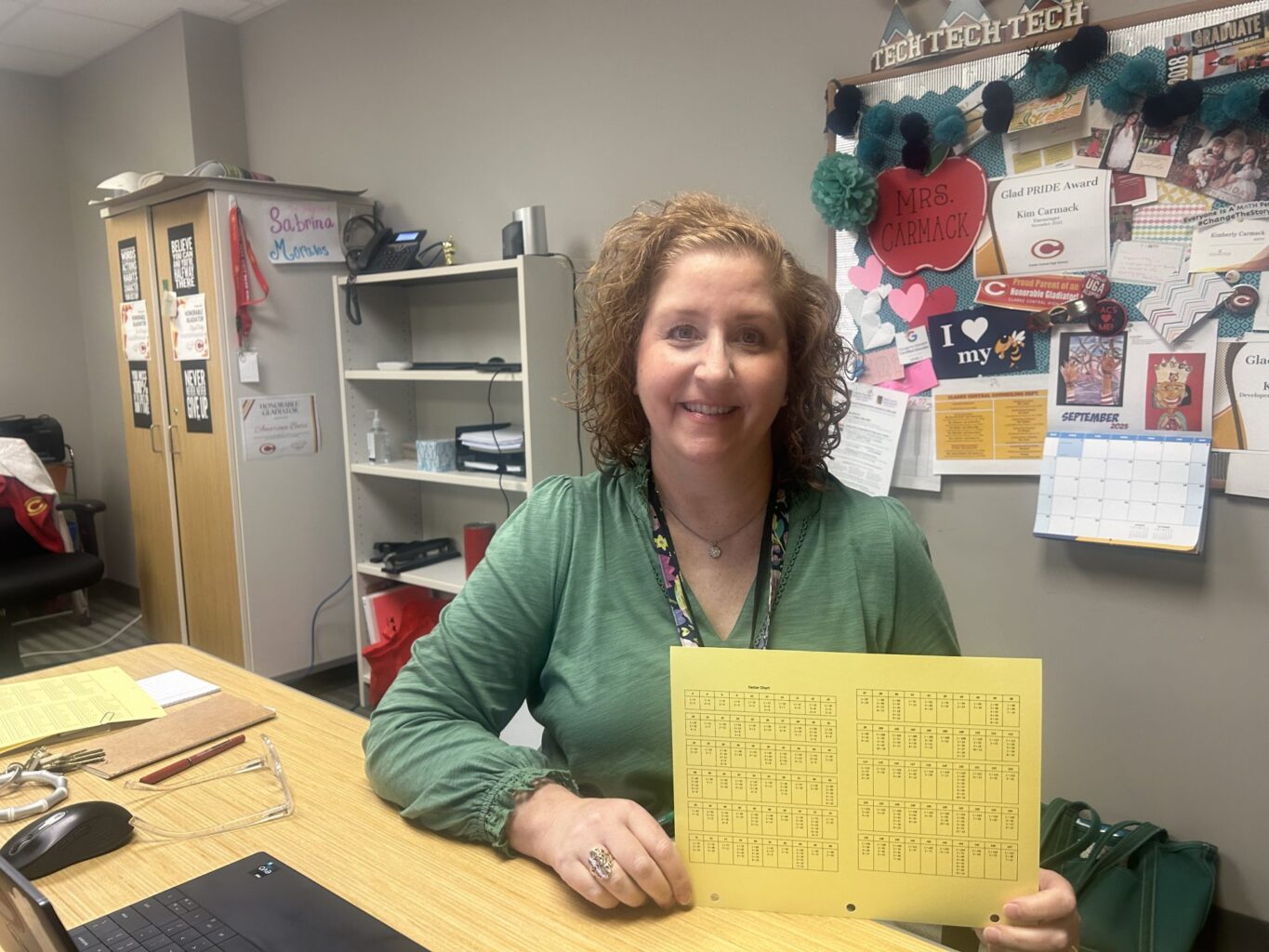
Clarke Central High School special education department teacher Kim Carmack poses with a factoring sheet in Room 112 on Sept. 24. CCHS’ math and special education departments have collaborated to ensure content remains accessible for both general education and special education students. “I enjoy working with the math department. They allow me to teach if I want to, or sometimes we split up the lesson (or) the activities, and I’ll do some and the math teacher will do some,” Carmack said. “(Our collaboration has) built up over time and years of trust with working with the same people. They know that I could teach it as well as they can.” Photo by Isabella Gresham
The CCHS math and special education departments collaborate in order to ensure all students’ needs are met in order to ensure success.
The Clarke Central High School math and special education departments work together to provide equitable learning for all students within collaborative math classrooms.
These classes involve a general education math teacher working alongside a special education teacher. During shared planning periods, teachers discuss lesson plans, assessments and tools to meet the needs of each student. Within the classroom, they teach simultaneously, conducting small group pull-outs and breaking down tasks to make them more digestible.
“My role as the math teacher is to know the content and make sure that content can be dispersed well to every student,” math department teacher Mallory Thomas said. “The collaborative teacher can come alongside, and maybe not know the content as well, but know how to support students who need it.”
“(Collaborative classrooms show) that all kids can be successful, and (that) multiple adults have different expertise that (are) useful.”
— Mallory Thomas,
CCHS math department teacher
To ensure each student comprehends the content, the teachers adjust in-class assessments by condensing written directions and word problems for those with reading disabilities, along with providing additional support materials like visual aids.
“For students with disabilities, you (need to) have someone in the classroom who understands the disability (and) how to make the content accessible,” special education department teacher Kim Carmack said. “It’s a lot for a regular math teacher to do their job, plus do all the things that a student with disabilities requires. It’s definitely helpful to have two teachers in the classroom.”
Thomas has found that the departments’ collaboration offers more opportunities for both general and special education students in terms of student success.
“(Collaborative classrooms show) that all kids can be successful, and (that) multiple adults have different (areas of) expertise that (are) useful,” Thomas said. “When you work together well, clearly define your roles and what you’re going to accomplish and have good communication, you end up being able to help out more students than you could by yourself.”