
Georgia lawmakers grapple with how to balance federal law and personal safety amidst rising gun violence rates within the state.
In his childhood home in South Mississippi, Spencer Frye, the State Representative for Georgia House District 122, grew up hearing stories from his grandfather about his walk to and from school.
His grandfather was usually alone, except for the consistent company of a hunting gun.
“When he would go to school, he’d carry a shotgun. He would get to the classroom, give his shotgun to the teacher and then (the) teacher (would) put it in the corner,” Frye said. “When he left school, the teacher gave him the shotgun back, and he’d hunt for food for dinner on the way home.”
Now a politician representing Athens and the surrounding area, Frye’s upbringing – hunting in the woods, watching classmates store guns in the back of their pick-up trucks and internalizing the stories of his family’s history – has cemented one lesson in his mind: the dangerous power of a gun.
A graph shows the gun death rates in Georgia between 2013 and 2023, according to Johns Hopkins University. Graph by Lea D’Angelo
“That’s the type of environment that I came from, and I think it’s really important to recognize the specific amount of training I went through. That was not any sort of standard training that we have (the) opportunity today to take advantage of,” Frye said. “It was training that was drilled into my head by my family members (of ) how to properly handle a firearm (that taught me) the best way not to shoot somebody is to not point the gun at them.”
Through his work in the Georgia General Assembly, Frye has grown to recognize the ways in which guns regulate and impact everyday life and how it has evolved past the basic Second Amendment right into a polarizing, political issue.
“As our society has gotten more complicated, we have basically, as a culture, placed firearms on an altar,” Frye said.
As such, gun regulation has fractured along partisan boundaries, with laws varying wildly from state to state. Amidst the legislative dissonance, gun violence in public spaces has increased dramatically – especially in Georgia.
According to 2022 data from the Johns Hopkins University Center for Gun Violence Solutions, firearms were the leading cause of death among children and teens ages 1-17. The gun death rate increased 56% in 10 years since 2013. The state had the 8th-highest gun homicide rate in the country.
On a county level, some areas of Georgia have felt the effects more acutely than others, perhaps none more so than Barrow County. Even before the Apalachee High School shooting on Sept. 4, 2024, which saw two students and teachers killed, Barrow County had the highest firearm assisted suicide rate in the state.
Georgia is not entirely unique in its struggle with gun violence – the increase is country-wide. However, in the Peach State, discourse stemming from the Apalachee shooting has cast the balance between personal liberty and protective responsibility in a new light, leaving legislators with a question: What now?


Georgia is ranked 46th in the United States for gun law strength, as reported by the nonprofit gun advocacy group Everytown Research and Policy. Citizens are not required to undergo background checks or secure permits to purchase a handgun. Citizens don’t need a permit to carry a concealed weapon.
In Georgia, there is various pro-gun legislation in place, including House Bill 260, also known as the “Safe Carry Protection Act.” When it was passed in 2014, Georgia residents gained the right to carry in churches, bars and through Transportation Security Administration (TSA) lines at airports, among other establishments.
Georgia also has a Stand Your Ground law that states, “A person who uses threats or force relating to the use of force in defense of self, others, habitation, or other property has no duty to retreat and has the right to stand his or her ground and use force, including deadly force.” This allows a measure of legal protection for citizens who use guns in self-defense regardless of the circumstances of that defense, leading critics to call them “Shoot First” laws.
Of the 50 most common laws used to prevent gun violence, Georgia has four. Accordingly, Everytown ranks Georgia near the bottom of its lowest tier for gun safety: “National Failures.”
“I think Georgia’s laws are too loose,” Frye said. “A lot of legislators are unwilling to vote for a piece of legislation that requires training if you carry a handgun, (but) we require training for a driver’s license to drive a vehicle. North Carolina and Colorado require three to five hours of range training from a certified range instructor in order to get a carry permit. Why is that controversial?”
Georgia’s non-restrictive laws correlate with above average gun violence statistics across the board. According to the Centers for Disease Control, Georgia’s overall gun death rate and gun homicide rate rose 37% and 66%, respectively, each surpassing national increases. Georgia’s gun suicide rate rose 20%, slightly less than the 21% national rate.
All incidents included, an average of 2,005 Georgians die from guns in a year – 905 from homicide, 1,035 from suicide.
“As our society has gotten more complicated, we have basically, as a culture, placed firearms on an altar.”
— Spencer Frye,
State Representative for Georgia House District 122 (D)
Legislators from across the aisle have called out the problem, but efforts to change laws haven’t often taken effect. While many politicians, such as Frye, advocate for legislation requiring firearm training to purchase a gun as an effort to increase safety, Jason Ridley, State Representative of House District 6 for the Georgia General Assembly, believes passing legislation with these requirements infringes on citizens’ Constitutional rights to carry.
“I think that (training) should be a choice, just like anything else. I don’t really like the government trying to tell us what we (can) do and what we can’t do. As far as the training issues, I think that should be a personal responsibility for a person,” Ridley said.

Gun violence in schools, particularly in high schools, was brought to the forefront of the public imagination by the 1999 Columbine High Schoolshooting that left a total of 13 victims dead. The case was one of the most-covered story of the 1990s and holds an immense significance in popular culture.
Today, the word “Columbine” is synonymous with gun violence and songs like Foster the People’s “Pumped Up Kicks,” which was written about the tragedy.
However, Dr. Jaclyn Schildkraut, the Executive Director of the Regional Gun Violence Research Consortium at the Rockefeller Institute of Government in New York, notes that Columbine wasn’t the first school shooting. Rather, it was the most publicized.
“Columbine showed that it could happen anywhere, especially suburban communities that historically have much lower rates of gun violence than urban areas,” Schildkraut said. “But, a lot of that was due to chance. Columbine was the first time we watched a shooting unfold live on air the way we are accustomed to seeing it today. Had that not happened, it likely wouldn’t have had the same cultural impact.”
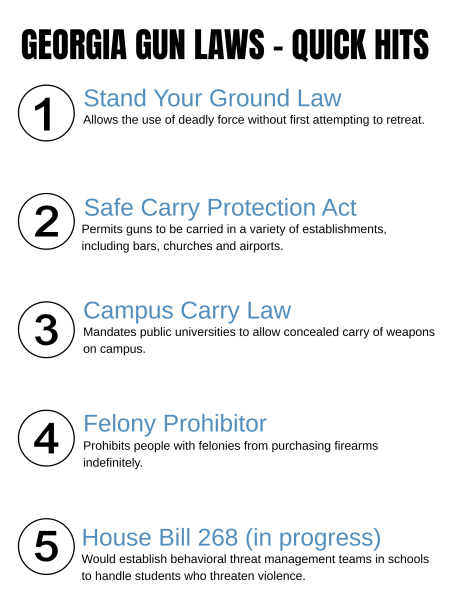
Five of Georgia’s gun laws are shown. Graphic by Wyatt Meyer
Fast forward more than 25 years, gun violence in the classroom – from kindergarten to university – remains relevant.
On July 1, 2017, Georgia House Bill 280 took effect across the state. HB280, also known as the “Campus Carry Law,” was signed by then-Governor Nathan Deal and authorized the concealed carry of handguns on the campus of any public university’s campus in Georgia and removed them from the “school safety zone.”
“There had been a policy against guns on the UGA campus that went back centuries. That was the policy of the University System of Georgia (USG), which comprises all the universities in the state,” Dr. John Knox, a University of Georgia Professor in the Department of Geography, said. “Everybody went along with (the bill). Even if the university presidents weren’t too thrilled with it, they weren’t going to say anything. I thought this was absurd, because it was incredibly poorly thought out, and still is.”
Frye, who voted against the bill, remembers an interaction a conservative family member who nonetheless expressed his distaste for the legislation.
“My uncle called me up and he said, ‘Spencer, what the hell are you boys doing over there?’ And I said, ‘What do you mean, Uncle Benny?’ He said, ‘How come this gun bill passed?’ Frye said. “I said, ‘Uncle Benny, I’m real sorry I had to vote against that bill. I just don’t think that that’s a good piece of legislation.’ My uncle from South Mississippi, with a gun cabinet built in his living room, said, ‘I’m so glad you didn’t vote for that bill, because that is the stupidest bill I’ve ever heard.’”
In the face of this legislation, Knox was one out of the hundreds who took a public stance on the issue, becoming the face of Knox V. Georgia – the 2017 lawsuit filed by five University System of Georgia professors to block HB280 on the grounds that it usurped the Board of Regents’ authority under the Georgia consitution to govern, control and manage the USG and its member institutions.
After an almost six-year battle throughout the Georgia judicial system, the Georgia Supreme Court ruled against Knox in a 7-2 decision on May 31, 2023.
“I guess there’s a reason that you don’t speak out because you’re afraid you’ll be next. But how far are you going to get pushed in the corner before you do something? And so I just decided life was too short to not stand up for the right thing. I’d rather die knowing that I gave it a shot, even if it was a long shot,” Knox said.
An added wrinkle in HB280’s impact might come as a surprise – the potential for weapons brought onto campus to be stolen and then used in crime. According to Athens-Clarke County records as of April 29, since the start of 2022, there have been 365 documented instances of firearm thefts from motor vehicles in Athens. Some Republican lawmakers, such as Ridley, have pointed to the thefts as a reason for citizens to carry their weapons on their person.
“(People) come from North Georgia down to Athens (for football season), but there’s certain places you can’t carry guns in, so you leave them in cars, they’re broken into and those guns are used in crime,” Ridley said. “If I didn’t have to leave it in my car and I could keep it on my person, then that wouldn’t happen.”
“I think that (training) should be a choice, just like anything else. I don’t really like the government trying to tell us what we (can) do and what we can’t do. As far as the training issues, I think that should be a personal responsibility for a person.”
— Jason Ridley,
State Representative for Georgia House District 6 (R)
Broadly, the phenomenon is especially prevalent in Georgia. As reported by the Bureau of Alcohol, Tobacco, Firearms and Explosives, an average of 14,288 firearms were reported as stolen from citizens in Georgia each year between 2017 and 2021. Based on population, Georgia ranks fifth among states.
ACC Mayor Kelly Girtz acknowledges the prevalence of the thefts, but believes more regulation would cut down on both theft and violence.
“There’s not a wall between Downtown Athens and the University of Georgia where somebody’s checking for weapons,” Girtz said. “Every year, students drive onto campus with weapons in their vehicles that get stolen. If you’ve got an open carry situation, you’re inviting people to have weapons.”

“There’s a lot of guns already out there, and you can’t prevent that, but we can mandate. I’ve actually had a piece of legislation that mandated insurance policies added to homeowner policies if there was a firearm in the house.”
Spencer Frye,
–State Representative for Georgia House District 122 (D)
Much of what captures public attention about gun violence is mass shootings, as the media often reports on the scale and magnitude of the crisis. As such, experts have suggested a “general imitation” effect applied to mass shootings, wherein extensive media coverage of the perpetrators and event leads others to imitate the behavior.
In Georgia, following the Apalachee shooting, threats of further violence sprung up around the state – including a middle school student in the Clarke County School District on Sept. 5. However, Schildkraut maintains that putting mass shootings in context is crucial to preventing the broader problem of gun violence.
“If you think about all of the crimes law enforcement encounters in a given year, homicides (of any kind) represent 0.1% of those. Mass shootings make up 0.1% of that 0.1%, meaning that they basically account for 0.01% of all crimes known to law enforcement in a given year,” Schildkraut said. “Other types of gun violence, like firearm associated suicide, is far more common than mass shootings or even gun homicides. (Mass shootings) are the rarest form of gun violence that happen to get the most attention.”
A uniting factor between most types of gun violence has been mental health. Where regulatory discussions have stalled, Georgia politicians have been active in passing bills like House Bill 268, which calls for school systems to set up a behavioral threat management team that’s to intervene when school officials learn that students have threatened violence.
“There’s a lot of guns already out there, and you can’t prevent that, but we can mandate. I’ve actually had a piece of legislation that mandated insurance policies added to homeowner policies if there was a firearm in the house.”
— Spencer Frye,
State Representative for Georgia House District 122 (D)
A map shows the composite scores of the strength of gun laws in the United States, averaged from the strength of the laws in each state, according to Everytown, a nonprofit gun advocacy organization. Map by Lea D’Angelo
Passed by a 159-13 vote on March 4 and moved onto Senate vote, the bill, which has not yet been signed into law, has undergone multiple revisions but has bipartisan support. For Frye, the legislation may be a start to detangling the complex web of gun violence causes, but the solution doesn’t begin and end with mental health.
“There’s not one magic bullet that can solve any problem, right? It’s a group of solutions put together that will make our lives safer and our children safer,” Frye said. “That’s going to be through a combination of us paying attention to our mental health, finally, as an issue like a disease, and then the institution of safe gun ownership.”
Outside of the legislative sphere, students like CCHS junior Carlie Holmes feel the effects of the country’s lack of regulation.
“I think it should be way harder to get weapons. That’s part of why all of this is happening, because it’s so easy to get your hands on guns so quickly,” Holmes said. “As far as mental health for students and gun regulation and control, I feel like not enough is being done to prevent this from happening.”
Holmes’s sentiment is echoed in the current political climate, where efforts to encourage safe ownership and not limit it continue to be struck down.
“There’s a lot of guns already out there, and you can’t prevent that, but we can mandate. I’ve actually had a piece of legislation that mandated insurance policies added to homeowner policies if there was a firearm in the house,” Frye said. “I think it’s a combination of things that are going to help us get to where we need to be.”
As conversations continue regarding gun violence in places as disparate as the Georgia General Assembly and Frye’s Deep South family home, Girtz is left with a question – not an answer – about what happens next.
“Connecticut has a third of the gun death rate of Georgia, so three times as many people die by a bullet in Georgia as in Connecticut,” Girtz said. “Same nation, the same US Constitution, the same Second Amendment, but doing some smart things on the regulatory front. Why wouldn’t we want to keep more of our friends and neighbors and loved ones alive?”