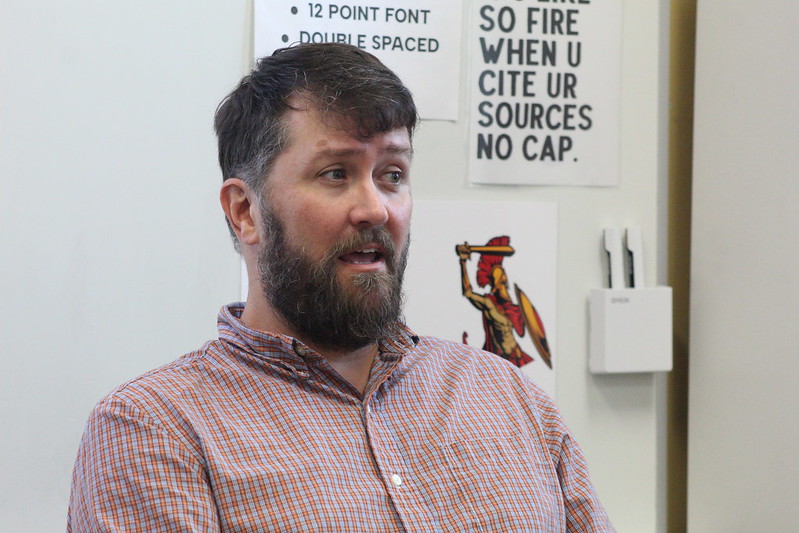
Clarke Central High School Family Engagement and Academic Support Specialist Christian Barner speaks at a press conference with the ODYSSEY Media Group on July 21 in Room 231. In order to improve school climate in the 2025-26 school year, CCHS’ Positive Behavioral Interventions and Supports (PBIS) committee has made an effort to build teacher-student relationships with individualized recognition. “We want to try to try to figure out ways to recognize students in the moment throughout the class, and be able to do that more. We talked about having notes, having candy, (and) trying to build on that,” Barner said. Photo by Iliana Tejada
New standards and community-building activities are being brought to Clarke Central High School for the 2025-26 school year.
As the start of the 2025-26 school year draws near, new practices are being brought to Clarke Central High School to build community and improve student success.
After going through multiple rounds of revision since 2019, new curriculum standards are being adopted state-wide in all English Literature K-12 classes for the 2025-26 school year. The Georgia Department of Education has also mandated a shift of the Literature and Composition end-of-course exam from 11th grade to 10th.
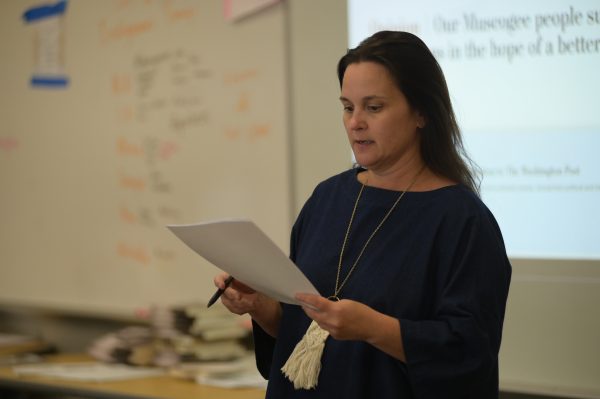
Clarke Central High School Literature IV Team Lead Jennifer Tesler teaches her Multicultural Literature class on Oct. 17, 2024. The Georgia Department of Education has adopted new standards for the 2025-26 school year, changing the content and texts taught across grade-levels. “There’s no Multicultural Literature anymore, or American Literature. The names of our courses are (now) Lit I, Lit II, III and Lit IV,” Tesler said. “Some teachers may still use (old) texts, but for example, Multicultural Literature (texts) could be used in all of the courses.” Photo by Grady Dunston
“There’s going to be more of a focus on research, (and) some specific standards that address poetry that we’ve never had before. The standards will both interpret text and more specifically, there will also be opportunities for (students) to construct texts,” CCHS Literature IV Team Lead Jennifer Tesler said.
As of 2023, roughly 50% of third grade students in the Clarke County School District were reported to be reading below grade level, a trend that began in 2019, and something Tesler hopes the new standards will help mitigate.
“Our standards are a progression of really trying to make a more robust early literacy program,” Tesler said. “One of the ways that it will challenge (teachers) will be to think of different texts we could use in the classroom, and we won’t be bound to the same old texts that we’ve always felt like we’ve had to (use).”
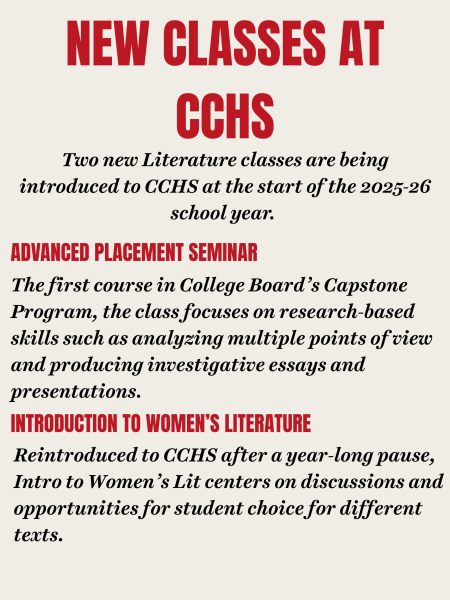
A graphic shows the two new Literature classes that will be introduced at Clarke Central High School at the start of the 2025-26 school year. One of the classes is Introduction to Women’s Literature, which CCHS Literature IV Team Lead Jennifer Tesler taught during the 2023-24 school year before it faced a year-long pause. “I love that class, and I’m really happy that (CCHS English department teacher Molly Dorkey) is going to be teaching it this year. Anybody who takes that class will learn a lot,” Tesler said. “It will add to what students consider legitimate literature to be studied in high school.” Graphic by Lea D’Angelo
On the school climate side, as part of a state-wide mandate, the CCHS Positive Behavioral Interventions and Supports (PBIS) committee looks to improve school climate by increasing PBIS programming. This means expanding on initiatives like attendance incentives, Glads are GRADS promotions, Honorable Gladiator awards and the Big Event.
“We want to try to do some things during lunch. Lunch is really short, but we’ve talked about trying to bring out some of the Big Event stuff that we have, like ping pong tables and video games and set them up in Mell Lobby,” CCHS Family Engagement and Academic Support Specialist Christian Barner said. “It’s about trying to recognize students for doing what they’re supposed to be doing and make the day a little bit more enjoyable.”
The committee is also looking for ways to improve student-teacher relationships on a classroom level.
“We’re (focusing on) ways to recognize students in moments throughout the class and be able to do that more,” Barner said. “(We want to help) teachers provide very specific feedback and praise to students and encouragement. Instead of just, ‘Hey, you’re doing a great job,’ but ‘Hey, you did a great job on that essay that you wrote.’”
“(PBIS is) about trying to recognize students for doing what they’re supposed to be doing and make the day a little bit more enjoyable.”
— Christian Barner,
CCHS Family Engagement and Academic Support Specialist