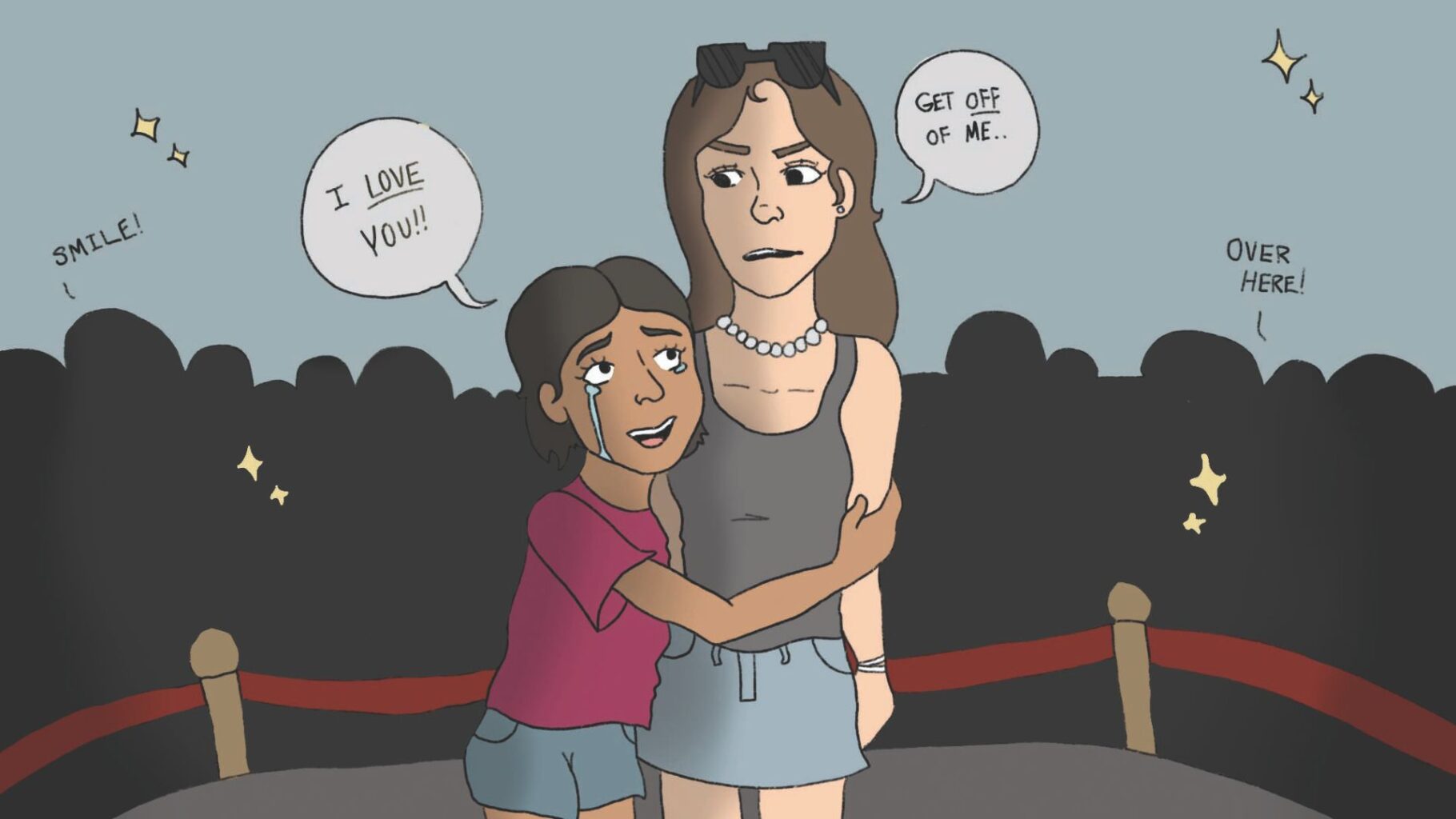
An illustration depicting a fan clinging to a disgruntled celebrity is shown above. After Instagram’s release on Oct. 6, 2010, the dynamic between fans and celebrities changed substantially. “Since apps like Instagram’s rise in popularity during the mid-2000s, celebrity culture has become more interactive, allowing fans to directly engage with their favorite artists,” Variety Editor Adah Hamman wrote. “This has led them to develop an unhealthy sense of entitlement, where they believe they have the right to influence and control celebrities’ personal lives.” Illustration by Sylvia Robinson
Since the rise of social media, users have developed a sense of entitlement towards celebrities, which has led them to exhibit invasive and even dangerous behaviors.
When the news broke in 2014 that Canadian singer Justin Bieber and American singer and actress Selena Gomez were dating, fans flocked to social media to express their opinion on the couple.
Whether or not someone was on #TeamJelena, though, Bieber and Gomez’s relationship had gained national traction, one of the many examples of a celebrity pairing to do so.
When the two decided to end their relation- ship in 2016, they attracted even more attention, especially when rumors began to circulate that Bieber was dating American model Hailey Baldwin. Celebrity news outlets released article after article, generating thousands of comments, both positive and negative, which resulted in the former temporarily deactivating his Instagram account for a short period of time.
But why? Why were people so enthralled, so invested in Bieber and Gomez’s relationship?
Since the rise of the internet in the 1990s and the advent social media apps like Instagram and X’s rise in popularity during the mid-2000s, celebrity culture has become more interactive, allowing fans to directly engage with their favorite artists. This has led them to develop an unhealthy sense of entitlement, where fans believe they have the right to influence celebrities’ personal lives.
Fans must learn to recognize that celebrities are entitled to privacy, just like anyone else.
A significant moment in the debate regarding fan-celebrity relations occurred on Feb. 21, 2007, when American singer Britney Spears attacked a paparazzo’s car with an umbrella after months of relentless stalking. This incident marked an important turning point in celebrity culture and sparked discussions about the implications of fame. In the information age, what did the public have a right to know?
For almost 20 years since Spears’s bust up, the answer to that question seemed to be almost everything. But recently, celebrities have begun to speak out and advocate for their right to set boundaries. American singer songwriter Chappell Roan, a rising pop star with a large social media presence, posted to the app in August 2024 to call out fans who she described as exhibiting “creepy behavior.”
“I don’t care that abuse and harassment, stalking, whatever, is a normal thing to do to people who are famous or a little famous, whatever. I don’t care that it’s normal,” Roan said in the now-deleted video.
Spanning decades, these incidents — Gomez’s, Spears’s, and Roan’s — highlight a growing need for society to reconsider its relationship with fame and the people who live in the spotlight.
Fans must learn to recognize that celebrities are entitled to privacy, just like anyone else. This starts with a collective change in behavior: think before commenting, avoid engaging in divisive online discourse, and respect when celebrities express the need for space.