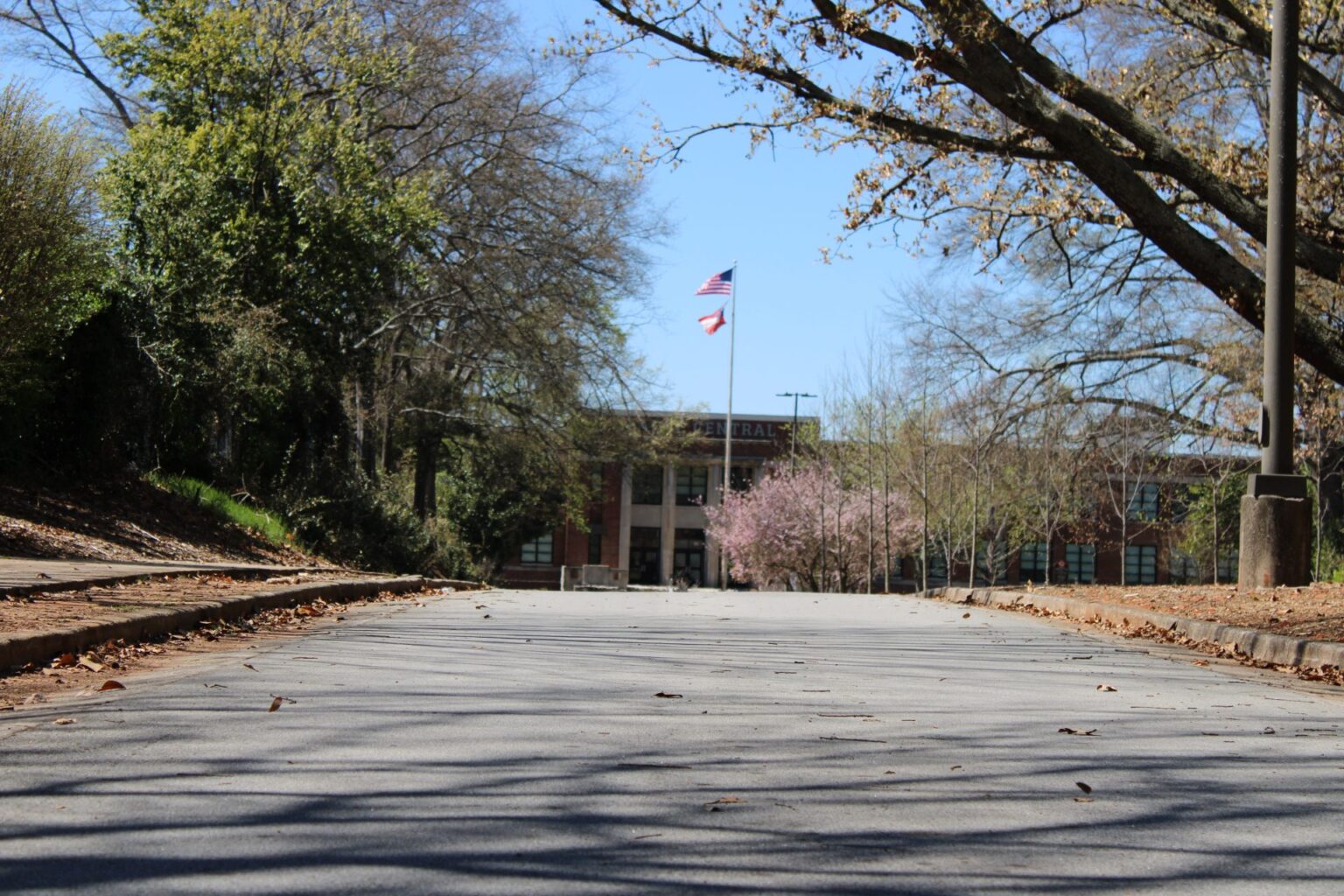
The deadly Apalachee High School shooting has cast a new spotlight on CCHS safety and security.
Just more than four months after the Sept. 4, 2024 deadly mass shooting at Apalachee High School, students and staff had finally begun to return to “normal.” They were back in classrooms, resuming their usual routines and adapting to updated safety measures.
Fears then resurfaced when another firearm was brought on campus on Jan. 8 by an unidentified Apalachee student.
The reality of schools’ fragile campus security has compelled schools across the nation to reassess safety protocols and question their effectiveness now and in the future.
“Not a day goes by that I don’t think about something happening at school. It’s infuriating,” fine arts department teacher Heather Garland said.
Clarke Central High School, like many schools, has a structured security plan in place. The school employs a combination of security personnel, technology and training to maintain a safe environment. All of these measures comprise the broader safety frameworks.
“School shootings have impacted the landscape. There’s more technology that’s being put in place. There’s more awareness,” Apalachee Assistant Principal Andy Dean said.
As safety and security retain their vast importance to modern school environments, CCSD and CCHS administrators and staff provide a more complete picture the safety situation at CCHS.

The goal is to ensure that there is at least one security personnel on every floor of the main building, so there’s multiple layers to ensure that we’re safe here.
Tamika Henson,
– CCHS Associate Principal of Operations
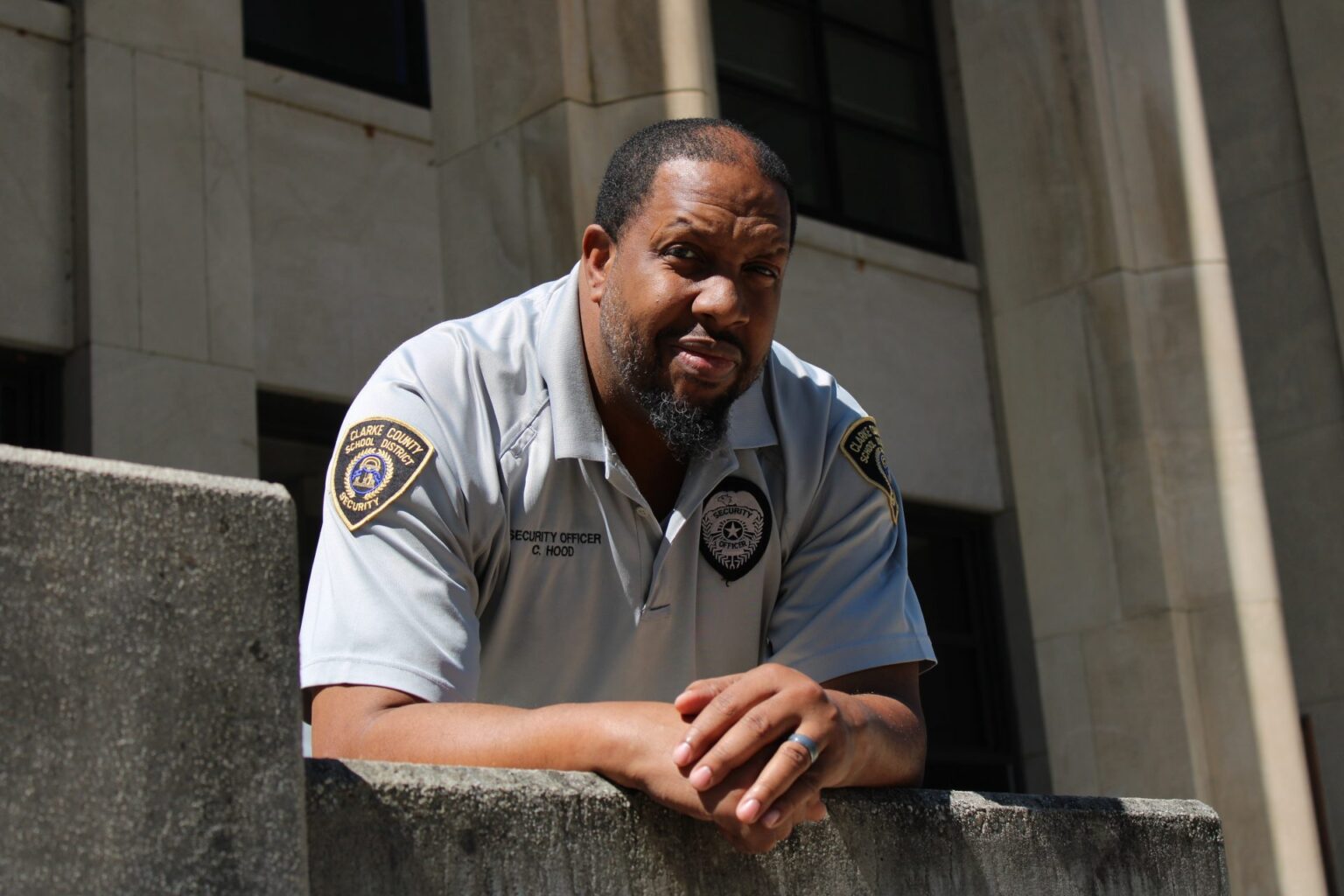
Clarke Central High School Security Officer Chris Hood poses outside the Ceremonial Entrance on March 18. Hood is part of a seven-person CCHS security team that resolves in-building conflicts and protects the school from potential intruders. Photo by Wyatt Meyer
Security officers operate on a rotating schedule, monitoring different floors and rotating into the camera room. CCHS currently has four security officers, or “grey shirts” and one full-time School Resource Officer. Under normal operations, the school would have two SRO’s, but one of those positions is currently vacant.
In addition to this personnel, CCSD has a partnership with the Athens-Clarke County Police Department whereby ACCPD officers are stationed across the district in each elementary, middle and high school. There is currently one ACCPD officer based part-time at CCHS. This partnership has been in place for over a decade and relies on a memo of understanding that lays out the terms of the agreement. CCHS also has one privately-contracted security officer who supplements the team.
A graph shows the reported severe behaviors incidents at Clarke Central High School between the 2023-24 and 2024-25 school years. The number of these incidents have remained low since the Clarke County School District began reporting data in the 2021-22 school year. “We have so many good kids that (the) kids that get in trouble or are having a bad day, it can average out to be a couple of students per security officer,” CCHS Security Officer Chris Hood said. Graph by Lea D’Angelo
At CCHS, this makes a total of eight security personnel responsible for 1,891 students, a 1:236 ratio.
“We have so many good kids that (the) kids that get in trouble or are having a bad day, it can average out to be a couple of students per security officer,” CCHS Security Officer Chris Hood said. “A couple more eyes wouldn’t hurt but we get the job done.”
The number of security incidents and high-risk students remains low – CCHS does not have a documented instance of student trespassing reported by the CCSD Student Behavior and Attendance Dashboard in the 2024-25 school year (it had three in 2023-24), while the number of weapons infractions rests at two, which would be the lowest in a school year since the dashboard began reporting data in 2021-22.
Nonetheless, school administrators continue to emphasize the importance personnel have in school security.
“The goal is to ensure that there is at least one security personnel on every floor of the main building, so there’s multiple layers to ensure that we’re safe here,” CCHS Associate Principal of Operations Tamika Henson, who oversees building safety and security on the administrative team, said.
The goal is to ensure that there is at least one security personnel on every floor of the main building, so there’s multiple layers to ensure that we’re safe here.
— Tamika Henson,
CCHS Associate Principal of Operations
At a district level, staffing of personnel remains one of the most pressing security challenges.
“I think the No. 1 safety priority is getting a SRO for every school. We need more SRO’s,” CCSD Director of Safety and Energy Patrick Dyer said.

Doors being open can draw attention for someone trying to get into school, who can just run up to the door while it’s open. If everybody comes through the front office like (they’re) supposed to, then we can find out who’s coming in the building, who’s not coming in the building.
Chris Hood,
– CCHS Security Officer
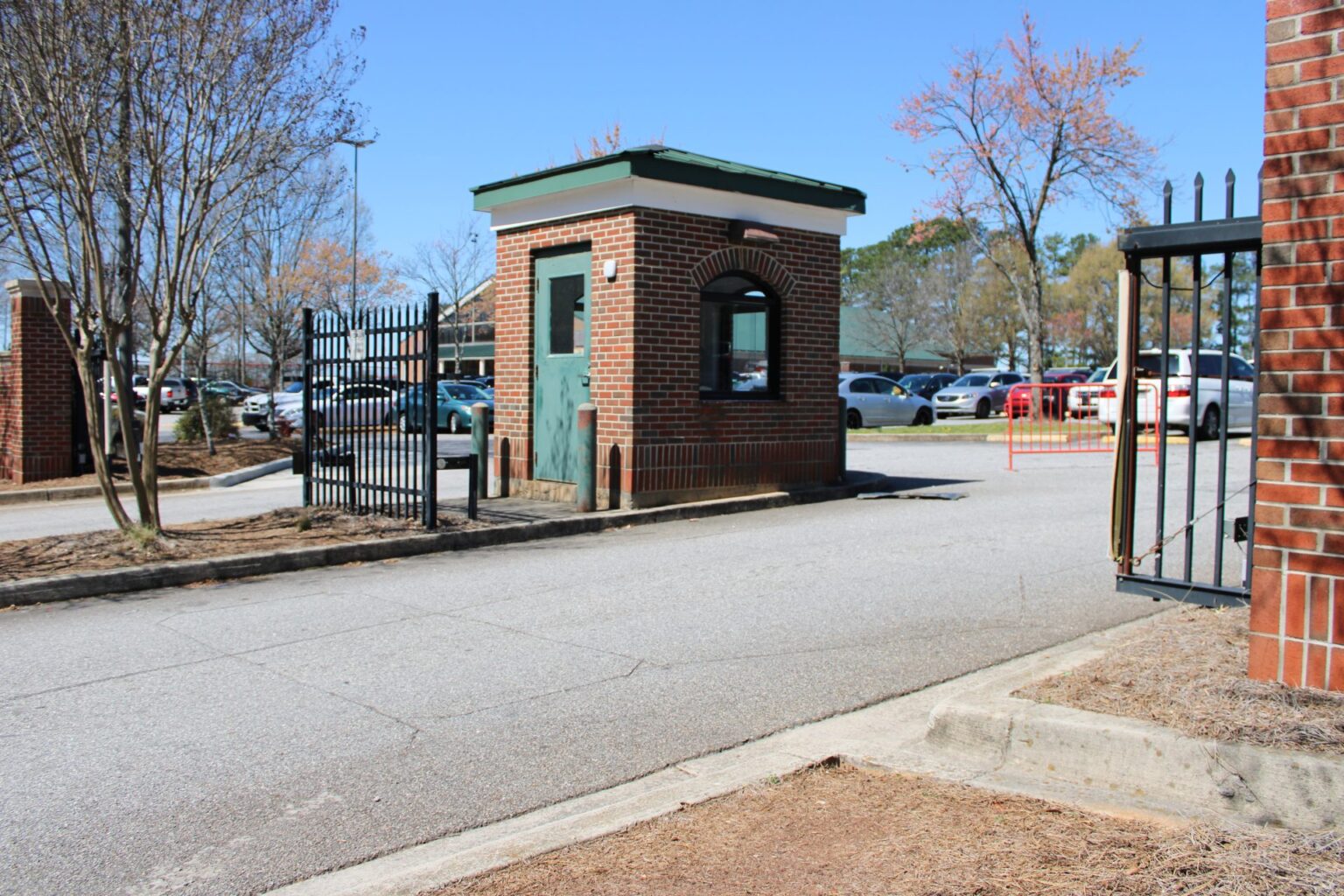
The Baxter Street entrance to the Clarke Central High School student parking lot is shown on March 18. This campus entrance receives the most traffic from students and parents trying to enter campus, necessitating a guard tower and a designated security officer for the area. Photo by Wyatt Meyer
Beyond personnel, infrastructure plays a crucial role in school security. CCHS has at least 12 access points into the building, all of which are expected to remain locked, with access for visitors limited to the front office. Cameras provide surveillance in key areas, including the bus loop and gym entrances, which have been identified as locations where unauthorized individuals may attempt to enter campus.
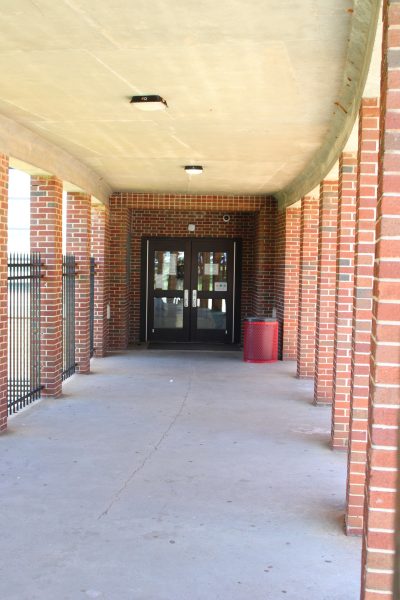
The Clarke Central High School Breezeway entrance is shown on March 18. According to CCHS security personnel, this entrance is a security concern when students open the door for those trying to access the building; CCHS policy states that all visitors or those wishing to access the facility must enter through the Main Entrance across campus. Photo by Wyatt Meyer
“Doors being open can draw attention for someone trying to get into school, who can just run up to the door while it’s open. If everybody comes through the front office like (they’re) supposed to, then we can find out who’s coming in the building, who’s not coming in the building,” Hood said.
Doors are expected to be closed and locked at all times except between 7:45 a.m. and 8:45 a.m. when students enter the building and during several six-minute class changes throughout the day. However, the directive relies on students not opening doors for those trying to enter the building. This is where struggles have occurred – the topic was discussed extensively at a Sept. 5 meeting with students following the Apalachee shooting, while signs have been posted on entrances warning students of the disciplinary consequences of letting intruders into the building.
With these challenges in mind, CCHS continues to explore ways to enhance safety. Some institutions, like Apalachee, have introduced metal detectors at entrances.
“We got weapons detectors at Apalachee High School, which is a great measure that the school district has taken. We have those set up at all the entry points where students come into the building,” Dean said. “They’re two towers that stand six (or) seven feet tall. They are connected to a cellular network. They have various settings: (they) can detect a razor blade or a gun.”
Doors being open can draw attention for someone trying to get into school, who can just run up to the door while it’s open. If everybody comes through the front office like (they’re) supposed to, then we can find out who’s coming in the building, who’s not coming in the building.
— Chris Hood,
CCHS Security Officer
As a mechanism to protect students, Henson believes pursuing similar technology might be worth the cost to implement.
“I’ve heard some conversations that some people may say, ‘They don’t work,’ or ‘If a person really wants to bring a weapon in, they’ll figure out a way to get it in.’ I can pretty much agree with that, (but) I think it will have a person think twice if that’s what they wanted to do and thinking twice is better than not having to think at all,” Henson said.
The district considered these options, but they too require funding CCSD does not have.
“Various companies offer AI enabled gun detection, but they require money. In addition to the funding, it requires changing our procedure, even changing how students come into the buildings,” Dyer said.

There’s more technology that’s being put in place. I think there’s also more awareness, (like) classroom doors were not necessarily locked back in the day, and that is something that pretty much every school preaches.
Andy Dean,
– Apalachee High School Assistant Principal
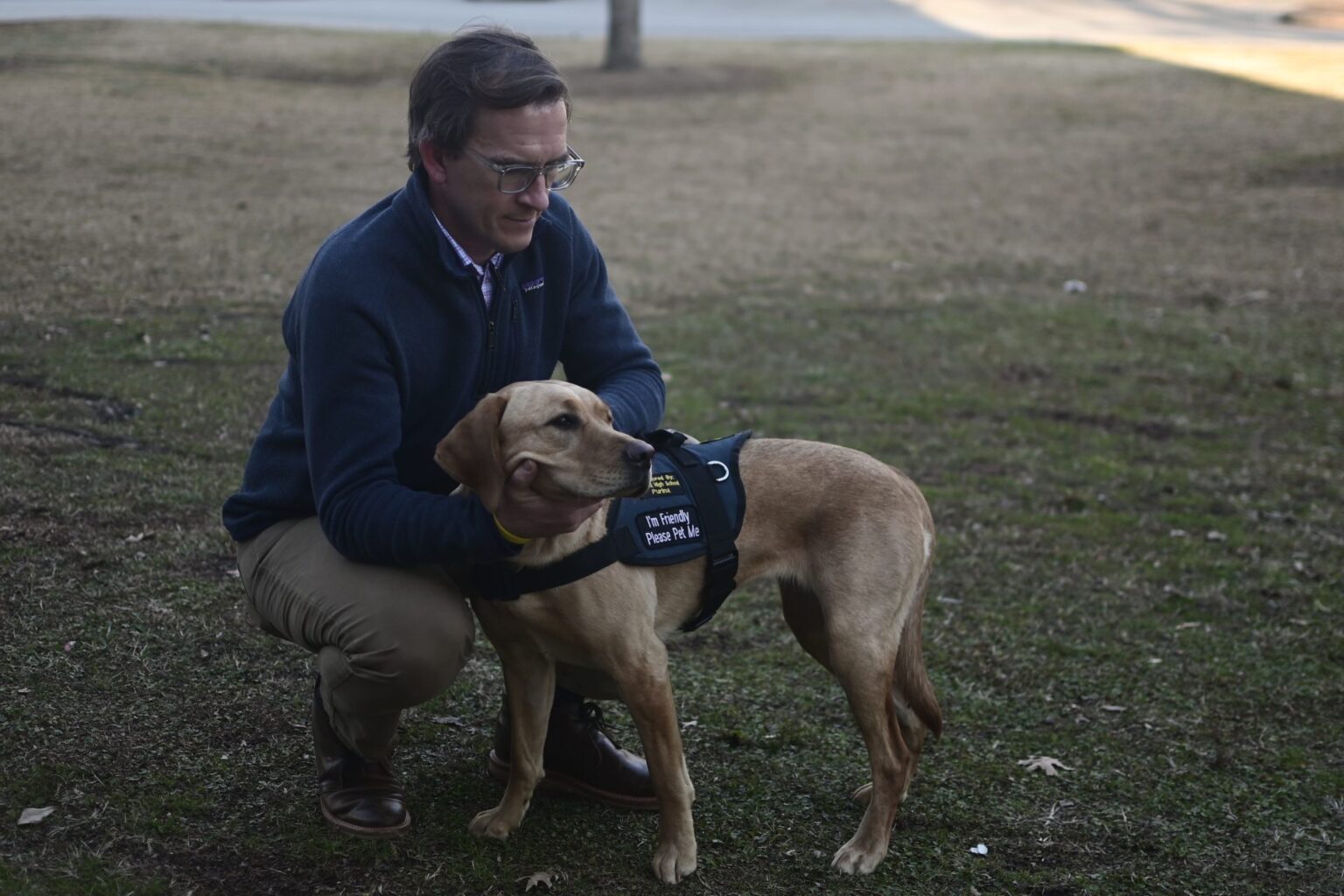
Apalachee High School Assistant Principal Andy Dean, a former Clarke Central High School teacher, pets his emotional support dog outside the CCHS Ceremonial Entrance. Dean has used an emotional support dog to process the trauma from the shooting at Apalachee earlier this school year. Photo by Liya Taylor
CCHS conducts regular safety drills to ensure students and staff are equipped to respond effectively in emergencies. These drills, which include lockdown, fire and severe weather simulations, are designed to reinforce protocols and minimize confusion during real incidents.
In addition to the internal safety measures, the Clarke County School District participates in the Site Threat Access and Response (STAR) audit, a comprehensive evaluation process designed to assess school protocols and identify vulnerabilities.
“Clarke County policy states that (there) are two required safety inspections per year at every school. We partner with Georgia Emergency Management and Homeland Security to do audits, (and) one of those is the STAR audit, Site Threat Access and Response,” Dyer said.
Conducted by school safety authorities, the audit examines various aspects of campus security including surveillance, emergency response plans and staff training. The audit provides schools with data-driven recommendations to strengthen their safety procedures to adapt to emerging threats.
There’s more technology that’s being put in place. I think there’s also more awareness, (like) classroom doors were not necessarily locked back in the day, and that is something that pretty much every school preaches.
— Andy Dean,
Apalachee High School Assistant Principal
Due to budget constraints, only nine CCSD schools were chosen to conduct the audit, CCHS included. The selected schools ranged from elementary, middle and high schools on both the east and west sides of Athens in an effort to properly represent the district’s demographics. The schools were not notified ahead of time to best simulate an intruder.
“(STAR auditors) come out in plain clothes and probe the building to see if they can get in, and they gauge the response of the staff once they enter the school. They’re trying to talk their way past our safety measures,” Dyer said.
After the audit, Dyer compiles all video footage and other relevant data to best understand each school’s response. Once this data has been collected, there are various post-audit meetings where constructive feedback is provided to each school on how they can better respond.
Click through the slides to see the development of different protocols
A series of charts shows fluctuations between safety protocols in schools over time. The Sept. 4, 2024 shooting at Apalachee High School has prompted conversations on safety protocols at nearby schools such as Clarke Central High School. “I’ve heard some conversations that some people may say, ‘(Metal detectors) don’t work,’ or ‘If a person really wants to bring a weapon in, they’ll figure out a way to get it in.’ I can pretty much agree with that, (but) I think it will have a person think twice if that’s what they wanted to do and thinking twice is better than not having to think at all,” CCHS Associate Principal of Operations Tamkia Henson said. Graphics by Lea D’Angelo
Another element of safety further revealed by the audit is the importance of identification of all staff and visitors. CCHS and CCSD employees all have issued badges, visitors are given a printed red sticker when checked-in, and all contractors who are working on campus for more than 10 days are given a yellow badge.
“(The audit) brought up another layer of support that we have. Staff should be 100% always wearing an (ID) badge above the waist. We’ve had safety trainings (where it’s) reiterated (to) look for a badge. That’s how we should know who’s on our campus and we’ve all been told to approach them to ensure that we know who’s in our building,” Henson said.
Despite these directives, protocols, personnel, audits and other safety measures, understanding and ensuring that the CCHS campus is secure is not an easy task.
“It’s hard in this building, with about 2000 people, to know who should be here, (or) should not be here. So that was the thing that the district did, put the badges in place so that way we’ll have a greater chance of knowing,” Henson said.
In addition to these identification measures, CCHS utilizes CENTEGIX, a crisis alert system designed to improve emergency response times and communication. This technology is integrated into school safety protocols, working alongside the other measures to create a comprehensive security framework. CENTEGIX has been implemented since 2019 but was not fully integrated into all CCSD schools until after the COVID-19 pandemic.
CENTEGIX provides staff with wearable badges equipped with an emergency alert function. In the event of an emergency, whether it be medical, a fight, or an active threat, staff members can utilize their badge to instantly alert the school security team and administrators. Unlike traditional intercom systems, which may not always be available in emergency situations, CENTEGIX allows for silent communication to better enhance overall campus security.
“I’m sure you’ve probably seen on the television the Life Alert panic alert buttons, it’s very similar to that, so with the button depending on how many times a staff member presses it, there’s differences that can be activated from the badge,” Dyer said.
When pressed two times, a StaffAlert is issued. In the event of a StaffAlert, the school is put into a soft lockdown. During soft lockdowns all regular activities can continue aside from leaving classrooms. StaffAlerts are most commonly used for smaller issues like medical emergencies or fights.
When pressed three times, a Campus-Wide Alert is issued. In this event, the school is put into a hard lockdown where all classrooms are secured and students and staff seek cover from a potential intruder.

We rely heavily on see something, say something in the community. The staff and the students have done great by reporting those incidents, and we’ve been very successful with that approach.
– Terry Reid,
CCSD Chief of Police
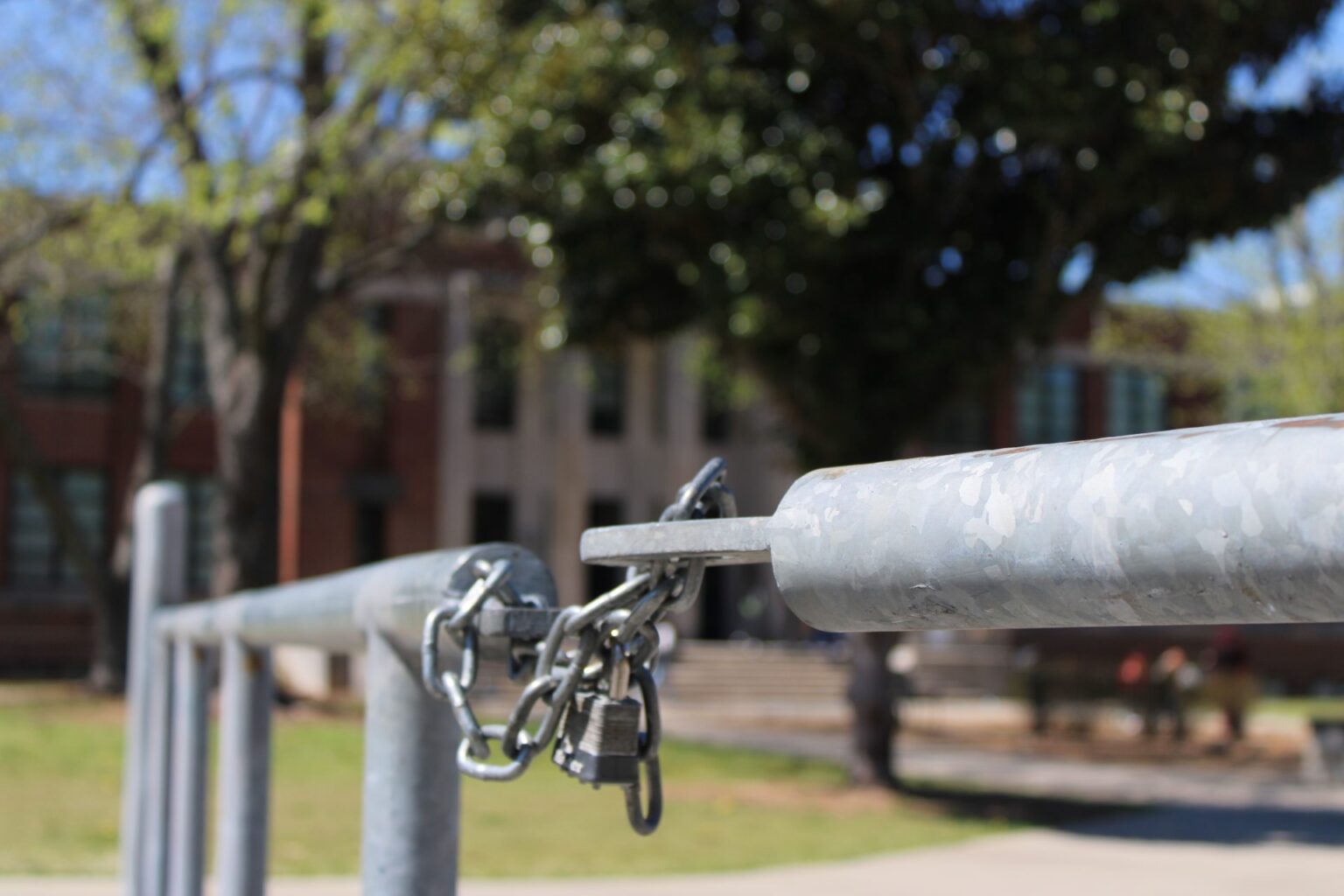
A lock holds together the barrier preventing access to the Clarke Central High School student and teacher parking lots from the roundabout at the CCHS Main Entrance. The barrier prevents campus outsiders from cutting through CCHS campus to access Milledge Avenue or Baxter Street during school hours. Photo by Wyatt Meyer
Through all of these staff and systems, the district comes down to the connectedness of the framework overall. Bridging each piece to ensure that there are no gaps relies on each student and teacher in each building.
“We rely heavily on see something, say something in the community. The staff and the students have done great by reporting those incidents, and we’ve been very successful with that approach,” CCSD Chief of Police Terry Reid said.
This community-reliant approach has been successful over the years, but the CCSD is still looking to expand safety measures to fully ensure campus security, an expansion reliant on funding.
“I wouldn’t call it a shortcoming so much as we’re trying to catch up, and we’re waiting on funding for the state to help,” Dyer said.
We rely heavily on see something, say something in the community. The staff and the students have done great by reporting those incidents, and we’ve been very successful with that approach.
— Terry Reid,
CCSD Chief of Police
From a teaching perspective, Garland wants to see more proactive measures taken. For her, measures seemed more punitive than prevention-oriented.
“We need to think more about how to solve the problem on the front end, rather than the back end,” Garland said.
Garland is not alone in the thought. Security administrators like Reid are advocating for safety to become more integrated into CCSD curriculum in the hopes it would raise awareness of security policies and procedures themselves.
“There needs to be some education, (it) should be a part of the curriculum somewhere,” Reid said. “If the students knew, if they had some understanding of the law and how easy it is to violate it, they’ll be careful.”
In the meantime, however, safety remains an ever-changing, turbulent landscape at CCHS, leaving students like junior Cortni Veasley with little under- standing of what positive safety practices look like.
“In my opinion, there is some confusion or misinformation about safety measures at CCHS, especially because the protocols are not consistently communicated to students,” Veasley said. “I feel like majority of CCHS students don’t fully understand.”