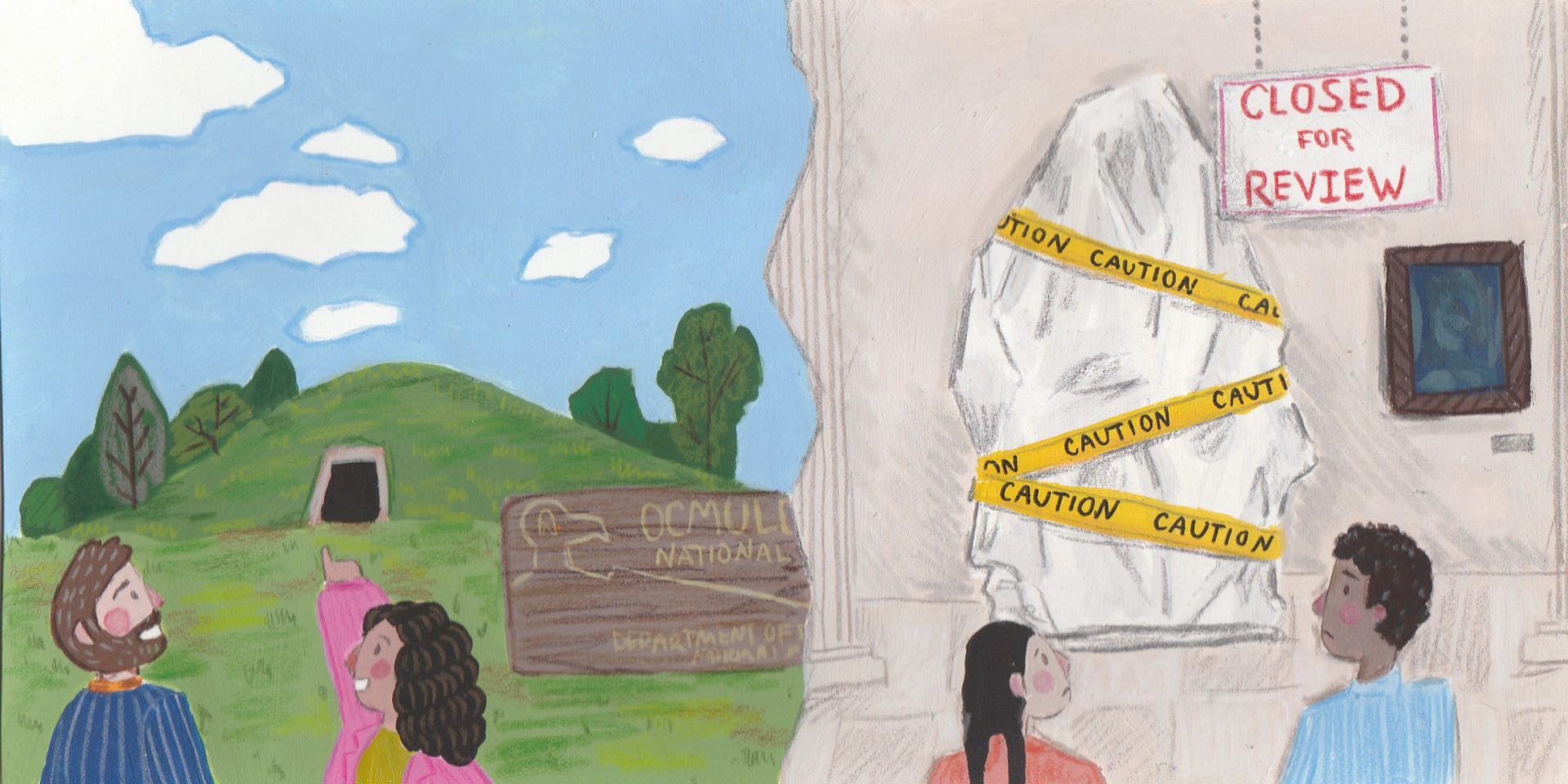
An illustration shows the juxtaposition between the Ocmulgee Mounds, a Native American historical site, and a museum with historical artifacts “under review.” For years, United States National Parks have been threatened by the government to sanitize historical facts and exhibits. “It is a common practice, particularly in (an) authoritarian light, (that) governments try to control the historical narratives much more tightly,”University of Georgia Assistant Professor in the Department of Mathematics, Science and Social Studies Education Dr. Rebecca Geller said. “That doesn’t make that history go away. That doesn’t diminish the people who are very much alive today, who are reflected in those histories.” Illustration by Tess van Wagtendonk
History is under attack as U.S. national parks lack legislative support and museums fight to keep themselves, and appreciative viewership, in good graces with the country.
“He who controls the past controls the future. He who controls the present controls the past.”
This quote is from English author George Orwell’s dystopian novel “1984,” a story about a man fighting a government that controls history and truth, which mirrors real-life efforts to censor, obscure and revoke history in the United States’ national parks.
If history is sanitized or altered in textbooks and national parks, U.S. residents lose the full picture of the past that they deserve.
Such sanitization has already begun. In February 2025, the U.S. National Park Service erased the word “transgender” and the name of LGBTQ+ activist Marsha P. Johnson from the Stonewall National Monument website to restrict the idea of “gender identity.”
In July 2025, signage dictating that land, such as the Yellowstone National Park, was originally inhabited by Native Americans was removed because they “disparaged Americans’ past.” On Jan. 13, the Smithsonian Institute was asked by the White House, under the Trump Administration, to review exhibits for “divisive narratives” that may create hostility within the country prior to display.
This “cleansing” of what can sometimes be a complex past is to make the past more palatable for the everyday tourist, who is strictly consuming history from the “patriotic” or “fun day-trip” view. But to warp history for the sake of naive enjoyment enables ignorance.
These parks are time capsules, but, without preservation or proper appreciation, places that honor history, especially indigenous history, will be forgotten to time.
Nearly 70 miles from Clarke Central High School is the Ocmulgee Mounds, a site featuring earthen mounds where Native American chiefs lived about 1,000 years ago. Now, Tracie Revis, a Muscogee Nation citizen, and U.S. Sen. John Ossoff, D-Ga, are leading the charge to recognize this historical site as Georgia’s first National Park.
“To warp history for the sake of naive enjoyment enables ignorance.”
Legislation to name it as such has been stalled in the U.S. House of Representatives since 2024. A similar outcome has occurred to other pieces of protective legislation like the Protect Our Parks Act of 2025, which has been stalled in the House since December of 2025. This pattern begs the question, why is history going underappreciated?
“We talk about queer histories, we talk about women’s histories, we talk about Native (American) histories, we talk about the history of reconstruction. We talk about things that are not only often absent (from textbooks), but often widely misunderstood,” University of Georgia Assistant Professor in the Department of Mathematics, Science and Social Studies Education Dr. Rebecca Geller said. “(Those topics) do require us to figure out where our own gaps in knowledge are. It’s an opportunity for us to learn something new.”
Ocmulgee is home to over 2.5 million recovered artifacts including jewelry and pottery as well as hundreds of unmapped and unprotected cultural sites.
These fragments of history will be erased if no one appreciates how valuable they are to understanding the world now. If someone doesn’t, or can’t because it’s been censored, learn from history, they are doomed to repeat it.
History like this can elevate one’s understanding of the community as a living classroom dedicated to the past. National parks should be protected above anything, because the historical value they hold is priceless.
To control the past, one has to first understand it. And to understand anything, its history must be recognized and analyzed.
Despite being written over 75 years ago, Orwell’s words were true then, and they’re true now.