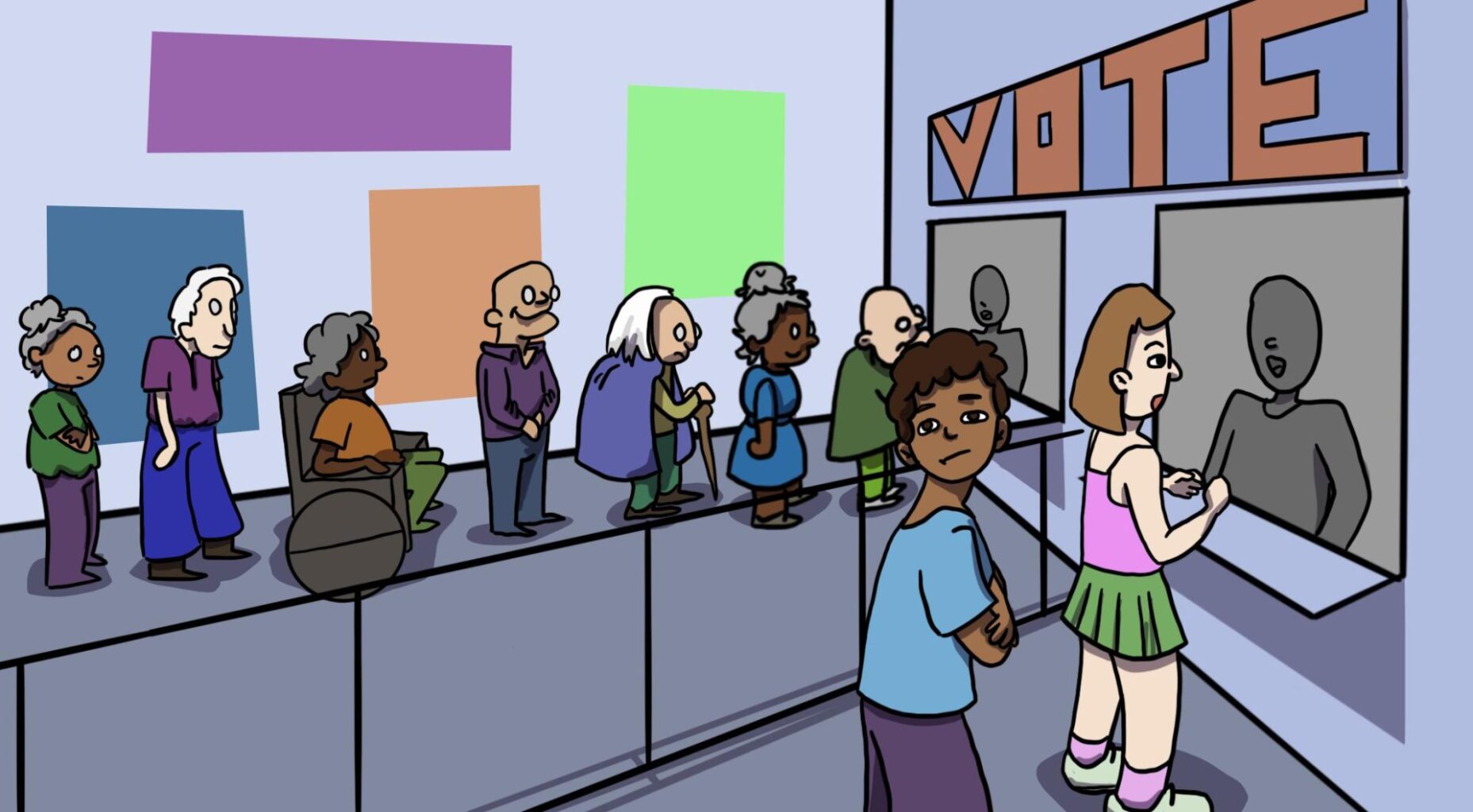
An illustration shows two voting lines, one with older voters (left) and a shorter one with younger voters (right). In the past, voter turnout from younger Americans had been slim, with growth needed before the start of the 2026 midterm elections. “Although the majority of Clarke Central High School students can’t vote yet, everyone should take advantage of the opportunities given to them to learn about the voting process and register when they do become eligible,” Viewpoints Editor Violet Dockery wrote. Illustration by Mabel Vaughn
Young adults are participating less in elections in a time and political climate where voicing their opinions matters most.
Nearly 174 million people across the United States voted in the 2024 presidential election, according to the United States Census Bureau. Of those individuals, one group is missing: young adults.
Eligible voters under the age of 29 often face disconnect from campaigns, candidates and older voters, leading to voter apathy, which is defined as a lack of interest in participating in elections.
According to a study by the Harvard Kennedy School Institute of Politics, which polled Americans between the ages of 18 and 29, “Half of young Americans now agree that, ‘People like me don’t have any say about what the government does.’ The sentiment crosses party lines: 53% of Democrats, 52% of Independents, and 48% of Republicans all feel voiceless.”
However, that absence of care for voting doesn’t mean young adults don’t have political opinions.
“As voters get older, they tend to turn out at much higher rates. Some of the reasons for this is because younger voters register less, they know less about campaigns (and) campaigns contact them less,” University of Georgia Assistant Professor of Political Science Dr. Laura Uribe said.
In the current U.S. political climate, which has unresolved international conflicts, inflation and economic pressure, young adults are navigating the “real world” in a time of difficulty. As a result, belief among the younger generation that government choices are being made based on the voices of the people is low, making them even less likely to vote.
Across social media platforms like TikTok, Instagram and YouTube, members of younger generations share celebrity news and funny videos. Content about current events and political issues, however, is pushed to the back of users’ feeds. Dean Withers, a Generation Z political content creator and streamer, has created a fanbase of young people who share their political opinions online.
Young adults are participating less in elections in a time and political climate where voicing their opinions matters most.
However, young eligible voters may be hesitant to take the step to becoming politically active beyond their screen. People can voice their opinions in an online comment section with the click of a button, but physically stepping into a voting booth is a different story.
In order to increase voter turnout and political interest, schools and local communities should provide education on the practices of voting through classes like Advanced United States Government and Politics, which teach students about U.S. government processes before they even become eligible voters.
Although the majority of Clarke Central High School students can’t vote yet, everyone should take advantage of the opportunities given to them to learn about the voting process and register when they do become eligible. Those who are old enough need to show responsibility for themselves and their political opinions.
Now is the time to take action, however that may look.