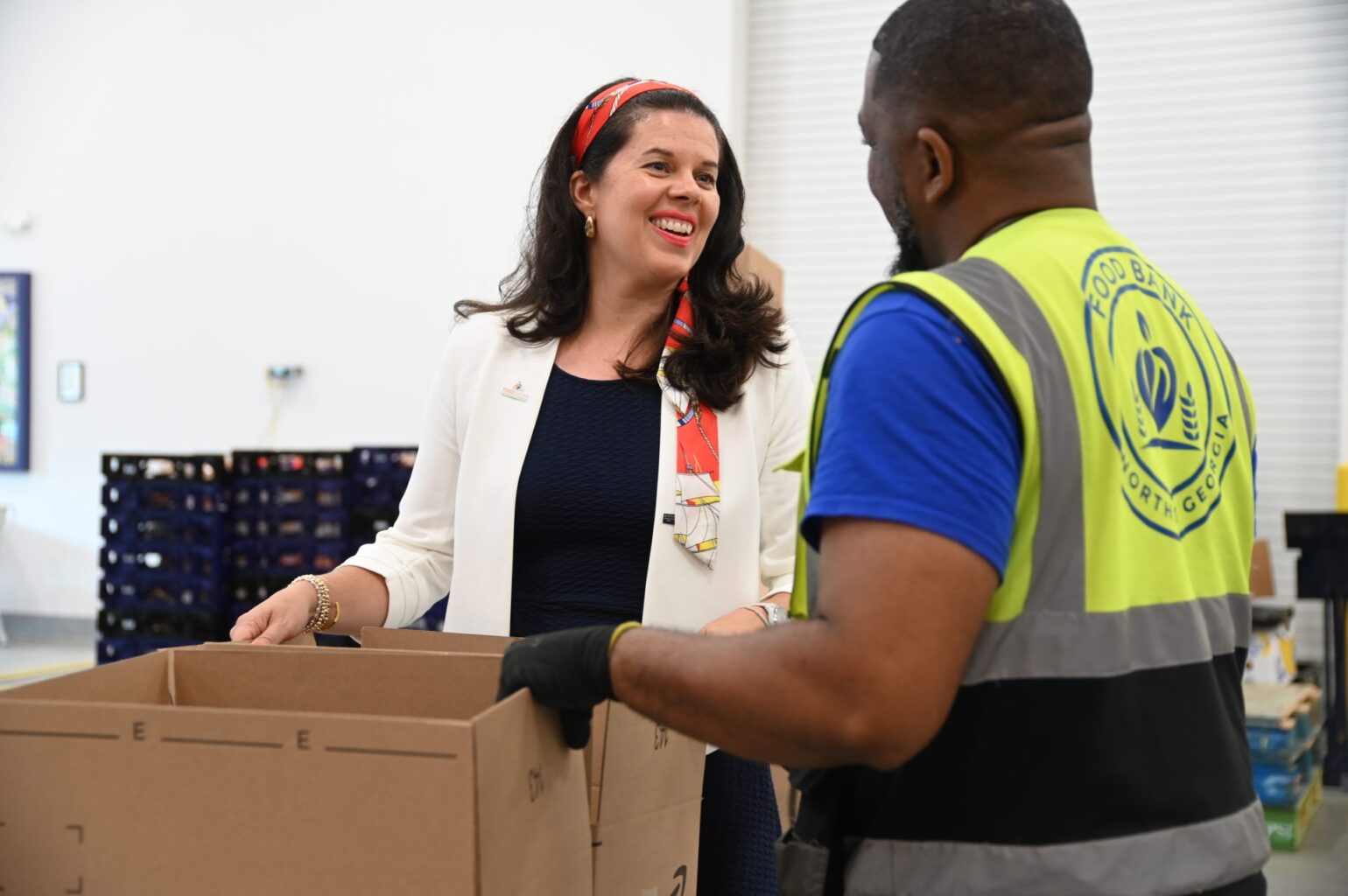
Food Bank of Northeast Georgia President and CEO Erin Barger talks with volunteers in the FBNEGA Volunteer Center on Sept. 3. Past experiences helped Barger discover a talent for philanthropic activity, which has carried her to her current position at FBNEGA. “In high school, a friend of mine became the target of (my) classmates (because of her) disabilities,” Barger said. “I intervened on her behalf by confronting this group of high school boys in the hallway. That was my first experience realizing that if I can alleviate suffering or (advocate for someone unable) to advocate for themselves, that (was) something that I actually had a gift for.” Photo by Iliana Tejada
Food Bank of Northeast Georgia President and CEO Erin Barger discusses FBNEGA, her goals and the impact the work she’s done has had on her.
News Staffer Charlie Crawford: What did your journey look like leading up to your current position?
Food Bank of Northeast Georgia President and CEO Erin Barger: My first real paid position was working with adults with developmental disabilities in a residential support program while I was in undergrad (in) college (at Western Kentucky University from 1999-2001). I learned a lot and found joy in caring for people different from me. I (then) worked with refugee families resettling in the United States from a variety of countries for the International Center of Kentucky. I created a summer camp opportunity for them (along with) after-school programming, and just welcomed them to our country. I had the opportunity to become the director of that agency, (as a) 21-year-old, and realized that I needed more life experience before I jumped into a leadership role of that magnitude, so I joined the Peace Corps. I lived in China for 27 months as a Peace Corps volunteer, and then attended graduate school at (The University of North Carolina at Chapel Hill) from 2007-2009 (where) I earned a Master’s of Social Work and Certificate in Nonprofit Leadership. At that point, my career became rooted in hospitality and connecting to people over food. (I) moved to Athens in 2009, (where I) worked at Our Daily Bread community kitchen, a faith-based organization, for about eight years. Then started an LLC named To Make and Mend, and for three years worked to launch the 20-year plan for Athens-Clarke County called Envision Athens, (which) now in someone else’s hands because I left that to come serve as the president and CEO (for the FBNEGA) five years ago.
CC: What has surprised you the most about working at the FBNEGA?
EB: I guess I shouldn’t be surprised (at this), but it is surprising how much it hurts. When I go out in the field and see the families who need food (and who have) the weight of the world on their faces and on their shoulders, it’s heartbreaking. In order to do this work according to (the FBNEGA’s) values, which include belonging, compassion and dignity, we have to hold on to the humanity of the people we serve, and there is no way to do that and not find the work very difficult. There are some people who come to the food bank for a period of time, and then their circumstances change, and they’re able to move on and even donate to us. For some people, for very difficult and real reasons, they will be relying on the food bank and our partners for a long time, and it is hard to see that, and I think it should be hard. I think I should be uncomfortable with that.
CC: What does volunteering at the food bank look like?
EB: Our volunteer center is an incredible place. It (doesn’t) matter if you are a high school student, middle-aged parent, aging adult or a college student. Whatever a volunteer is able to give, whether that be one hour every six months or six hours a week, the food bank is a great place to show up. (They’ll) receive clear instructions, get to work, move your body and put food together knowing that the food you are helping organize, box or rescue is food that will be on someone’s table very soon.
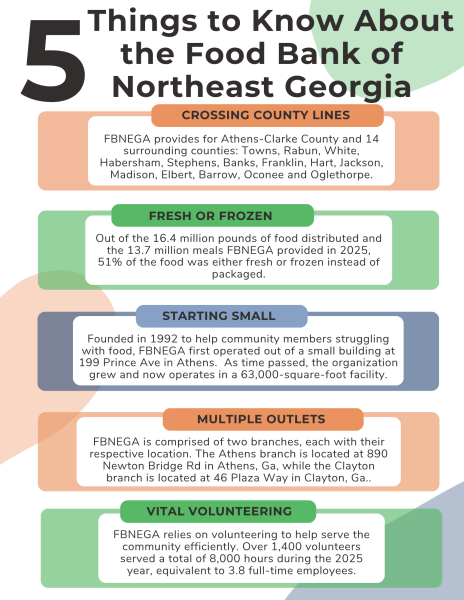
A graphic shows five things to know about the Food Bank of Northeast Georgia. Working with families and communities helped FBNEGA’s President and CEO Erin Barger understand the importance of FBNEGA in Northeast Georgia. “We think that food is important, and for many of our neighbors, we, the food bank and our partners, are their access point,” Barger said. “Their experience must be convenient, consistent, and compassionate, because food is essential, and what is essential cannot be negotiable.” Graphic by Charlie Crawford
CC: What does the process of distributing food to communities look like?
EB: We use our unique position as a food bank connected to the Farm Bill, the (Emergency Food Assistance Program) and state-level resources like the (Georgia Nutrition Assistance Program) to leverage food that is still good to eat. Retail partners (also) donate that to us, and we reallocate that along with federal commodities and purchased food. Food banks are organizations (that) equip members or partners across a geographic region to mobilize food. We have more than 230 members, half of (which) are faith-based and half (of which) are 501(c)(3) nonprofit organizations. (Members connect food to) neighbors in their own communities through a variety of models. It might be an organization that has a pantry open (on) Tuesday and Thursday from 4 to 7 p.m. (that allows) neighbors come (to) pick food or get boxes of food. On any given month, (we have) mobile pantries, which are typically drive-through distributions that serve anywhere between 200-300 families with a box truck of food, or 500-600 families with a tractor trailer of food. These are high volume food mobilization opportunities. (We also collaborate) with schools all over our region who address student and family food insecurity through standing pantries within the school. We partner with Clarke Central High School and (Burney-Harris-Lyons Middle School).
“When I go out in the field and see the families who need food (and who have) the weight of the world on their faces and on their shoulders, it’s heartbreaking. In order to do this work according to (the FBNEGA’s) values, which include belonging, compassion and dignity, we have to hold on to the humanity of the people we serve, and there is no way to do that and not find the work very difficult.”
CC: What are your specific responsibilities as CEO and president of the FBNEGA?
EB: My primary responsibility is to communicate, activate and protect the mission, vision and values of the food bank. The mission of the food bank is to connect neighbors with nourishing food and we believe that one day we will see our vision, which is every neighbor with enough food every day. The way we go about that is by establishing everything we do on the values of accountability, belonging, compassion, dignity, efficacy and stewardship. My job has a lot of responsibilities related to stewardship and accountability (as I work to) ensure we have enough philanthropic resources to fund the work. We have about a $6 million operating budget, so working with a remarkable team of people and ensuring that we have strong and healthy relationships with our members, who are literally the hands and feet of the organization, is key. Ultimately, as the CEO, I want to (ensure) that every neighbor who encounters a food bank distribution or a member food access opportunity has an experience that is convenient, consistent and compassionate.
CC: How has position as president and CEO helped you bond with your community and better learn about the struggles and injustices that people face?
EB: Feeling a connection to the neighbors that we serve has been an incredible blessing for me, (along with) getting to know our volunteers, some of (which) have been steadily serving this organization longer than I have been here. It’s an honor to be a part of it, but I think part of my job is realizing the magnitude of what (the FBNEGA) is, and how it is much bigger than me, and it is mostly about the neighbors we serve. Getting to see them and literally hand them their food and talk to them about their lives and their families is an incredible gift.
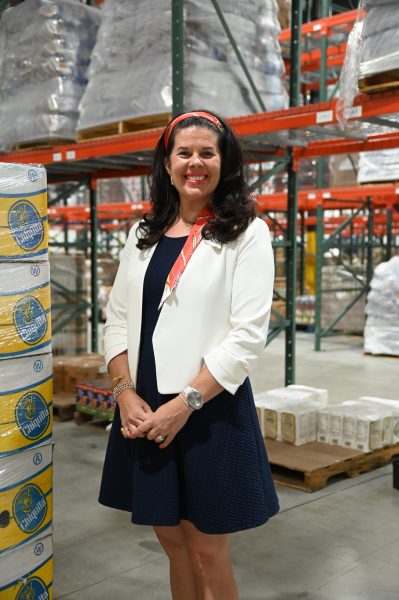
Food Bank of Northeast Georgia President and CEO Erin Barger stands in a storage area at the FBNEGA Athens location, located at 890 Newton Bridge Road, on Sept. 3. Barger worked to positively impact the community throughout her time working at FBNEGA. “I (hope) that our neighbors leave a food bank experience saying I feel honored and loved, and that our team (leaves saying) I feel valued, supported and I feel like I matter,” Barger said. Photo by Iliana Tejada
CC: What has been the most impactful encounter you’ve had while working as president and CEO?
EB: Something that stands out as a core memory for me is seeing the team of the food bank grow and flourish in their potential. I often just show up unannounced at distributions and interact with our neighbors, (which) out of all the things I do at the food bank (is) my favorite thing to do. My core memories are just talking to neighbors, hearing about their stories, and seeing how kind and grateful they are (even though) we don’t expect people to express gratitude in that environment. It’s very humbling. It’s difficult because for me, it’s a privilege to do what I’m doing. It can also be difficult because I don’t think there’s something inherently different about me that explains to me why I am the person offering the help. It’s very grounding to spend time with our neighbors, and it helps me know for sure that the experience I want them to have is the experience that they’re having.
CC: What can individual people do to contribute to a hunger-free world?
EB: I think the two key issues that have to be solved before that question can even be answered is one, for people to see (world hunger) as a problem that can be solved, and two, to see it as a problem that is their business to solve. Realizing that we will never be free until all people are free, we will never, as a world, be at a place where it is time to rest until the work is done, and as long as humans are hungry, there is work to be done. And that can be as simple as donating $5 or donating two hours. I have never seen someone engage as a volunteer at the food bank and it not change their lives. Supporting one of our members would also be an incredible way to start to understand the value in taking time to act on behalf of and alongside other people.
CC: What changes do you see being made to the food bank in the future?
EB: We’re really excited about (the) Food is Medicine (program), which is (also) a statement of reality, food is actually medicine for our bodies. More than half of our 16 million (plus) pounds of food (moved) this year will be fresh food. Connecting strategically and creatively with healthcare partners and even athletic departments, schools, to connect nutrition education to the communities in which we serve is an area of growth and innovation for us that I’m really excited about.