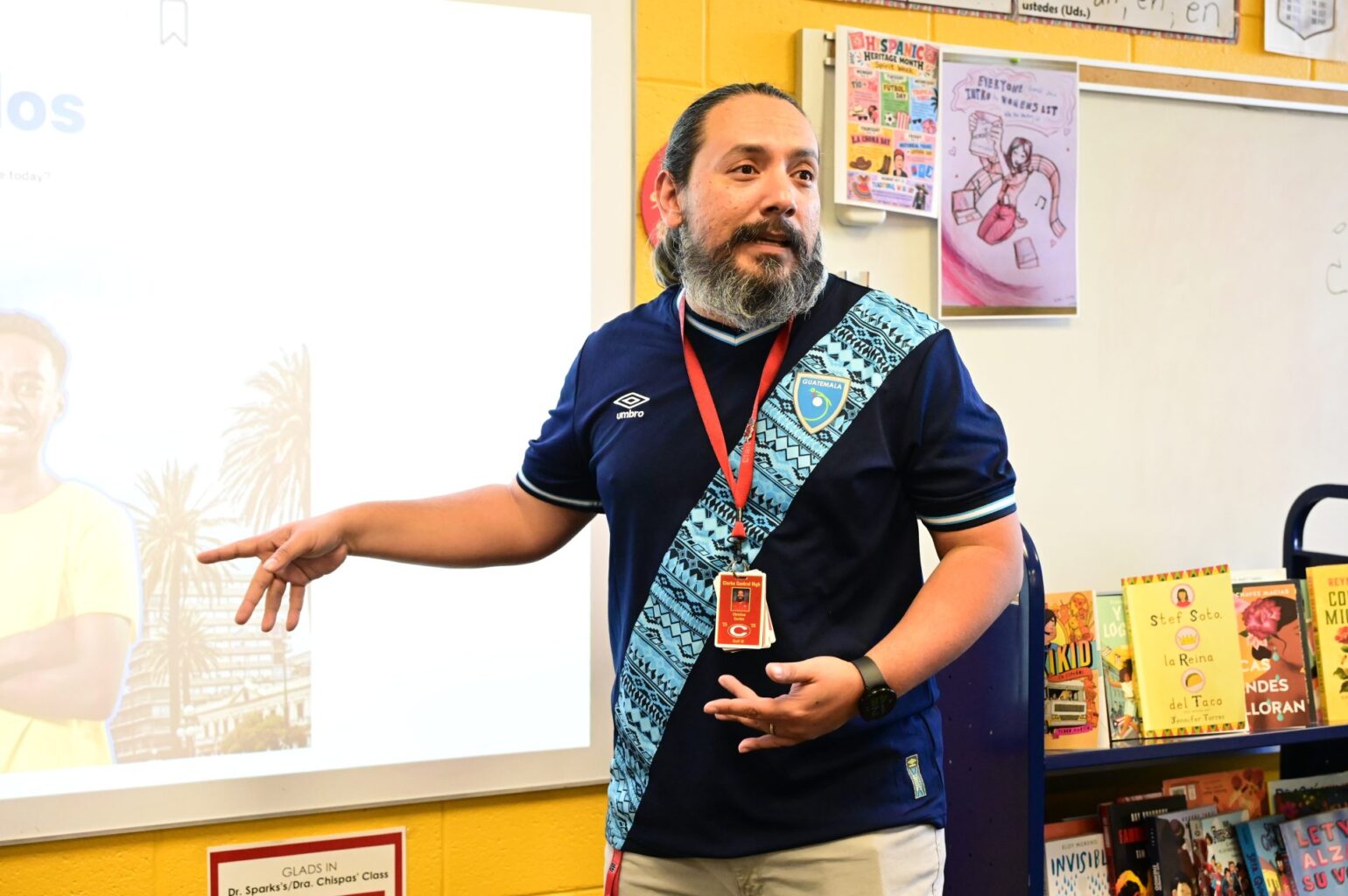
Clarke Central High School world languages department teacher Christian Cordón teaches in Room 390 on Oct. 12. Cordón has worked at CCHS since 2019 and has tried to find ways to make his lessons different over the years. “I heard somebody say you can teach the same class 25 times,” Cordón said. “I’d (rather) create new (lessons), depending on the students I have, depending on what they’re interested in, so that way, all interesting and fun for them and for me, too.” Photo by Maypop Wren
CCHS world languages department teacher Christian Cordón has carried his culture from Guatemala to the U.S. and works to empower students to do the same with their own culture.
It’s 8:15 a.m. at Clarke Central High School. Most teachers have their doors closed, preparing for the day ahead, but not world languages department teacher Christian Cordón. The door to Room 390 is wide open, and the sounds of nearly 20 students speaking Spanish can be heard from the hallway.
Their dialects might not be the same, their tenses might not match up, but this is a space where they feel comfortable, where they know that the teacher at the front of the room wants to connect with them and their culture. Little do they know, it’s also a way for him to connect with his own. Although Cordón was born in the United States, he grew up in Guatemala, in the Zacapa Department.
“There wasn’t a high school in my hometown, so I had to travel to a bigger city, called Zacapa. I had to take the bus (for) 45 minutes to get (to the Instituto Experimental José Rodríguez Cerna), then back (home),” Cordón said. “I was excited to meet people from other parts of (the) Zacapa (Department), because that’s what happens (in Guatemala): the high schools are in the main city of the state, (so) everybody has to travel there.”
A graphic shows different ways in which Clarke Central High School world languages department teacher Christian Cordón attempts to emphasize cultural identity to his students. Graphics by Merren Hines and Lea D’Angelo
After graduating high school, Cordón worked at a bank, saving up the money he needed to buy a plane ticket to come to the U.S. for college. When he was 20, those plans accelerated after his parents encouraged him to leave Guatemala due to safety concerns and move to Miami with his great-aunt and uncle in 2007.
“Miami was really easy to adapt to because there’s a lot of Cubans there, (and) people (who) speak Spanish. It was really fun to ride the bus and speak with people from different countries, and so I wasn’t forced to learn English right away,” Cordón said.
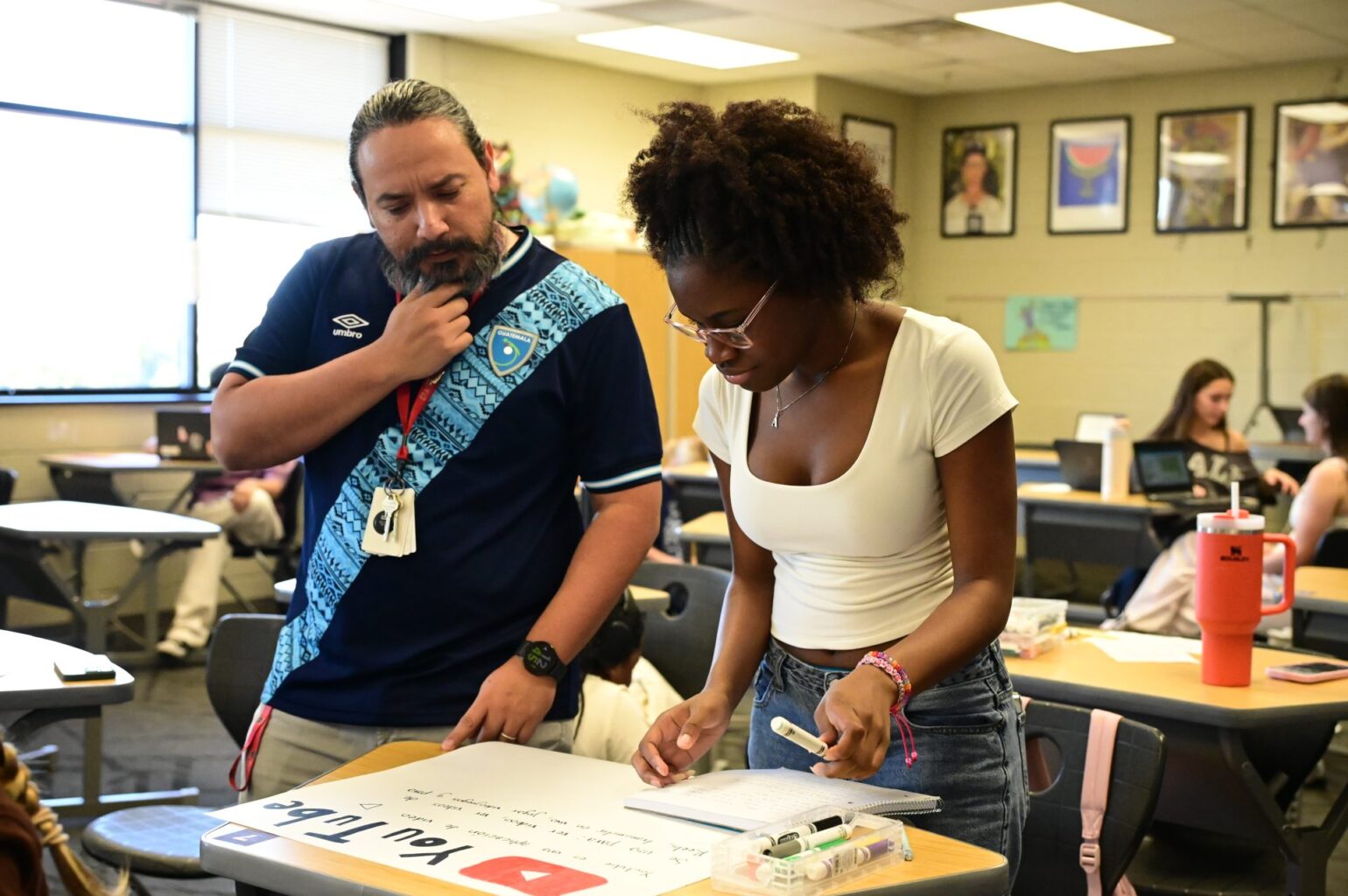
Clarke Central High School world languages department teacher Christian Cordón helps a student in Room 390 on Oct. 390 on Oct. 12. Photo by Maypop Wren
When Cordón was 21, he moved to Rome, Ga., to work at a carpet factory. When he was 28, he started attending Georgia Highlands College, going to school during the day and continuing to work night shifts at the factory.
“I went to work first. Most Latinos that come from another country, their mentalities are, ‘Work first, try to make money to send back to help the family.’ Even though I started like that, I didn’t give up on my dreams of being a professional, getting a college degree, to move forward in life, to do hard work,” Cordón said. “Fight for your dream to get a college degree and study and do what you want.”
“I try to do my best, and hopefully (students) learn something from me and see me as an approachable person that they can share knowledge with. I’m one semester in their lives, and I try to make the best out of it.”
— Christian Cordón,
CCHS world languages department teacher
Cordón transferred to the University of Georgia in 2018, where he graduated with his Bachelor of Secondary Education in Spanish/World Language Education. He then student-taught at Cedar Shoals High School before coming to CCHS at the start of the 2019-20 school year to begin his career as a teacher, primarily working with native Spanish-speakers.
“Culture is very valuable, so I give students the spotlight for them to show their culture. They are the experts, and I like to learn from the culture, too,” Cordón said. “I don’t take the responsibility to say, ‘Okay, what I’m saying, or my cultural experience, is the only culture that represents Latinos in general.’ Even (within) the same country, (there are) different experiences, so I let the students share their experiences.”
Cordón has carried this idea of cultural identity into CCHS’ Spanish Book Club, which he co-founded and co-sponsors with CCHS world languages department teacher Dr. Javier Soler. The club was awarded the three-year Glickman Challenge Grant from UGA, which they used to fund the creation of “Nexus,” a multilingual magazine featuring work from CCHS students.
“(Cordón) has these entrepreneurial skills; he wanted to found this club. It was his idea. He was thinking about doing this magazine,” Soler said. “He’s working with his club (and) it’s (emphasizing how) important it is to bring the culture and to support the culture of many native speakers and those who want to learn Spanish.”
Spreads from the Clarke Central High School Spanish Book Club’s Multilingual Magazine “Nexus” are shown. Spreads courtesy of the CCHS Spanish Book Club
SBC President Alejandra Cariel, a senior, first met Cordón in her freshman year and has both seen him as a teacher at the front of a classroom and as the co-adviser of the SBC, both spaces where connection is a defining feature.
“Aside from bonding with everyone, he also manages to understand a bit of each student’s story and where they come from,” Cariel said. “(That’s) helping the students because, as more students from different countries arrive, they get to know one another, learn a bit about each person’s story, and begin to connect with those stories.”
Above all, Cordón wants to have an impact on the students he’s working with, whether it be through SBC, Chess Club, or 90 minutes of class time.
“I try to do my best, and hopefully (students) learn something from me and see me as an approachable person that they can share knowledge with. I’m one semester in their lives, and I try to make the best out of it,” Cordón said. “(I want to create lessons) depending on the students I have, depending on what they’re interested in, interesting and fun for them and for me.”
More from Lea D’Angelo
More from Emlyn McKinney
More from Cesia Martinez
More from Merren Hines