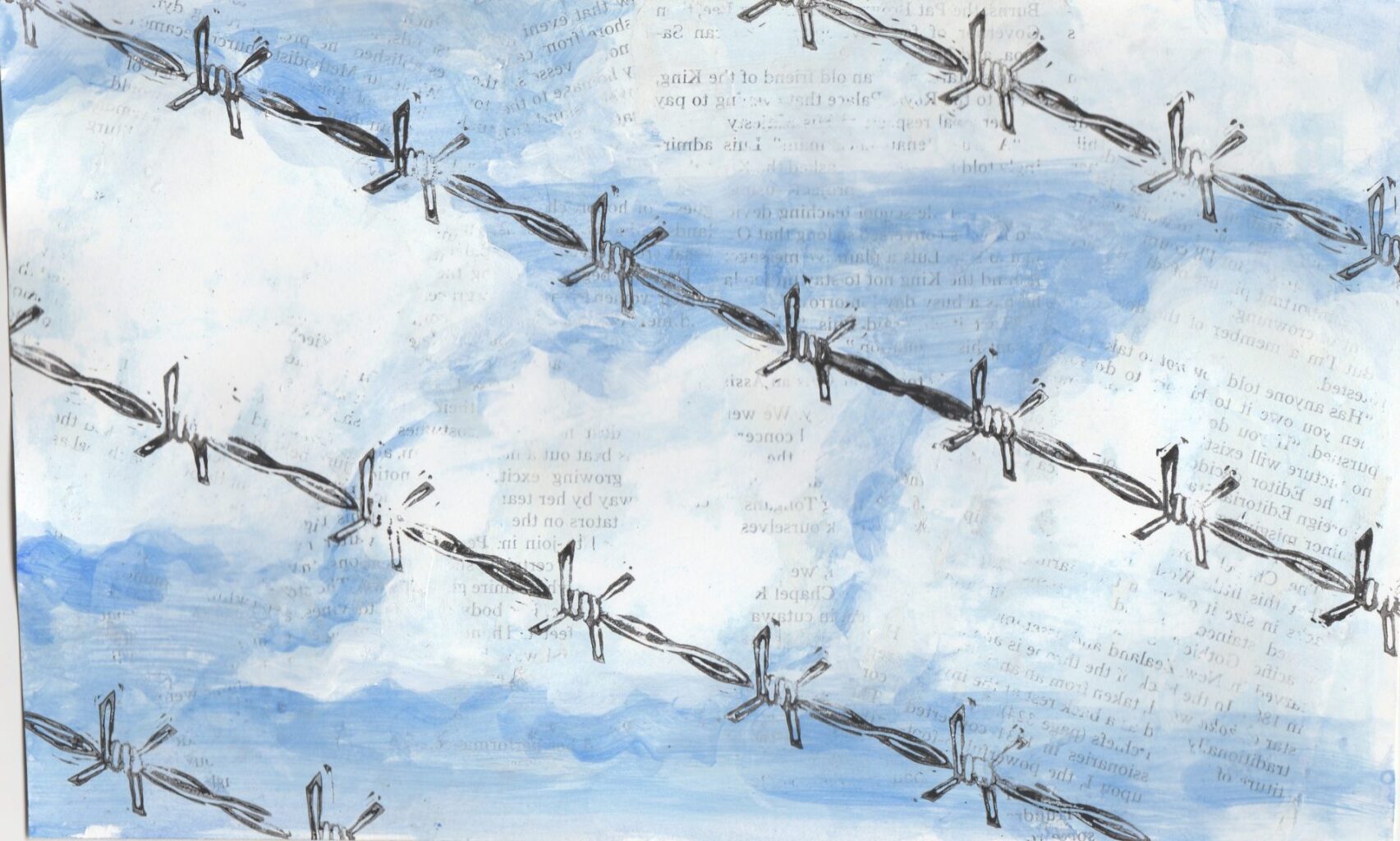
An illustration shows a barbed wire fence in a concentration camp during the Holocaust. In recent years, the political climate of the United States has started to bear faint similarities to the Nazi Party’s rule in Germany, a sign history hasn’t been fully internalized. “(U.S. Immigration and Customs Enforcement) does not equal Gestapo, the authoritarian police force in Germany during the Holocaust, and NPR losing funding does not equal Nazi-level propaganda, but the similarities point to a question of how far these actions can go before it becomes clear history hasn’t been internalized?” Editor-in-Chief Lea D’Angelo wrote. Illustration by Tess van Wagtendonk
Editor-in-Chief Lea D’Angelo discusses the current political climate in the U.S. and how events like the Holocaust must be learned from rather than replicated.
People talk about history, the good, the bad and the ugly, so they can learn from it and so they don’t repeat it. For decades, the horrors of the Holocaust and the Nazi Party’s rule in Germany during the 1930s and ‘40s have been retold, both for remembrance of people whose lives were wronged and deserve to be honored, and as a lesson. Every plaque, memorial and testimonial carries a reminder of what must not be repeated.
However, the lessons learned from the Holocaust and other genocides don’t quite seem to have sunk in.
The warnings of the millions of “un-German” people, or those considered “undesirable” who were forced to leave Germany, the propaganda disparaging Jewish people and the torture the millions thrown in concentration camps, such as Auschwitz and Dachau went through.
All of that, and it still doesn’t quite seem like society has learned.
To say the political climate of the United States in recent years is equivalent to a mass genocide would be a dismissal of the horrors those impacted faced that many people can’t even begin to fathom. However, to claim resemblance between two points in time wouldn’t be too far off.
Mass deportations and government control on media outlets were both prominent issues of the Holocaust. Both warning signs, and in recent years, the U.S. has seen a rise in them.
Since U.S. President Donald Trump took office in January 2025, U.S. Immigration and Customs Enforcement has deported over 600,000 people.
In May 2025, Trump issued an executive order that cut funding to public news outlets NPR and PBS, claiming their coverage was not a “fair, accurate or unbiased portrayal of current events to taxpaying citizens.”
Our government hasn’t learned from what seems like a glaringly obvious lesson.
<p
ICE does not equal Gestapo, the authoritarian police force in Germany during the Holocaust, and NPR losing funding does not equal Nazi-level propaganda, but the similarities point to a question of how far these actions can go before it becomes clear history hasn’t been internalized?
There are these faint similarities that suggest our government hasn’t learned from what seems like a glaringly obvious lesson. And then there are the stark resemblances that make it seem as though people are intentionally trying to apply the same hallmarks that defined the Holocaust.
During a rally celebrating Trump’s inauguration on Jan. 20, 2025, then-head of Department of Government Efficiency Elon Musk made a gesture that was widely interpreted as a Nazi salute.
While the similarity could easily be written off as an act done in ignorance, the question remains the same: Has society not learned enough from a mass genocide to know not to make distinct references to the anti-semitic mottos and signs that defined it?
“We need to have a sharper eye and a sharper ear for (extremist) language, (and it) really boils down to the use of the language, and then those become actions,” Clarke Central High School English department teacher Meghan McNeeley, who teaches Holocaust and Genocide Studies, said. “There is a certain amount of hope, because (CCHS has) a class where I can help young minds understand the parallels and become more more critical consumers,”
So, as people living through what will one day become history, students need to look at their country’s current political climate, not to draw comparisons but to draw conclusions about what’s happening in the world. Students need to truly take in what they’re being taught, not simply as facts to memorize, but lessons to apply and truly learn from.
Rather than repeating what has already proven to not work, Americans need to form their own history.