Clarke Central High School JROTC students hold a 9/11 ceremony in front of the CCHS Ceremonial Entrance on Sept. 11, 2019. Sept. 11, 2026 marked the 25-year anniversary of the terrorist attack in the United States by al-Qaeda in 2001, killing 2,977 individuals and causing effects that would extend into the days, weeks and months after. “I (have) never seen the country come together like it did during those times. Everyone, no matter what your race, creed, nationality, or religion, came together as a country, and you had people stepping up to serve in the military to fight the terrorists that caused 9/11. So that, reassured that ‘Hey, we still got people that’s willing to be there for one another, because right now, the times seem divisive,” Clarke Central High School JROTC Instructor First Sergeant Atione Clark said. Photo from the ODYSSEY archives
Sept. 11, 2026 marks the 25th anniversary of the 9/11 terrorist attack in the United States and is an opportunity to honor the heroes and the reverberations that can still be felt decades later.
Today marks the anniversary of Sept. 11, 2001, the day the terrorist group al-Qaeda committed a series of planned attacks in the United States, hijacking four planes, two of which hit the Twin Towers in New York City, another hitting the Pentagon in Washington D.C., and a fourth that crashed in a field in Pennsylvania, likely to be en route to the White House.
Every year since, we, as a country, have stopped, reflected and honored the people lost and the horrors caused by the aftermath of the event. But this year’s anniversary is even more significant, as it marks 25 years since the attack.
A quarter of a century later, the memory of the attack that killed 2,977 individuals, both for those who lived through it and those who have grown up within its reverberations, still rings strong, including for Clarke Central High School JROTC Instructor First Sergeant Clark, who was on deployment in New York City on Sept. 11, 2001.
“Living in New York City, there’s no way in the world a plane could crash into the Twin Towers unless it was intentional. Then, once the second plane hit, the communications started to deteriorate throughout the city, where you couldn’t receive or make calls, and it made me very alert about the safety of my loved ones,” Clark said. “My wife (and) my sister-in-law, (who) worked in Manhattan. So, I was worried about her safety and the safety of friends that either lived in Manhattan or worked downtown in Manhattan.”
The impact can also be seen in those who were going about their everyday lives, including CCHS Associate Principal Dr. Summer Smith, who was a Master’s student at the University of Georgia at the time of the attack.
“(I was) on the way to class, heard on the radio (that) a plane hit the (North) Tower, and I thought, ‘That’s weird. That shouldn’t happen,’” Smith said. “(I) went to class, had the whole class, got out of class. Everybody in (Aderhold Hall) was watching TV, and that’s when we found out that a second plane had hit, (that the Twin Towers were) falling.”
“I was in college. We had a game that week. I do vividly remember walking from our rec center, or I just got through working out, or maybe I had a class. I can’t remember, but we were in flux trying to figure out if we were going to play a game or not play a game. We got on the bus (and) we was headed to North Carolina to play a game, and then they called it off. Nobody kind of knew what the next step was.”
– Terry Liggin,
CCHS assistant principal, who was a student at Eastern Kentucky University
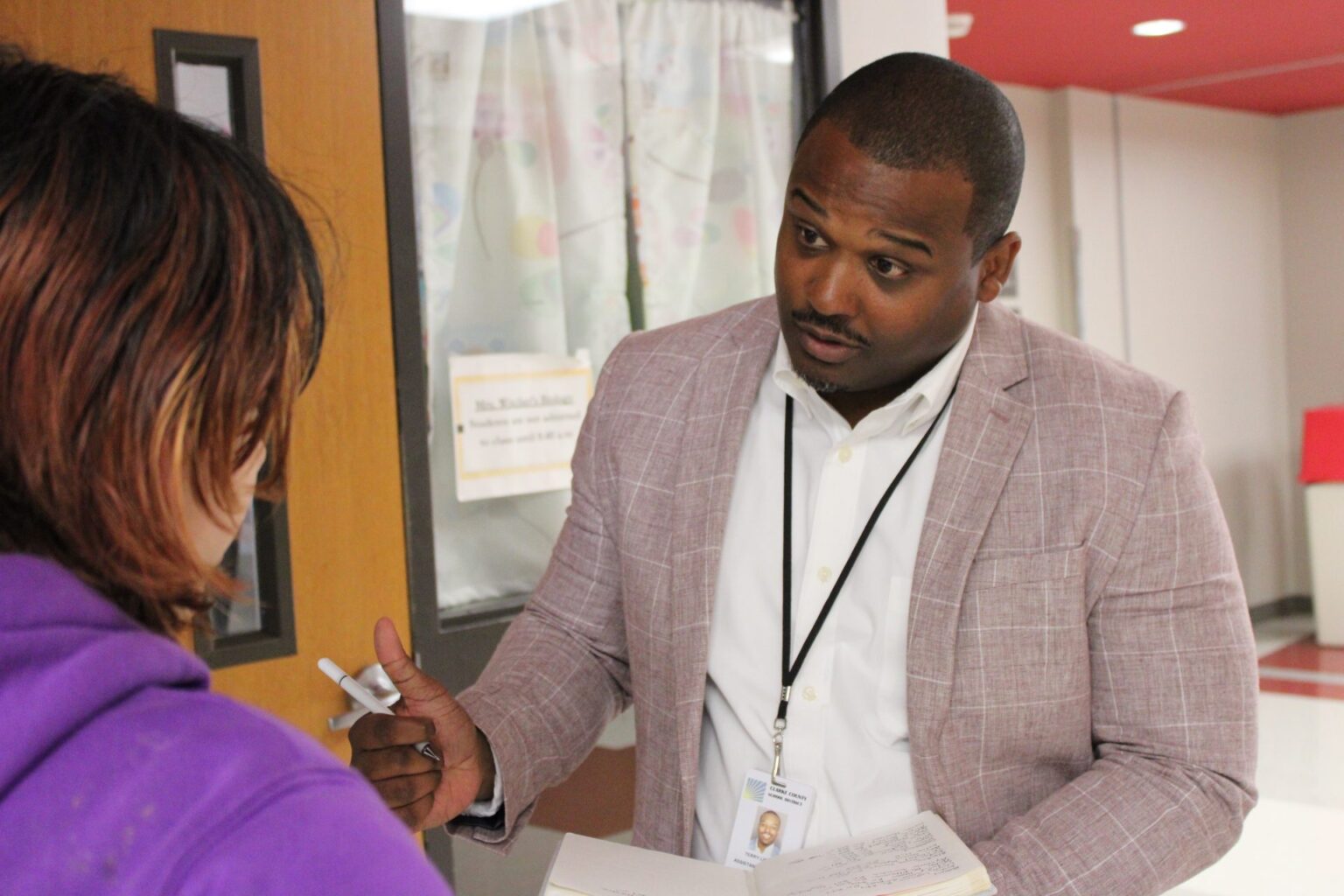
“I was in college. We had a game that week. I do vividly remember walking from our rec center, or I just got through working out, or maybe I had a class. I can’t remember, but we were in flux trying to figure out if we were going to play a game or not play a game. We got on the bus (and) we was headed to North Carolina to play a game, and then they called it off. Nobody kind of knew what the next step was.”
— Terry Liggin,
CCHS assistant principal, who was a student at Eastern Kentucky University
CCHS Assistant Principal Alexis Scott is part of a younger, different generation. One alive during the attacks and who became young adults under the immediate effects, but who was sheltered in the moment.
“I was an elementary school student, and so they did not televise that. I did not watch the live footage, but I do remember that day vividly. Everything was weird,” Scott said. “I remember all of us being like, ‘What is wrong with our teachers? Why are y’all (upset)?’ And people were getting checked out. My parents were both educators, and so they couldn’t really leave (work). My friend’s mom picked us up, and our families had dinner together, and they sat us all down and told us what had happened.”
While the memories of Sept. 11 still echo in the heads and hearts of many today, for some it’s the events in the weeks, months and years following that carry the most weight. That day led to what is now known as the “War on Terror,” which refers both to the subsequent wars in Afghanistan and Iraq and the various measures taken to deny aid to foreign terrorists.
“That morning radically challenged America through major changes in national security, foreign policy, air travel, U.S. government structure, military action and daily life,” former CCHS JROTC Instructor Lieutenant Colonel David McMickle said. “High deployment rates exposed troops to severe trauma, leading to lasting physical injuries and mental health struggles, like (post-traumatic stress disorder). I count myself in these numbers. Over the years, I have lost friends to post 9/11 military operations, as well as mental health trauma. Everything that we do as a nation is looked at through the 9/11 lens.”
“I was angry because it’s like, ‘Who would do this to us?’ There was times that I was sad because I just knew the loss of human life, being that people worked in those buildings, and then I was very empathetic for the first responders, because that was their job.”
– First Sergeant Atione Clark,
CCHS JROTC Instructor, who was on deployment in New York City

“I was angry because it’s like, ‘Who would do this to us?’ There was times that I was sad because I just knew the loss of human life, being that people worked in those buildings, and then I was very empathetic for the first responders, because that was their job.”
— First Sergeant Atione Clark,
CCHS JROTC Instructor, who was on deployment in New York City
For CCHS assistant principal Terry Liggin, the polarity of the attack, a reminder of what can happen in the U.S. both in terms of horrific events, but also how people are capable of coming together in the face of tragedy, is the lens through which he looks at the current political climate in the U.S..
“We came together as a country and (that) became one of the few times that that has happened,” Liggin said. “But why does a traumatic event have to bring people together or have to make people act in a sense of urgency to be kind and nice to one another? We need to do better as people, and I think it’s just a reminder of when you don’t do good to all people, what things could happen, how the world could be. (9/11) should be a reminder that we need to get our act together as people (and) as a country.”
“What I remember vividly is I was supporting a mom who was transitioning during that time, and so when I went home that evening, I was in a recliner by her bed, and she was heavily medicated. She was always pretty much sleeping predominantly throughout the day, and she woke up, and we had a conversation about 9/11, so that would always stand out in my mind.”
– Dr. Swade Huff,
CCHS principal, who was working at Rutland Academy

“What I remember vividly is I was supporting a mom who was transitioning during that time, and so when I went home that evening, I was in a recliner by her bed, and she was heavily medicated. She was always pretty much sleeping predominantly throughout the day, and she woke up, and we had a conversation about 9/11, so that would always stand out in my mind.”
— Dr. Swade Huff,
CCHS principal, who was working at Rutland Academy
Current CCHS students are part of the generation that has only heard about 9/11, whether it be through history classes, the stories of the adults who saw it happen through a television screen or simply the resonance of such an event in our country’s history. Regardless, the message is as strong now as it was then: this is an event that must be remembered.
“Although it was 25 years ago, it still seems like it was yesterday to me because that’s the day I never forget, (but) some people look at it as in history books,” Clark said. “So we need to commemorate 9/11 every year, just like (we do) Pearl Harbor. Because if we don’t commemorate 9/11, then it can happen again, and we need to pay homage to the people who lost their lives.”