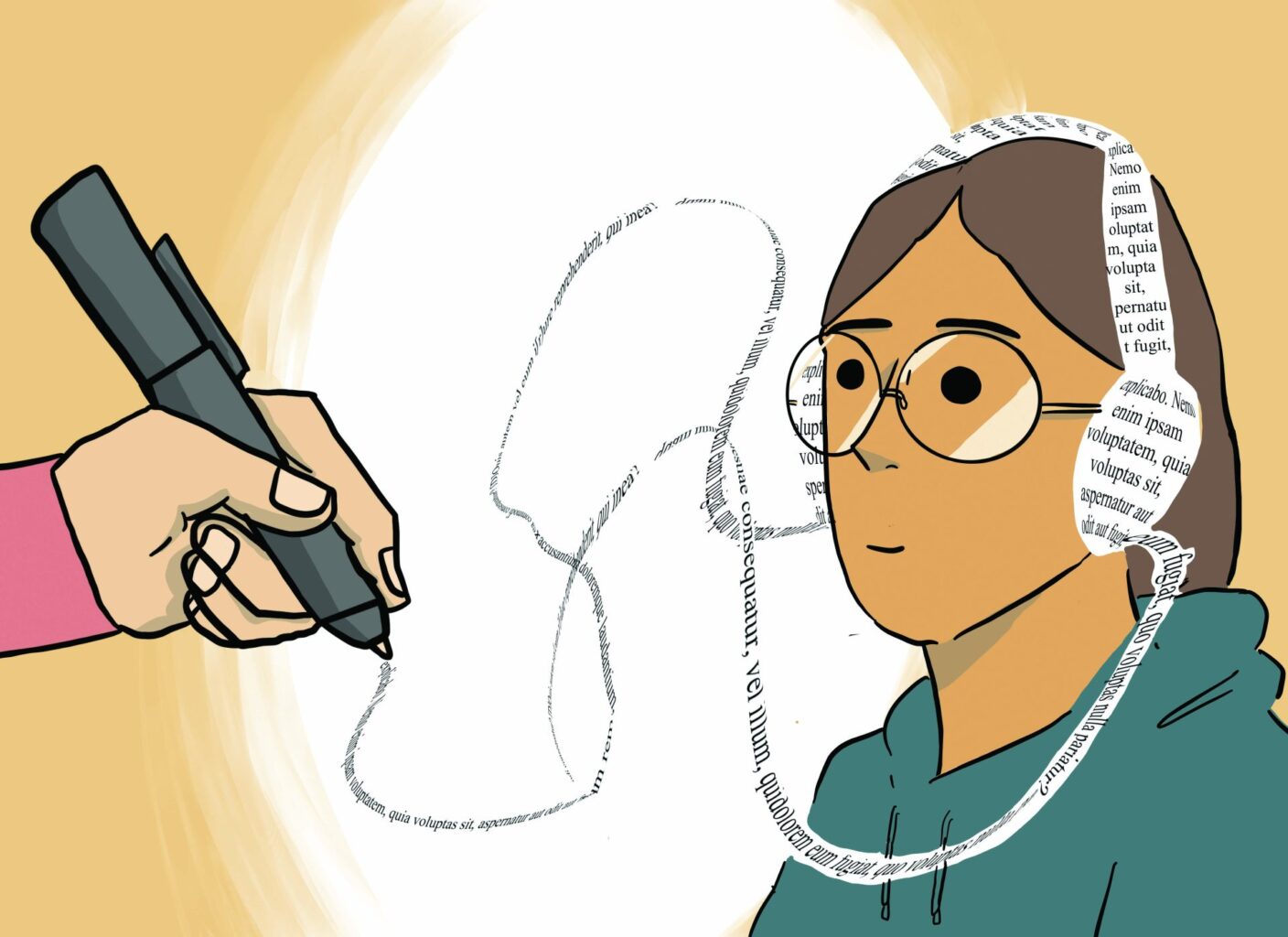
Editor-in-Chief Wyatt Meyer’s words worm their way into the head of an attentive listener. In four years as a student journalist, Meyer has observed increased connection with readers throughout journalism. “Audience engagement isn’t inherently good or bad in the same way that enhanced connection isn’t – it creates new opportunities beyond our ancestors’ wildest dreams,” Meyer wrote. Illustration by Sam Harwell
Editor-in-Chief Wyatt Meyer reflects upon the importance of human connection in stories as he leaves the world of scholastic journalism.
Across newspaper headlines and Instagram captions, an understated, almost secret journalistic revolution has been brewing for the last 15 years. It’s neither a revolution waged with swords and spears – nor even pens and printers – but with a far more concrete entity.
No, this revolution is fought with you, the reader.
Traditionally, the relationship between me, the journalist, and you, the audience, was strictly confined to third person objectivity in news writing, while opinion pieces retained a measure of detachment. Ball State University’s journalism blog testifies to this classical perspective: “In order to remain objective, journalists must keep themselves out of stories.”
As journalists in a delicately intertwined world, connection is not something to shy away from.
The advent of social media turned this notion on its head. On a platform designed to manufacture relationships, journalists saw an opportunity to create more impactful stories not by distancing the reader, but by inviting them to participate in the story. Thus was born audience engagement, a principle, which refers to the “cognitive, emotional, or affective experiences that users have with media content,” as defined by University of Groningen professor Marcel Broersma.
Nowadays, stories and headlines not only mention the reader, they’re often addressed to them in hopes readers engage. “Tips for Protecting Your Home From Extreme Weather” (New York Times) and “RFK Jr. is targeting ultraprocessed foods. What are they, and are they bad for you?” (Associated Press) are just two examples.
Plenty of journalists and media experts – that say this personal connection with the audience is purely detrimental. After all, U.S. trust in media plummeted during the 2010s and 2020s, reaching an all time low of 31% in 2023, according to a Gallup poll. The decline of trust is correlated with the rise of social media audience engagement journalism.
In spite of the evidence, I disagree with this notion. Audience engagement in journalism can be dangerous, but it can be even more powerful.
As humans and society have evolved, we have looked for connection – communication has gone from letters to telegrams to emails to texting, each bringing people ever closer to each other. The same is now true of the media.
When I think about the present state of journalism, I think about connection. As humans and society have evolved, we have looked for connection – communication has gone from letters to telegrams to emails to texting, each bringing people ever closer to each other. The same is now true of the media.
This idea is backed up by research: a team of professors from several European universities conducted a test with South American news outlet BioBio Chile that contradicted the assumption that audience engagement journalism threatens trust in the media. Instead, they found that connection made BioBio Chile’s stories more relatable.
Audience engagement isn’t inherently good or bad in the same way that enhanced connection isn’t – it creates new opportunities beyond our ancestors’ wildest dreams.
It is up to journalists to ensure those dreams don’t turn to nightmares.
As journalists in a delicately intertwined world, connection is not something to shy away from. It is a tool that journalists can – and must – wield to tell stories that evoke an emotion, inspire change or impact others somehow.
The good news for readers is that your job remains the same: bear witness.