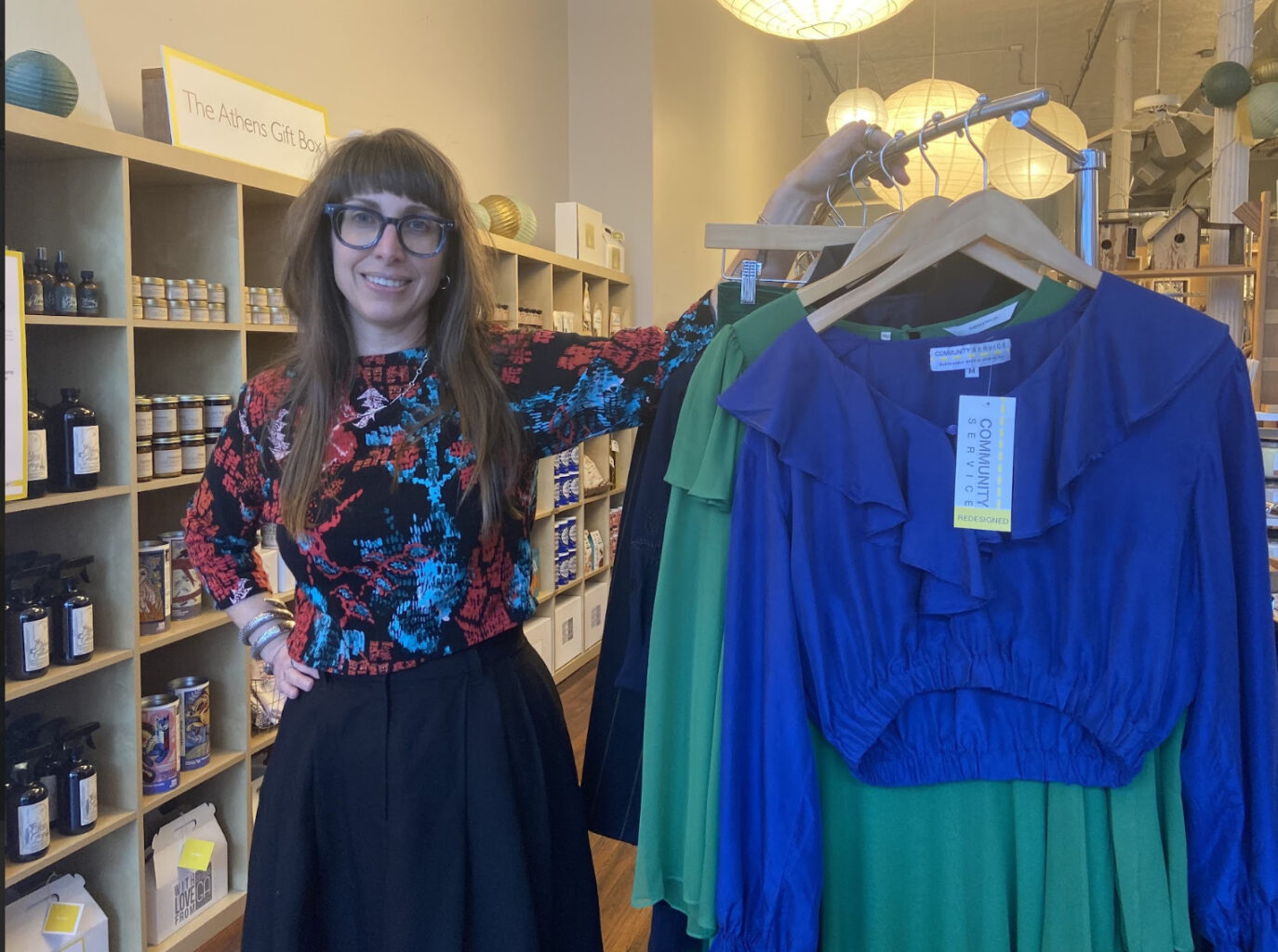
Bobb Community Connector and Sales Associate Bobbi Jo Clarke stands next to a rack of clothes in the sustainable clothing store Community located on 260 N Jackson St. on Nov. 16. Community opened in 2010 as a local Athens business with the mission to sell and repair sustainable clothing. “We’re taking garments that would not be wearable (because they’re) damaged or not marketable anymore, (and fixing them.) We work with primarily recycled and natural materials to create new garments in timeless designs, (and) we’re about trying to keep garments in circulation as long as possible, that will be versatile, can be worn over a long period of time and are impervious to trend cycles.” Clarke said. Photo by Lucca Fleenor
Community Connector and Sales Associate Bobbi Jo Clarke discusses the impact sustainable clothing store Community has made on Athens through creating sustainable fashion and upcycling clothing in Athens.
News Staffer Lucca Fleenor: How was Community first established?
Community Connector and Sales Associate Bobbi Jo Clarke: (Community owner) Sanni Baumgärtner was a German exchange student at the University of Georgia when she was in college, and after she graduated, she opened a vintage booth. She was at the forefront of recognizing that fast fashion was growing at a rapid rate and that textiles were winding up in the landfill, so she started taking some of her vintage clothing that was damaged, not trendy or saleable and upcycling it herself. The label, (Community Service), existed first, and Sanni likes to say that Community grew into its name. It originally started as a vintage shop with upcycled clothing, then began to include local vendors, things made throughout Athens and ultimately the state of Georgia. As Community grew, she started focusing on not only upcycling clothes, but teaching classes so people could learn how to make (and) repair their own clothing, as well as extending the life of (it) in different ways.
LF: Can you tell me what different roles at Community look like?
BJC: I wear two different hats. I work as a sales associate, so my job is to provide superior customer service wherever I can, and (however) that looks like. We (have) decentralized all the managerial duties, so everybody here carries an additional responsibility in addition to being a sales associate. We’re all responsible for the social media in the shop, communications, the general order, cleanliness and restocking of the shop. So, in a lot of other stores where things that you would have a manager do, those duties have either been shared or divided amongst the staff (here), which really makes for an equitable team. The additional hat that I wear is the Community Connector role. My position was created because we found that we were saying “No” to a lot of people. (University of Georgia) students would come and want to interview us, and (Sanni Baumgärtner) just didn’t have time to do it all. So, my position was created so that we could say, “Yes” to more people.
LF: Where does Community typically get the textiles and the recycled clothing that is used in the store?
BJC: We are avid thrifters, and we primarily thrift in secondhand stores. A lot of our vintage comes from a vintage wholesale market in Atlanta, but the textiles we’re using to make our clothing come from all over the place. Sometimes, we’ll take textile donations. Sometimes, we will find amazing things at (the) thrift, like (the) beautiful clothes we made out of vintage bedsheets. Everybody was like, “These are so nostalgic. I love them.” I had a woman walk in and go, “I had these sheets,” and she left with the tank top cut out of the sheet pattern she had as a kid.
LF: Are there any pre-existing brands that have shaped Community’s aesthetic of loose, colorful, and unique clothing from its start to now?
BJC: The aesthetic was largely inspired by (Baumgärtner’s) upbringing in Germany, and a lot that we have and make has not been modeled off a particular designer. We try to make our clothes primarily out of textiles that already exist. A traditional fashion model is you design a collection, and then you go and purchase fabric to make that collection. We kind of work in reverse. We find all kinds of vintage textiles (and) cut those into clothing. We (made) a patchwork collection called the Macaron Collection because it came in three different colors, and that was specifically designed to accommodate the sizes of fabric that we had. The aesthetic of (the clothing label) Community Service is largely dictated by what we have access to, and inspired by particular garments or forms we find interesting.
LF: What are some things Community offers that are sustainable options for fashion and why are those services so important?
BJC: One of the things that we do is drop-off repairs. As part of our sustainability mission, we’re here to keep the clothes that you have in circulation as long as possible. So, it’s not just about generating new clothes from old clothes, but keeping the ones you already have in good shape and wearable. The longer you wear a garment, the longer it stays in your closet, so if we can keep your jeans, your shirts (and) clothes in circulation longer, they’re not winding up in the landfill. A lot of times, if you take something that’s damaged to the thrift store, it’s going right in the dumpster, even if (it’s) in repair. People think if they take their clothes to Habitat ReStore (or) Goodwill, somebody is going to buy literally all of them, and they’re going to go back into circulation. That’s not the case. The last statistic I saw was that (around) 70% of those clothes end up as rags or in the landfill, so from an environmental (and) human rights standpoint, the longer that we keep your clothes in your closet and in good form, the better it is for everybody.
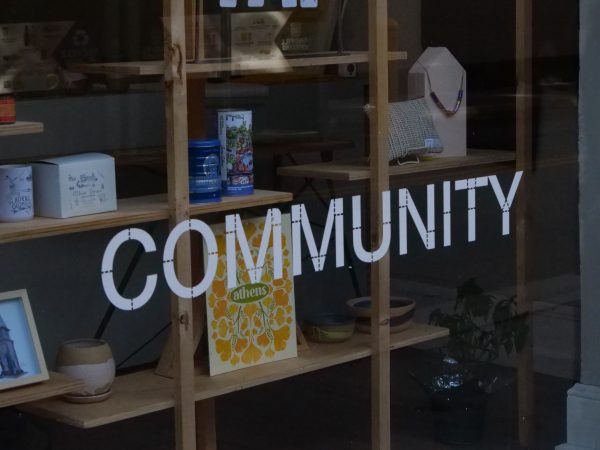
The storefront sign for local Athens sustainable clothing store Community, located on 260 N Jackson St. on Oct. 20, 2025, is shown. After shopping as a customer at the store, Community Connector and Sales Associate Bobbi Jo Clarke began working at Community in 2023. “I have been a shopper here (at Community) for as long as the shop has been open, (which was in 2010), and the shine has never worn off for me. I love this shop as a customer (and) as an employee as well. It’s fantastic. You meet interesting people, and I feel like we’re doing very good work in the line of sustainability.” Clarke said. Photo by Lucca Fleenor
LF: How does Community and yourself view micro-trends and fast fashion in teenagers?
BJC: As a teenager, you’re still developing a sense of self, and the clothes you put on your body develop that. I very much believe in clothing as a second skin. The clothes that you’re wearing on the outside are very much telling the world about you on the inside. You’re an adolescent until you’re (25)-years-old, so how do you balance buying quality clothes that are going to be durable over a long period of time when your personality, likes, tastes and your body is changing? As far as micro (trends), I think that in the most perfect of worlds, everybody would have a good, solid base wardrobe, which you could punch up with micro trends every once in a while just to keep things fresh. Don’t be hard on yourself (when) falling victim to a micro trend (because) you’re still figuring out who you are and what you like, and it’s hard to build a wardrobe that says, ‘This is who I am,’ that’s going to last for years, when who I am hasn’t completely developed yet.
LF: What would you say Community’s perspective is on how clothing shapes a person?
BJC: We’re very inclusive with our clothing. That’s one of the reasons, in addition to the sustainability element, that we have our alterations department. Even if you did not buy your clothing here, we want you to feel good in your clothes, so that fuels how we sell clothing at Community. We are not about a pressure sale. I will never try to talk somebody into a garment because if you don’t feel good in it the minute you walk out of the door of the dressing room, you’re not going to feel good in it when you take it home. We very much believe in clothing as a means of personal expression, and we pride ourselves (on the fact that we) offer private styling appointments for people to come in and really explore the range of what we have, to help them fill holes in their wardrobe or accommodate changing bodies. Speaking as a middle-aged woman, my body has changed many times throughout my life, from the time I was your age, to having a baby (with) weight loss (and) weight gain. We want to meet people where they are and help them find a wardrobe that really expresses who they are.
LF: How do you feel Community impacts the community of Athens as a whole?
BJC: People come here because it’s a cute shop (or) because we sell goods primarily from Athens and all over Georgia, but what is really lovely is we (have) expanded people’s understanding of sustainability (and) why sustainable fashion is important. We live in a world where people feel very out of control–you’ll hear about global warming, climate change and big problems that seem like, “What can one person do?” The amazing thing about working here is we show people you can make an impact (through) the choices you make on a daily basis. Particular choices (about) what kind of clothes to buy, how long you wear them and what you do with them when their lifespan is over really does make a difference in global problems, and textile waste is a huge problem. A lot of people don’t realize a lot of textiles get incinerated, particularly clothes that can’t be recycled or don’t decompose. Polyester, especially, is probably going to be incinerated at the end of its life, and if (the clothing is) made of plastic, it’s not going to break down for (thousands) of years. So, the impact we’ve made in the community is empowering people to make choices they can feel good about.
“ We want people to see what goes into making and repairing garments, so that people have a true understanding of that process. If you want to come and watch alterations, watch us make clothes, we welcome that.”
— Bobbi Jo Clarke,
Community Connector and Sales Associate
LF: What are ways people in Athens can make more sustainable fashion choices?
BJC: (In) fast fashion, I think there are quality pieces to be had, (and) it all comes down to how durable those pieces are going to be. If you go into a store and you’re pulling a pretty sturdy garment, and you think, ‘I’m gonna get four or five years of wear out of this,’ that’s what really matters. I always tell people, make the best choices you can with what you’ve got. If you can buy it secondhand, great, but not everybody has time to go out to a thrift store and go digging for something that’s necessarily gonna fit with their wardrobe. That’s why here, we do the curating for you, so you know everything here is a quality garment and you don’t have to go hunting. I’m not opposed to shopping at H&M, Gap (or) Old Navy. It all comes down to your intention, like how you are going to treat that garment? Are you going to mend it when it gets damaged? What are you going to do with it at the end of its life? It really just comes down to being mindful about what you’re buying and why you’re buying it.
LF: What is one thing you think separates Community from other shops in Athens and makes it unique?
BJC: The sewing area here is open for a reason. We treat it like an open kitchen. We want people to see what goes into making and repairing garments, so that people have a true understanding of that process. If you want to come and watch alterations, watch us make clothes, we welcome that. (Clothes) in Gap (and) H&M are made in sweatshops in places like China, Indonesia, Bangladesh, and the people who are making those clothes are working under terrible conditions. They’re almost exclusively women, and another thing a lot of people don’t know is all garments are made by a person, so if you’re buying a T-shirt for $3, you start to think, “Who is not getting paid to make this $3 shirt?’ That’s one of the reasons why we strive for radical transparency here, as far as what we’re doing, why our clothes cost as much as they do, how a garment is made and the amount of work that goes into it.
Photos of local Athens sustainable clothing store Community, located on 260 N Jackson St., are shown on Oct. 20, 2025. Photos by Lucca Fleenor
LF: Over the years, what have been some challenges for Community?
BJC: (The COVID-19 pandemic) was a major challenge for Community. We are a small business, (and) we really depend on this town to show up, to keep us afloat. When Community had to close, that was a hard pivot. Nobody really understood how (COVID-19) was transmitted (at first), we all just knew it was a very bad thing that could kill you, so when everybody went into lockdown, we (questioned everything). Is this virus coming in our groceries? Contaminating surfaces? There were just so many unknowns. So, Community’s major pivot during (COVID-19) was making face masks for the hospital, and (shifting) the store to primarily an online presence. We still have a robust online store that anyone worldwide can shop at, largely because of (COVID-19).
LF: What is Community looking to expand or continue improving on in the future?
BJC: What we’re about to implement is a customizing program. Our two most popular garments are the circle skirt and the circle pants, and what we’d like to do is make it so people can customize those. You can put in an online order where you choose (from) fabric we have available, (and) by letting people customize their wardrobes further and making a garment that is truly one of a kind, we think that that’s gonna last even longer than one you just find off the shelf. We are growing our sewing classes, (and) we recently hired three new sewing instructors. We want to make sewing, making and mending your own clothes more accessible. There is a store renovation planned for January that we’re excited about, and one of (our) goals is to build a seating area, because this (store) functions as a third space for a lot of people. Our customers become like friends to us, and we want to encourage people to stay, visit, talk and collaborate with each other.