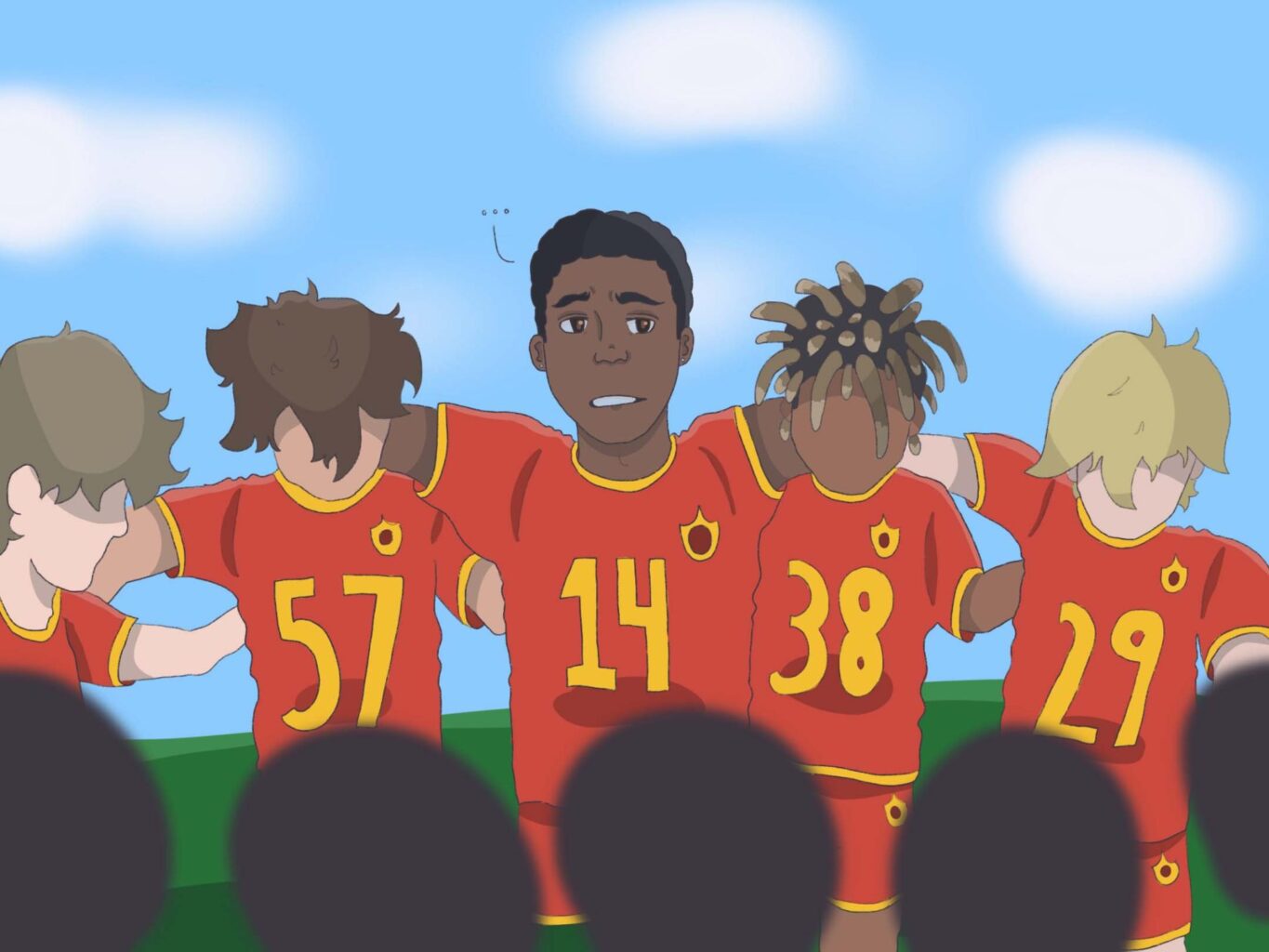
An illustration shows a Clarke Central High School sports team praying before a game. Sports Editor Liya Taylor discussed how team-led prayer alienates some athletes and instead, players and coaches who wish to pray should do so individually.“Athletics should bring out the best in every player, but when rituals pressure some to leave their beliefs at the door, a team isn’t stronger, it’s fractured,” Taylor wrote. Illustration by Sylvia Robinson
Prayer can be meaningful for many athletes, but it should remain a personal choice and not a team expectation.
Minutes before a game begins, when the referee’s whistle hasn’t blown yet, squads gather around. Hands clasp, heads bow, teams pray. It looks like unity, but for some athletes, it’s the exact opposite.
Under the First Amendment’s Establishment Clause, team-sponsored prayer is unconstitutional in Georgia public schools. Defined as instances when school officials or coaches organize, lead, encourage or endorse prayer, the practice continues at Clarke Central High School and elsewhere. However, without a formal complaint, the CCHS athletic department has not taken action.
“I know teams do it,” CCHS Athletic Director Dr. Jon Ward said. “I’m hopeful that we’re not putting students in a situation where they’re feeling uncomfortable or obligated.”
But as a Jewish volleyball athlete, I’ve felt that discomfort. The sting of standing in a huddle, wanting to belong, but staying silent when Christian prayers are said. That moment which should symbolize solidarity instead draws a line between those inside the prayer and those outside.
While some might argue that prayer brings people together, it should remain a personal choice.
According to the Pew Research Center, 37% of United States adolescents ages 13 to 17 don’t identify under a part of the Christian umbrella.
“Personally, I go in the circle and I don’t talk, but part of me wishes that I didn’t have to do that,” CCHS varsity flag football kicker and senior Cameron Mojock, who is not religious, said. “(Team prayer) creates an ‘us-versus them’ idea. When the entire team is doing it and you’re the one person who’s out, it doesn’t feel good.”
The effects of those “it doesn’t feel good” moments can be dangerous. University of Georgia professor of Human Development and Family Science Assaf Oshri explained that, when adolescents feel the need to conform or silence themselves to be included, their stress response gets activated.
“If a key task for healthy development is to form (a) healthy identity, then if the social structures around you are not accepting you, you feel excluded. And social isolation has very (harmful) effects,” Oshri said. “It can cause (a) lack of emotion regulation, which undermines our ability to make decisions (and) can lead to anxiety and depression.”
While some might argue that prayer brings people together, it should remain a personal choice. Players who wish to pray should feel empowered to do so individually while allowing those who don’t to feel equally included and respected.
Athletics should bring out the best in every player, but when rituals pressure some to leave their beliefs at the door, a team isn’t stronger, it’s fractured. True unity comes when every player feels they belong, not because they pray together but because everyone feels respected for what they believe or don’t believe.