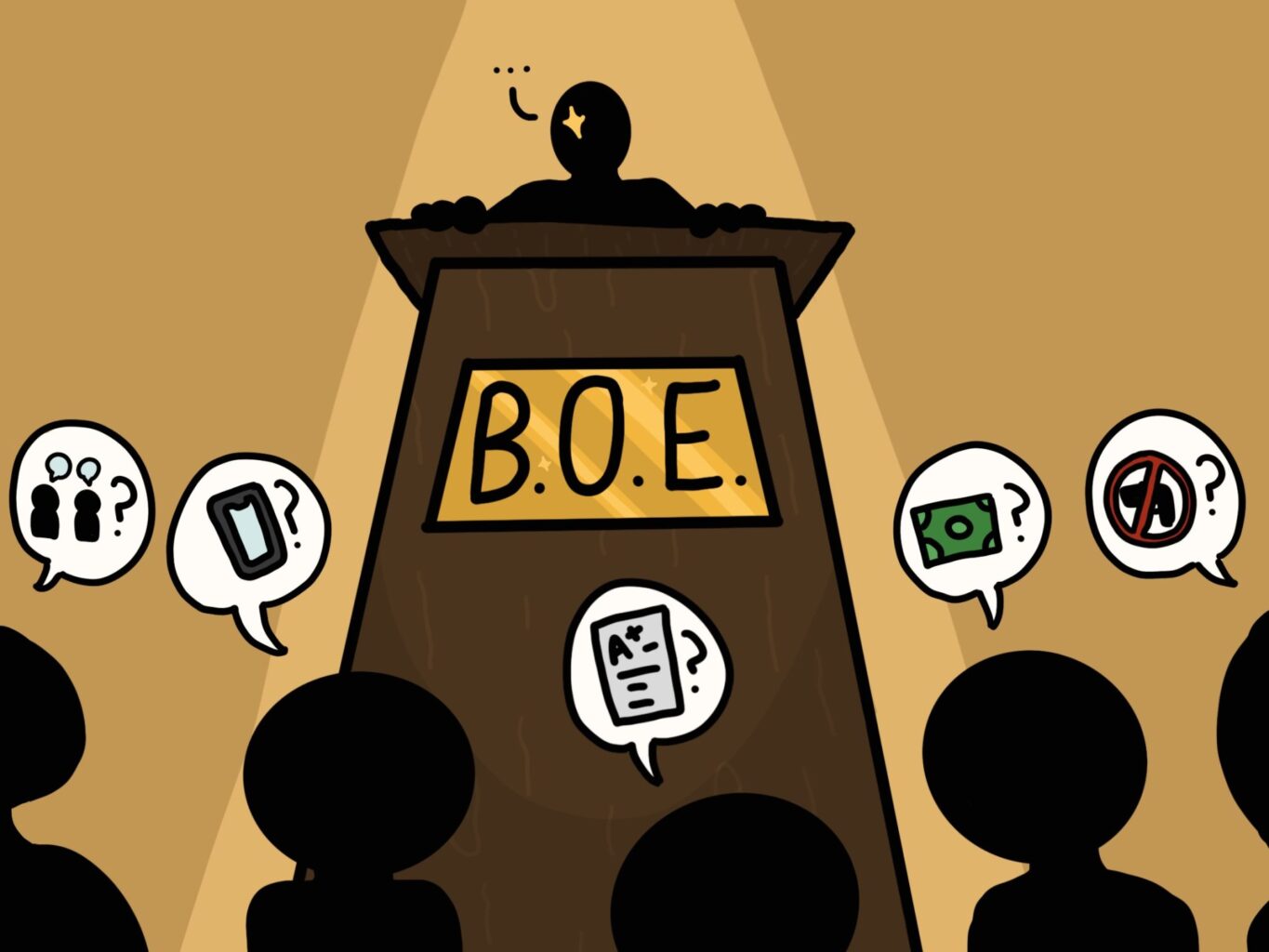
Audience members question Clarke County School District Board of Education members during a BOE meeting. The BOE has shown growth in keeping conversations at meetings and work sessions productive, particularly in a discussion about choosing the next superintendent at its August work session, in which members expressed the desire to not repeat past mistakes. “The discussion showed the BOE’s commitment to learning from the mistakes of the past,” Digital Editor-in-Chief Lea D’Angelo wrote. “But that growth must continue beyond the selection process and into the transition, which has been proven to be a rocky area.” Illustration by Sylvia Robinson
The CCSD Board of Education must remain committed to making decisions as a united front rather than backsliding into the fractured group they once were.
The Clarke County School District Board of Education is currently responsible for representing 12,482 students.
The BOE has nine members who are required to act as a united front, rather than individually. That unity wasn’t always there, but is something the BOE has made strides in and must continue to commit to in the interest of each of those students and employees they serve.
This discord was exemplified during the COVID-19 pandemic, where the BOE faced severe backlash over the various decisions it made, from putting schools in lockdown to mandating that teachers get vaccinated. That separation continued as the BOE and community faced issues with then-superintendent Dr. Demond Means, culminating in an ethical complaint accusing him of plagiarism and lying on his application for the role.
Conflict persisted until a separation agreement, a termination of Means’ contract, was reached with a 5-4 vote on July 23, 2020. Since that era, however, it’s clear the BOE has come a long way.
“I don’t think that anyone can see from the outside how hard we worked to get to a place where we are communicative, where we are responsive to each other, where there’s no hostility,” BOE president Dr. Mumbi Anderson, who has been on the board since 2020, said.
However, in that time, the district has also gone through three subsequent superintendents, four in the last six years.
So, as the BOE faces the choice of their next leader following the retirement of three-year superintendent Dr. Robbie P. Hooker in May, that longevity is something they must consider right alongside the issues of those they represent for their respective districts.
The decision has included a multitude of others, most notably what the process would look like, something the BOE spent a great deal of time debating in its August work session.
“There was no process before we decided on Dr. (Robbie) Hooker, we were doing it ourselves and it was chaos,” District four representative Dr. Patricia Yager said during the meeting. “If (current Interim Superintendent Dr. Jennifer) Scott applies and we decide to hire Dr. Scott, that would be awesome, but let’s have a process, that’s what’s gonna keep the community from being split.”
The August discussion showed the BOE’s commitment to learning from the mistakes of the past, but that growth must continue beyond the superintendent selection process and into the transition, which has been proven to be a rocky area, even going as far back as the 2000s
“That unity wasn’t always there, but is something the BOE has made strides in.”
— Lea D’Angelo,
ODYSSEY Media Group, Digital Editor-in-Chief
“You have to lay the foundation of trust between board members and between the board and the superintendent,” University of Georgia Mary Frances College of Education Dean Dr. Denise Spangler, who served on the BOE from 2002 to 2012, said. “We were super intentional from the beginning with the search committee of setting up professional development, community building and trust building between the (then-superintendent) and the Board from the get-go, because we had not had great experiences with a prior superintendent.”
The conflicts the BOE faced during Spangler’s era and five years ago are no longer as predominant as they once were. It’s clear the BOE has put in the work. But, as half of the BOE goes up for reelection in June of 2026, that work must not be undone.