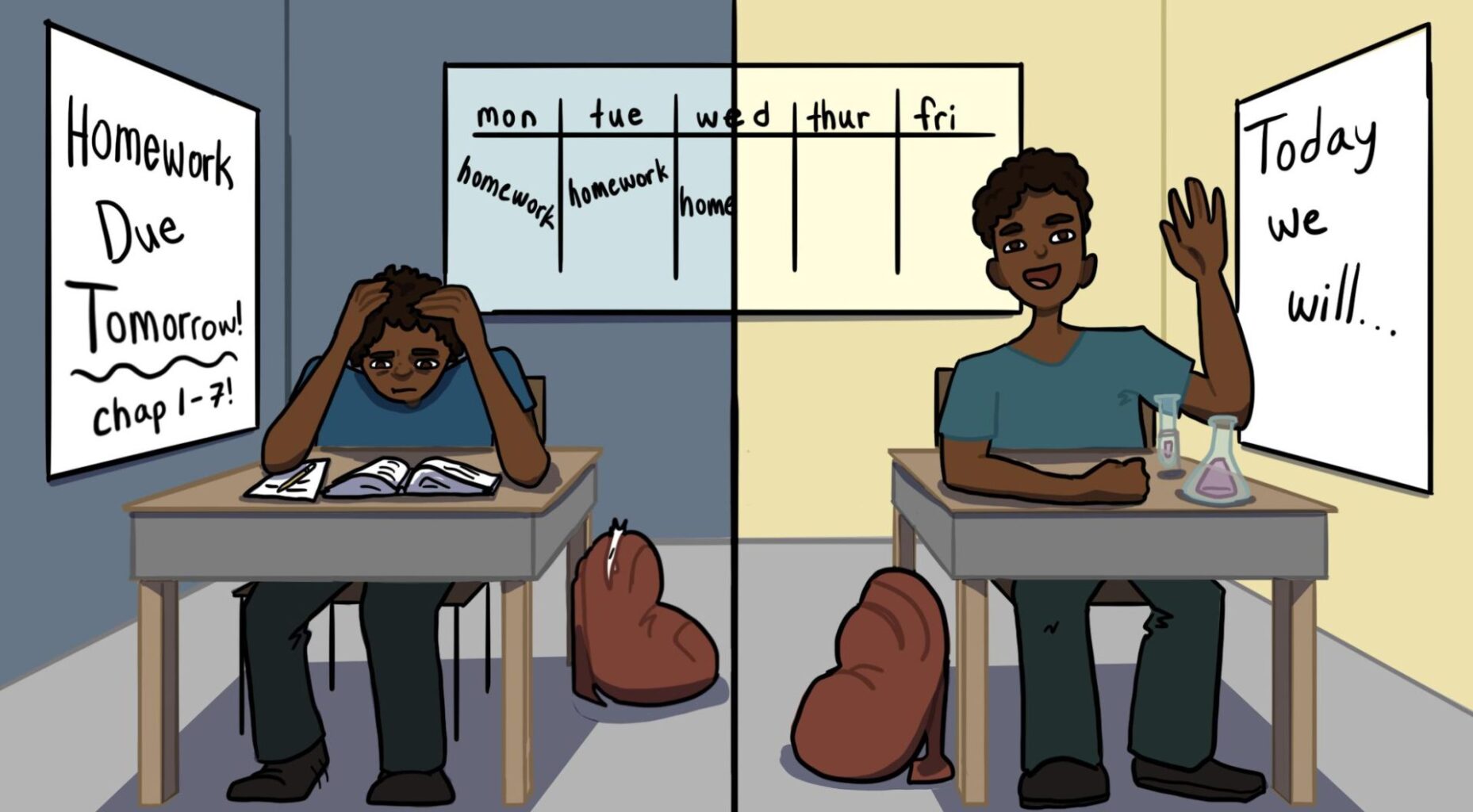
An illustration shows students in two different classroom environments, one focused on preparing them for an upcoming End-of-Course exam (left) and another prioritizing collaboration and discussion (right). As test scores have decreased in the United States over the past decade, with 83% of school districts reporting a decrease in reading scores since 2015, teachers have had to prioritize tests over students’ needs to master the fundamentals. “The problem is a public education system that has spent far too long teaching to the numbers rather than the students. Numbers that have made many classrooms a place where teachers have to go by the questions asked on a test given in May.” Illustration by Mabel Vaughn
As test scores continue to decline and educators are forced to adapt, student learning must be prioritized, not the metrics that define the public education system.
It’s the end of the semester and a Clarke Central High School student is sitting down to take yet another standardized test. It might be the 10th-grade End of Course Literature Exam or the School Day ACT at the end of their junior year. Either way, it’s yet another test in a long series of quizzes, assessment and projects.
The student puts her head down.
In the 2025-26 school year, administration of the PSAT in the Clarke County School District, a test most often taken by 10th grade students, found that 37.8% were identified as “Not Yet Approaching Standard” on the Evidence-Based Reading & Writing portion.
According to data released by The Educational Opportunity Project at Stanford University in May, 83% of school districts saw a decrease in reading scores from 2015 to 2025 and 70% in math scores in that same period.
In an era in which test scores are at an all-time low, they can’t be a metric of student success. These numbers are an indicator of what students are retaining and a public education system that has fallen behind, not what they are capable of.
Yet, these scores determine the lessons students are given and the activities they are asked to complete, some preparing for a test without gaining any real understanding of the fundamentals they might have missed along the way.
“Educators should ask more questions. We come in with a plan that we established before we even met (the student), before you walked in the room,” Clarke County School District Governance and Flexibility Specialist Stephen Nobles said. “What if we can come up with a curriculum with the students, discussing what we’re looking to accomplish and asking you what you think about it, so that we can collectively come up with a plan. If you’re part of the plan, you’ve committed to the task.”
If test scores across the country have decreased in the past decade, why have graduation rates gone up?
The problem isn’t the teachers doing their best to keep up with the guidelines they’re given. It’s not the students who have gotten used to “making it,” to giving up before trying, to turning to artificial intelligence before original thought.
And it’s clear they are “making it.” According to data released by the Clarke County School District on Sept. 28, the four-year high school graduation rate in 2026 increased by 4.5 points from 2025.This follows a trend from 2015 to 2026, in which the graduation rate has incrementally increased from 80% to 86.35%.
If test scores across the country have decreased in the past decade, why have graduation rates gone up? Why are students entering the world needing the fundamentals when it’s clear they don’t have them? The problem is a public education system that has spent far too long teaching to the numbers rather than the students.
Numbers that have made many classrooms a place where teachers have to go by the questions asked on a test given in May rather than giving students the critical thinking skills they need when they inevitably enter the world.