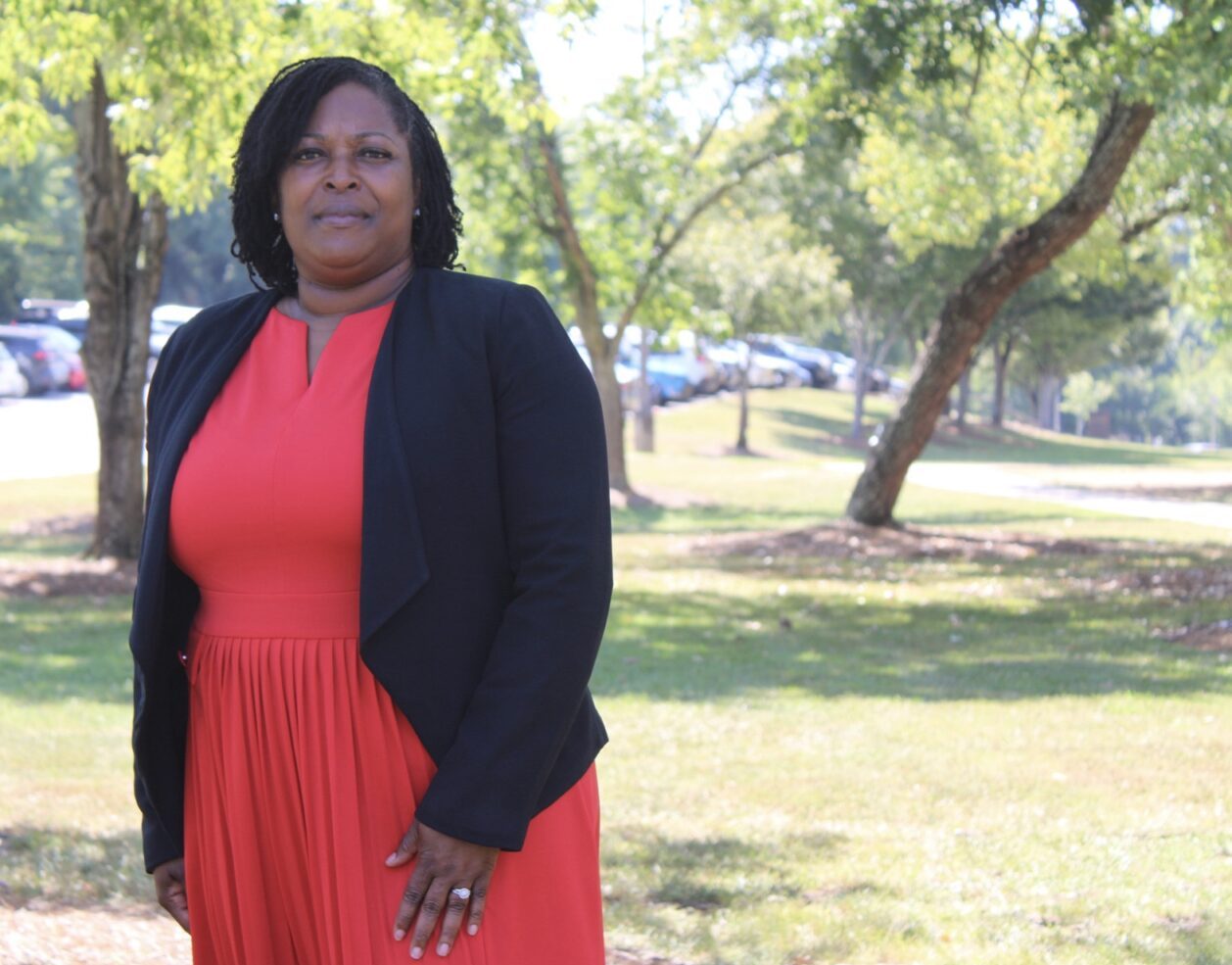
Clarke Central High School Associate Principal of Operations Dr. Tamika Henson poses in the front of the CCHS Ceremonial Entrance on Sept. 17. Henson experienced barriers to regularly attending school during her childhood, contributing to her decision to obtain her doctorate from the University of Georgia in Educational Leadership. “As a young girl, I was always really smart. I was in the gifted program and my mom didn’t have a car, so there were days that if we missed the school bus, I would cry because I wanted to go to school so bad,” Henson said. “I know that education is the key to opening doors.” Photo by Olive Forrester
CCHS Associate Principal of Operations Dr. Tamika Henson discusses her recently earned doctorate in educational leadership from the University of Georgia on Aug. 3.
Social Media Staffer Olive Forrester: What was the process you went through to obtain your doctorate in educational leadership?
Clarke Central High School Associate Principal of Operations Dr. Tamika Henson: My favorite teacher, Mrs. Tommy Farmer, was my fourth-grade teacher at Barnett Shoals Elementary School. She mailed me a letter here to CCHS. The way she ended her letter is what really matters around me obtaining a doctorate. She ended it with, “You will be Dr. Tamika one day.” When I saw that, I didn’t think much about it at all. However, I had an assistant principal, Latinda Dean, who was working (at CCHS, and) she encouraged me to apply for the doctoral program. So, I did at the University of Georgia, and I was accepted to the program. As I began the program, initially, I wanted to do my dissertation around mathematics. Math is my background. I taught math (at CCHS) for six years, and I was eager to know more about the math achievement rates of Black and brown students in a non-(End Of Course class). However, I wanted to do something that I was not comfortable with. I began to think about our data here at (CCHS), and our data for many years has shown that special education students’ achievement levels were much lower than general education students. Ultimately, I began to think about special education students, knowing that you’re going to find Black and brown students in special education.
OF: Why is education important to you?
TH: Education is the key to opening doors. Your intelligence: no one can take that from you. My oldest daughter had taken the Math (Criterion-Referenced Competency Test), and she had failed it by about two to three points. She was in the eighth grade, and at that time, the CRCT really mattered whether you would be retained or not. She was at Hilsman Middle School. She called me, and when she called me, she was crying really bad. Of course, I went to Hillsman to console her. When I got there, their front office was full of Black and brown students who had failed the math CRCT as eighth graders and thought that they would not be able to be moved on to be freshmen, and it was in that very moment in time that I was like, “I’m going to help these students.”
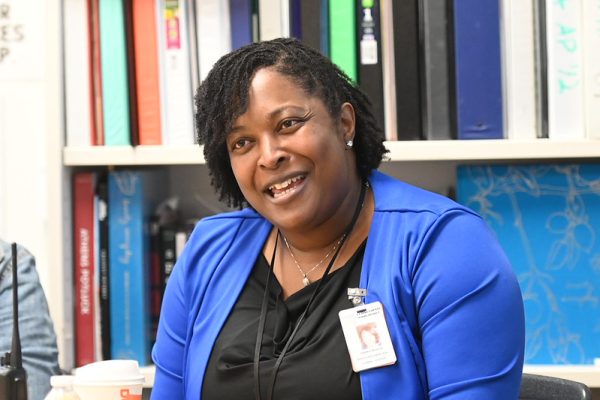
Clarke Central High School Associate Principal of Operations Dr. Tamika Henson speaks at an ODYSSEY Media Group press conference in Room 231 on Oct. 7, 2025. Henson recently obtained her doctorate degree in Educational Leadership from the University of Georgia on Aug. 3 and has high expectations of herself beyond that achievement. “I’m always setting goals,” Henson said. “Oftentimes, once I start on a new goal, I already set (another) goal. My goal is to lead my own school. I am and will be seeking a principalship.” Photo by Maypop Wren
OF: What was a moment during this process that made you excited?
TH: The initial moment that made me excited was my interview process that I had to go through to gain acceptance. The initial acceptance was a big (deal) for me, because I never envisioned that I would be accepted to the University of Georgia, especially as an African American female. This particular program has what you call “critical milestones,” and there are three critical milestones that you have to meet, (and) being able to achieve a passing at my first critical milestone was also amazing.
OF: What was an obstacle that you came across and how did you overcome it?
TH: It’s extremely hard to work a full-time job and go through a doctoral program. I also had to travel to (Gwinnett County) for my courses, so I would leave work (at CCHS) and then begin to travel. That was a major obstacle: working not just a full-time job, but an administrative job. Of course, (also) being a mother and a wife and a grandmother. It was just scheduling and timing. I really didn’t have a life for the last two-and-a-half years, but I survived it.
OF: How can this degree impact your role at CCHS and how you work with students?
TH: This degree will sharpen me and my willpower for leadership and how we should always, in my opinion, be ready to improve and be able to model that. (That) was a biggie in my dissertation: modeling the expectation as a leader, (being) willing to communicate, (being) ready to provide feedback for change, offering a glow and a grow. I think sometimes we get to a place where we think there’s no longer a need for growth. I feel like an effective leader will also always help educators see where they can grow and model that and offer recommendations for doing so.
