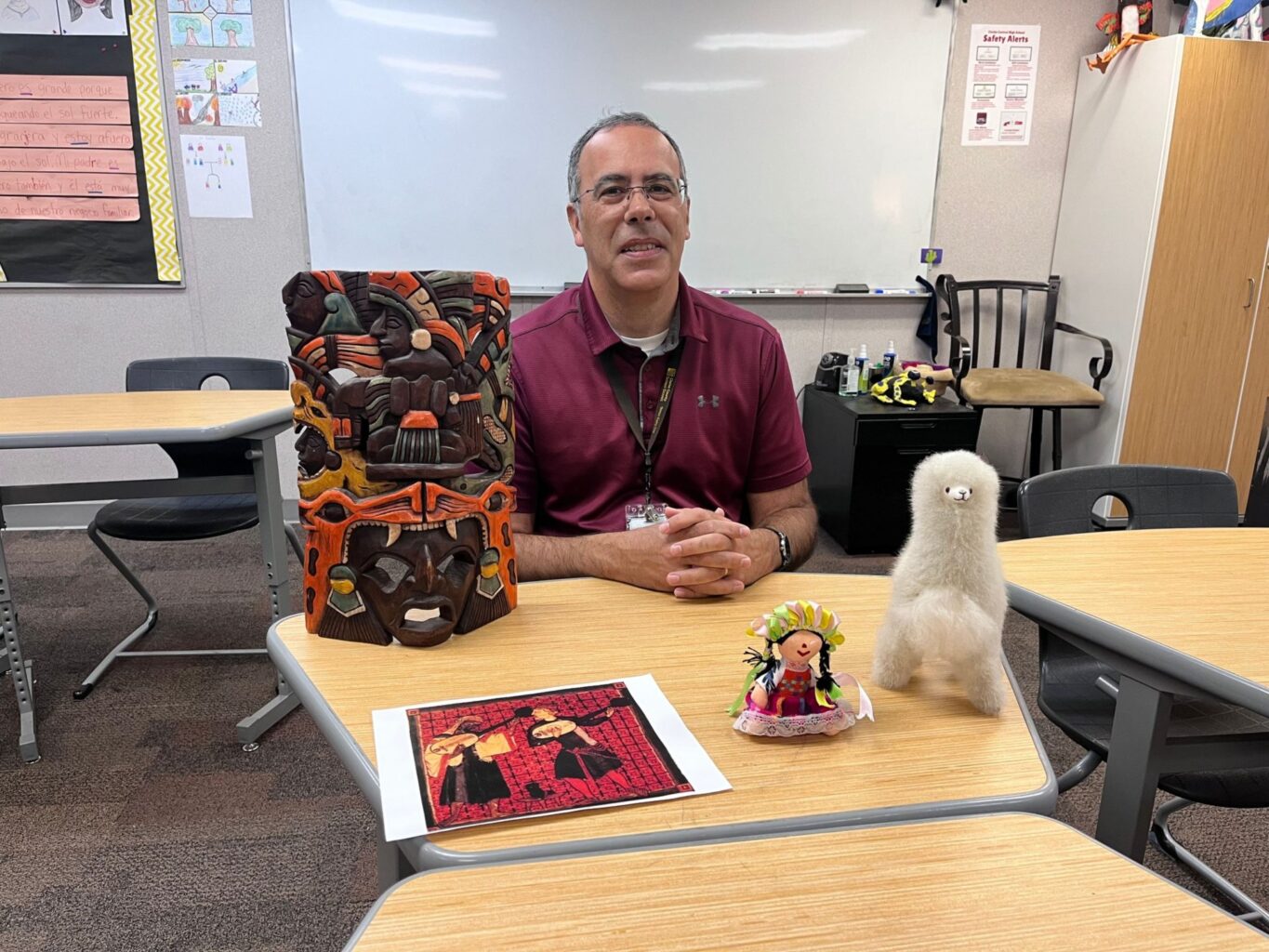
Clarke Central High School world languages department teacher Javier Soler sits at a desk displaying several Hispanic heritage items, including a mask from Mexico, a llama made of real llama fur, an art piece showing a Christian dancing with a Jew, and a Mexican doll in Room 903, on Oct. 5. Soler lived in Spain for 35 years and has been in the United States for 16 years. “I’m in the (CCHS) Celebration Committee and we are organizing things for this upcoming (Hispanic Heritage Festival),” Soler said. “It’s going to be on Oct. 12 and (the Celebrations Committee is) going to put (up) a table with a teacher from the Spanish national team that won the World Cup last summer.” Photo by Maya Pringle
Clarke Central High School world languages department teacher Dr. Javier Soler discusses his heritage and the importance of Hispanic Heritage Month.
Webmaster Maya Pringle: What was it like living in Spain?
Clarke Central High School world languages department teacher Dr. Javier Soler: I was born in 1974 and there was still the dictatorship of Francisco Franco. He was a cruel dictator that ruled Spain for four decades, and before that, there was a (Spanish) civil war in Spain from 1936 to 1939. So, there was no constitution, no civil rights, no liberties, no freedom of religion. All that changed next year when he died, in 1975, and then democracy was introduced again. We had a constitution, again a king, but with (a) parliamentary democracy, meaning the king doesn’t have any power. I’m from Barcelona, which is the capital of Catalonia, and we have a strong identity. Since Catalonia was deeply oppressed during the regime of Franco, it was an experience of (a) strong feeling of a nationhood apart from the rest of Spain. There (was) a lot of struggle between Catalonia and Spain, (and) I grew up among all of these political tug of war.
MP: What’s your cultural background of Spain and can you dive into your family history a little bit?
JS: My family are all from Barcelona, the region of Catalonia. A little bit from the side of my mother from Aragon, and that is why we speak Spanish and not Catalan. Although only my family, from my father’s (side), speak Catalan. Culturally, I’m pretty much a typical family from Barcelona, pretty much middle class. (Catalon) is a little bit similar (to Spanish), but it’s another language. It’s like French, Spanish, Italian (and) is a language that comes from Latin, and originally it comes from Occitan, which is the language that was spoken in the south of France. Then, in the year (801 AD), (currently) the city of Barcelona was conquered by (Louis the Pious), son of Charlemagne, who was the emperor of the Franks. At that time (that) was France and Germany, and he went and conquered Barcelona. So they brought a lot of settlers from the south of France to Catalonia, and then in the 12th century, the languages started to split. It was Occitan and then Catalan. It’s a different language, and we have a very strong literature, a lot of writers. It’s a very small place, but very rich in literature and culture. It’s like a beautiful little garden.
MP: Do you have any family traditions that have left an impact on you or any that you want to share?
JS: We had all the traditions. For example, we celebrated La Castagnada, which is Halloween (which) is like the chestnut holiday, and we used to eat chestnuts and eat Pinoli, which is also an Italian (dish wish) a lot of pine tree seeds or nuts in almond (dough). It’s super delicious, and then that was probably one of the feasts I really liked the most. Of course, Christmas, New Year’s Eve, and Día de Los Reyes is very fun. We didn’t have Santa Claus when I was growing up. That was introduced later, and now it’s pretty much Santa Claus and Los Reyes Magos, the wise men that bring presents to kids. Our presents were on Jan. 6, which is King’s Day. And Santos, which is your name’s day, is very important, almost like a birthday. My name’s day is on Dec. 3. It’s San Francisco Javie, and we celebrate Los Santos, the Saints.
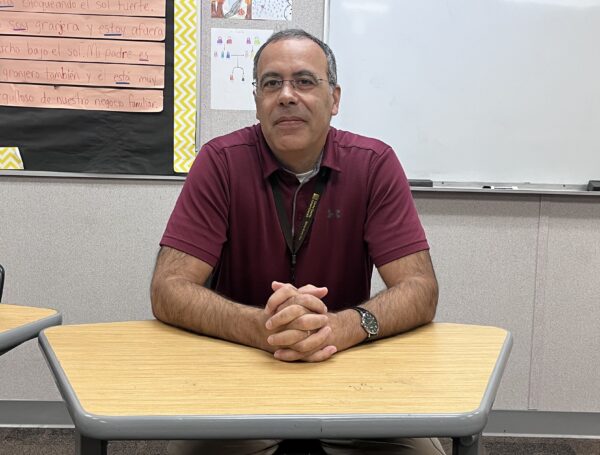
Clarke Central High School world languages department teacher Javier Soler sits at a desk in Room 903, on Oct. 5. Soler believes CCHS has done a good job of celebrating Hispanic Heritage Month. “(In the United States, Hispanic Heritage Month) is a big celebration. In Spain, (it is) pretty much my mother’s name, Pilar, (that is celebrated),” Soler said. “Apart from that, many families don’t do anything, no barbecue, like you (would) have on the Fourth of July. It’s pretty much a feast day. People don’t work most of the (time), but (in the United States), they have festivals.” Photo by Maya Pringle
MP: How do you think your Hispanic background has influenced your journey and lifestyle?
JS: First we came to Florida, and for some reason in Florida (it) felt like an extension of Spain a little bit. So we used to spend summers in Ibiza, (an) island in the Mediterranean. It was pretty much similar to the lifestyle of what I found in Florida with these condos and the beach. I’d spend (thousands) of hours (on) the beach. I love the sea. So when I was in Florida, it felt familiar to me. Then we moved to Athens and that was very different somehow. (That) Hispanic feeling of life. I couldn’t find it here. Then I was teaching at University of Georgia, as a Teaching Assistant and there were very few students that were Hispanic, but here, when I came (to CCHS), there were more and more. I felt somehow connected with them through the language and the religion. At the University of Georgia, the Department of Romance Languages, there were a lot of professors, teachers from Spain and other countries of Latin America, so I was supported there in that sense and I spoke a lot of Spanish there.
MP: What was your journey like coming to CCHS?
JS: I was (getting) my PhD at the University of Georgia, and before I finished my PhD, I was looking for jobs, and I lived not very far away from here. I used to work every day, especially during COVID, because I didn’t want to take the bus. It was just a five-minute ride on the bus. I knew some people working here and actually, when I came here to Athens, one of the first places that I looked for (a) job was here, but they had everything covered as a Spanish teacher. So when I finished my PhD, I applied here and I got the job.
“ I hope (my students) can learn something new or have an experience, if they come to the (Hispanic Heritage) festival. I always like that many people from town come (to the festival). Sometimes there are colleagues from UGA, and they come (too).”
— Dr. Javier Soler,
CCHS world languages department teacher
MP: Have there been any Hispanic like figures’ that have inspired you or just influenced you growing up?
JS: My grandmother had a country house, and there was a collection of all the kings of Spain in small paintings. My great grandfather (liked) antiques, there was a lot of art, and I think that was very impressive to see. I always liked the history of the kings of Spain, especially Charles I, who was also king of Germany as Emperor Charles V, and actually that house in the countryside had been a hunting house of this emperor. He was there a couple of times and there were some sculptures in the house of his head and these hunting dogs. He was the first Habsburg (and) he did many terrible things. He fought in Germany against the Protestants and there was this piece of Habsburg, now Augsburg, that said, “cujus regio, ejus religio,” meaning the religion of each prince or duke is the religion of the people here. Everything in Germany was split until Bismarck. If the Duke of Sasan was Protestant, everybody there was Protestant. If the Count of Munich or Bavaria was Catholic, everybody was Catholic.
MP: What is the importance of celebrating Hispanic Heritage Month?
JS: Well, I have a lot of contradictions here. In Spain, we celebrate (Hispanic Heritage Month) on Oct. 12, which was the day that Christopher Columbus discovered America. There was a lot of abuse (on that) conquest, a lot of people were killed, (and) slavery was introduced. It’s nothing that I’m proud of (and) being Catalan, there was a lot of conflict with (the Hispanic Heritage) feast. We didn’t feel like we should celebrate that, and some people were making barbecues with sausages because that’s called butifarra sausage. They were doing things against this feast. But then I came here, and Columbus Day was changed (to) Indigenous Peoples Day, which I think (is) better. I like to celebrate Hispanic Heritage Month here (at) Clarke Central, but the history of Spain is very cruel (and has) a lot of violence.
A video shows Clarke Central High School world languages department teacher Javier Soler during an interview in Room 903, on Sept. 29. Before Soler started at CCHS in 2021, he had dreams of teaching. “I was very young and I read a book, (but) I don’t remember the (name of the) book (or) the author,” Soler said. “I know it was an Italian author and it was a pedagogy book that I bought in a bookstore in Barcelona, and this author said, ‘Let the kids play freely, give them as much freedom as possible.’ I really liked his book and I thought I really want to be a teacher.” Video by Maya Pringle
MP: For Hispanic heritage celebration, is there a different name for it in Spain?
JS: We call it Día de la Hispanidad (or) El Día de la Hispanidad. It’s also the saint patron of Spain, which is Virgen del Pilar, the Virgin of El Pilar. We have two saint patrons. My mother’s name is Pilar. So we celebrate her saint and it’s an important feast. Everybody goes to my mother’s house and there’s a big lunch. There’s another saint in Spain that is also their patron, which is Santiago or Saint James, and that’s the 25 of July. Since it’s a Catholic country, the saints are very important. On Oct. 12, there’s two things: the Virgin Mary, patron of Spain, and also the day that Christopher Columbus landed in the Americas. Some people see that as a miracle (that) the same day of the same patron of the Virgin Mary of Pilar was the day that Christopher Columbus landed (in the Americas). That was a message from heaven because he had to introduce the gospel (in the Americas) and Christianity. I celebrate my mother’s saint, and that’s it, on Oct. 12.
MP: Through your Hispanic knowledge and experience, what impact do you hope to leave on your students?
JS: I hope (my students) can learn something new or have an experience, if they come to the (Hispanic Heritage) festival. I always like that many people from town come (to the festival). Sometimes there are colleagues from UGA, and they come (too). There’s people from different backgrounds, people from the neighborhood here in Rock Springs that come, too, (and) they want to to celebrate. They bring the kids and I hope they can learn things from Guatemala, Honduras, Venezuela, Spain, (and) from the dresses, there’s gonna be a fashion parade. So maybe they’re gonna see something new.
