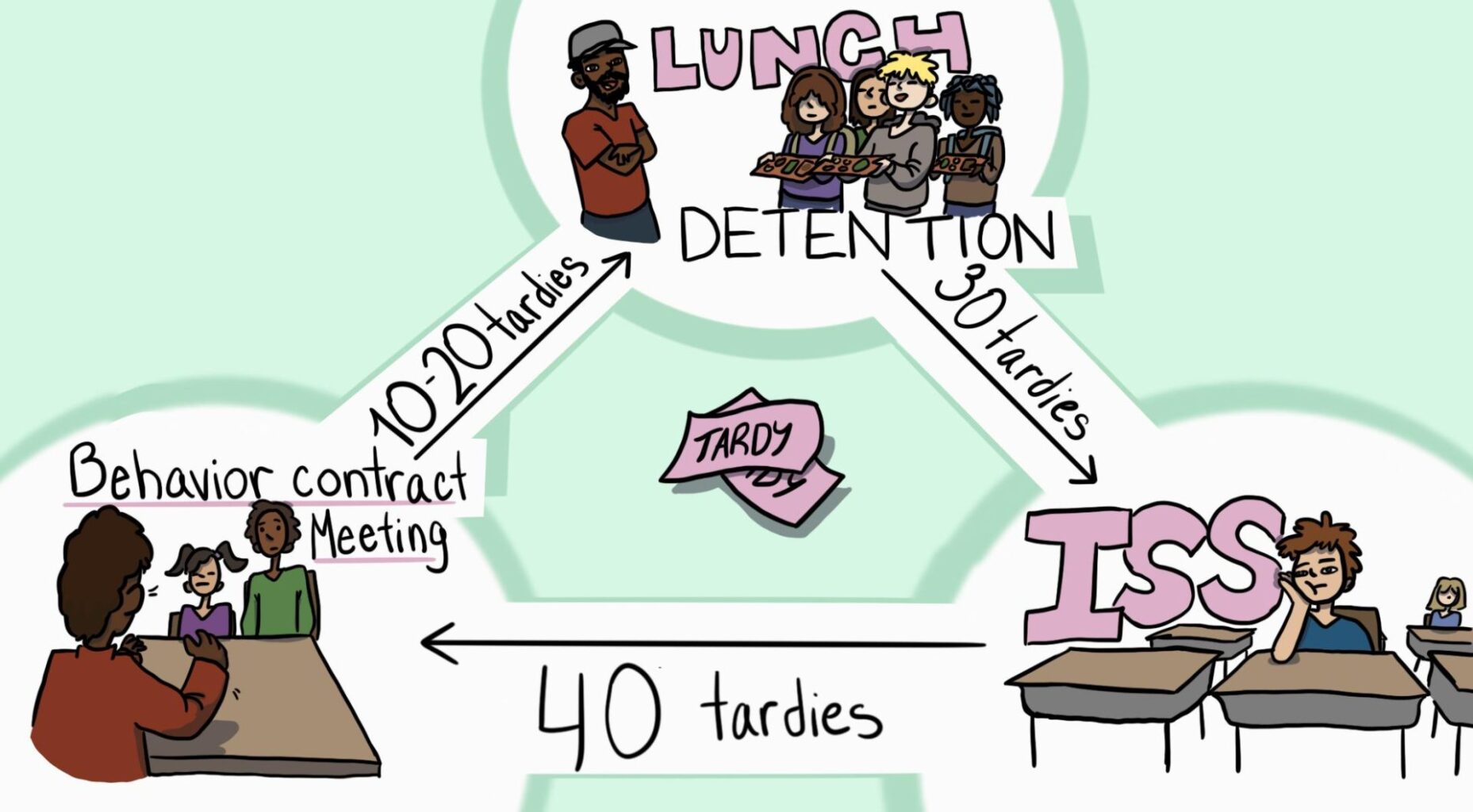
An illustration shows the Clarke Central High School tardy policy process for the 2026-27 school year. The new policy is stricter than it was in the past, something Viewpoints Staffer Senya Kero believes indicates progress. “Coming up with a plan where the student will not receive any more tardies, such as taking a different route to class or waking up earlier, will cause students to be in class more and therefore learn more,” Kero wrote. Illustration by Mabel Vaughn
The new tardy policy for the 2026-27 school year is on track to reduce the tardies students receive at CCHS.
The tardy policy at Clarke Central High School for the 2026-27 school year introduces new consequences for tardies, such as lunch detention after 10 and 20 tardies, and in-school suspension and parking pass revocation as the numbers increase.
The policy is a drastic change from previous school years that had very few consequences for students being tardy, but it could be the much-needed wake-up call for students to stop lingering in the hallways.
Previously, the CCHS Administrative Team has struggled with controlling the number of tardies students receive every year. Without a specific plan set in place at the start of the school year, administrators and teachers could not strictly enforce consequences for students who received a large number of tardies, according to the CCHS Admin Team.
Being in class is necessary for students at CCHS to learn, so having repercussions for being late to such as being sent to in-school suspension, which has been part of the previous policies, posed as barriers to student learning.
Part of the new policy includes lunch detention, which occurs on Tuesdays and Thursdays. This is a consequence that makes students miss social time with their friends but not any class time.
“It seems silly to make (students) miss class for not going to class,” CCHS Assistant Principal Alexis Scott said. “We want you learning, and so lunch detention allows you to still be in class, and you only have to serve it that one time, maybe two times if you continue the behavior.”
Being in class is necessary for students at CCHS to learn.
Students can’t afford to use lunch detention as a space to scroll on their phone and should instead work with CCHS physical education department chair Joshua Dawson, who is eager to help the students he meets in lunch detention.
“Once you reach a certain amount of tardies, you have to go spend your lunch with me,” Dawson said. “We have a discussion during lunch detention like, ‘Why am I having lunch detention?’ What’s going on? Is it first block, is it third block after lunch?’ (We) just try to build a plan for success to make sure that we’re not accumulating more tardies as we go along through the semester.”
The new policy serves as a much-needed incentive for students to get where they need to be on time. Coming up with a plan where the student won’t receive any more tardies, such as taking a different route to class or waking up earlier, will cause students to be in class more and therefore learn more.
Although the full impact has yet to be seen, this new tardy policy is a step in the right direction of decreasing the number of tardies students receive.
