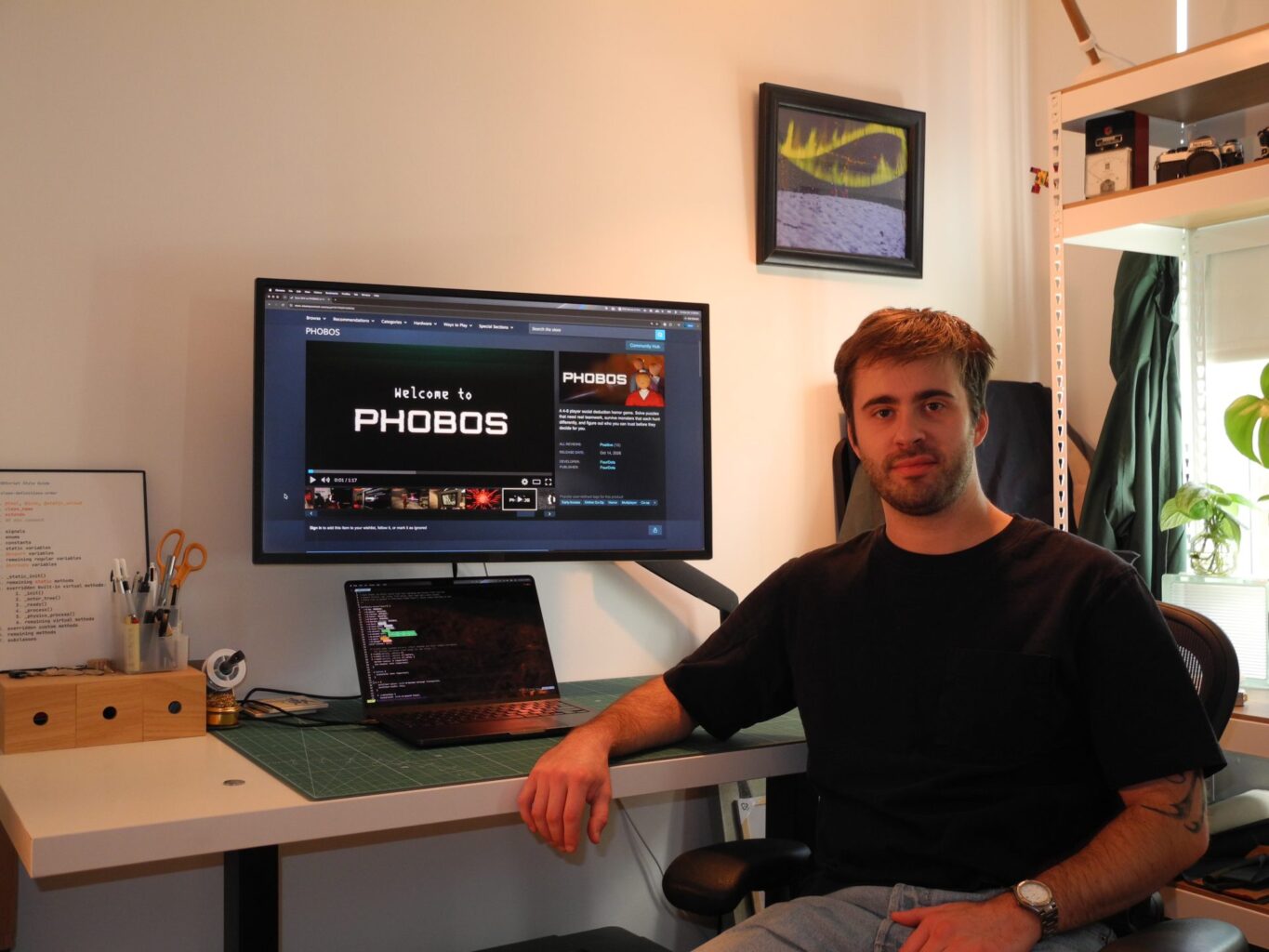
Clarke Central High School Class of 2017 alumnus and software engineer Trent Slutzky sits at his desk in New York, where his computer displays coding for his new game PHOBOS, shown on the monitor above. Slutzky’s new indie game PHOBOS was released Oct. 14 with the help of three friends who helped bring the vision to life. “I’m working on (PHOBOS) with three other people. Usually in a professional game studio, there’s ton of jobs that are split up between different people. My friends and I are taking (a) more indie approach to it where we all do everything,” Slutzky said. Photo Courtesy of Trent Slutzky
CCHS alumnus and software engineer Trent Slutzky discusses how his CCHS experience connected to the world of game development and engineering and his new game PHOBOS, which released Oct. 14.
Sports Staffer Singer Brinson: Could you tell me about your experience at Clarke Central High School?
CCHS Class of 2017 alumnus and software engineer Trent Slutzky: I was mostly doing the Robotics Club. We were doing robotics (competitions), and I really liked it. I got super obsessed with it. I became the “captain” of the team. I was super motivated to (do) it and (spent) most of my time working on (robotics) and that was really fun. I was (also) doing cross country. I was interested in photography and videography. I did ODYSSEY and some videos for (ODYSSEY). On the side, I was making video games. For classes, I would sometimes make a mini video game for a project instead of a presentation.
SB: Moving on from high school, could you tell me about your college experience? How did that transform your experience in robotics?
TS: I graduated (from) Clarke Central in 2017. I went to Stevens Institute of Technology. At the time, I wanted to do robotics as a career (so) I did mechanical engineering as my major in college with a concentration in robotics. I did classes that were complicated (in) math and programming specific to robotics. (In) college, my interest in making video games dwindled because I was busy with everything in life that happens when you’re in university. I was still into robotics, I was doing the robotic club in college and I was also the captain of (the) team.
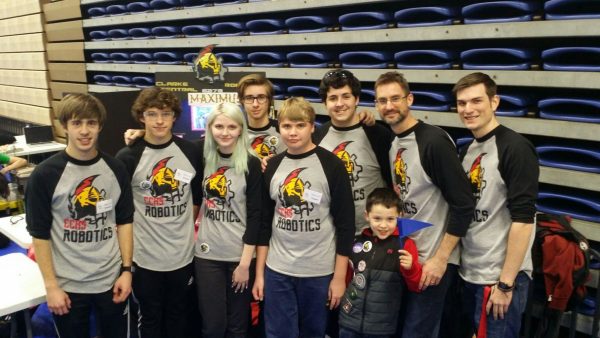
Members of the 2016-17 Clarke Central High School Robotics Team pose for a photo at the Georgia State Robotics Competition. Photo from the ODYSSEY archives
SB: What are you doing now and how did you get there?
TS: I studied robotics and I was trying to find a mechanical engineering job in New York City. It was very difficult to find a job that was interesting to me. Most of the mechanical engineering jobs are in construction and I wasn’t really interested in structural engineering. The other (option was) working for government companies that make weapons, (which) I didn’t want to (do) either. Because of my interest in making video games, I had gotten a skill set in writing code. I (thought) I could get a software job because, for one, they’re fully remote, which is nice because it didn’t have to specifically be in New York City and it was more interesting to me. I applied to a handful of software engineer jobs, and I ended up in a company called Narmi, a software service company. We make account opening software for smaller banks and credit unions, it’s a fun job.
SB: Why were you interested in that specific field of engineering?
TS: There’s a lot of new challenges every day, which I find fun. You get these complex problems that you have to solve and you get instant gratification because you can get to the final product quickly and iterate on it, which I also find fun.
SB: What has been the hardest part of developing PHOBOS?
TS: The hardest part of making a video game isn’t making the video game, it’s marketing a video game. We finished the game months ago, and it (came) out October 14. The last six months (have) been figuring out how to market it and make it so that people know it exists (and) will want to buy it. Other than marketing, for me the hardest part is the art. I’m an engineer. I’m not really an artist, (but) I try to be an artist, and) I’ve done most of the art in the game.
A video displays a clip from a Google Meet held Oct. 12, featuring CCHS Class of 2017 alumnus and software engineer Trent Slutzky. Slutzky attended Clarke Central High School where he was head of the CCHS Robotics Team, he later graduated in 2017. “The first thing that I remember building was a Lego Mindstorms kit. That (was) the start of everything. I really (wanted) to document it so I started taking pictures and videos of every robot I built. And then I (thought), ‘I want to put this somewhere.’” Slutzky said. Video by David Ragsdale
SB: What has working on this new game taught you?
TS: It’s taught me a lot about everything. I’ve grown a lot in the past couple of years in every aspect of making a game. I’ve learned a lot about coding. It’s completely different from writing finance software. It’s (also) taught me a lot about working on a team with other creative people who are (also) driven to have a personal project and make creative decisions on the project. Because before this game, I’ve done tons of other game projects, but they’ve always just been me solo and so that was a big learning experience working on the team, working on the project with other people. I’ve done other game projects, but (they’re always solo projects and a big learning experience was working on (a) project with other people. That’s why it’s become a final product, because most of my personal projects never take off.
SB: How did your experience with robotics at CCHS impact your career now?
TS: Doing robotics in high school is the reason I am where I am. It got me interested in engineering and working on a team with other engineers who are excited to solve problems. (It) taught me about the science and math that we do in class (and) how it’s actually applied. It’s fun when you’re working on (something) that’s interesting.
SB: What advice would you give a high schooler who maybe wants to go into game developing or engineering?
TS: The advice that I give (to) people that (say), “How do you do that? That seems complicated,” (is) if you look past (the) thought of “That looks complicated, I’m scared to try it,” and you just try it, you’ll realize it’s easier than you think. That can be applied to so many things.
