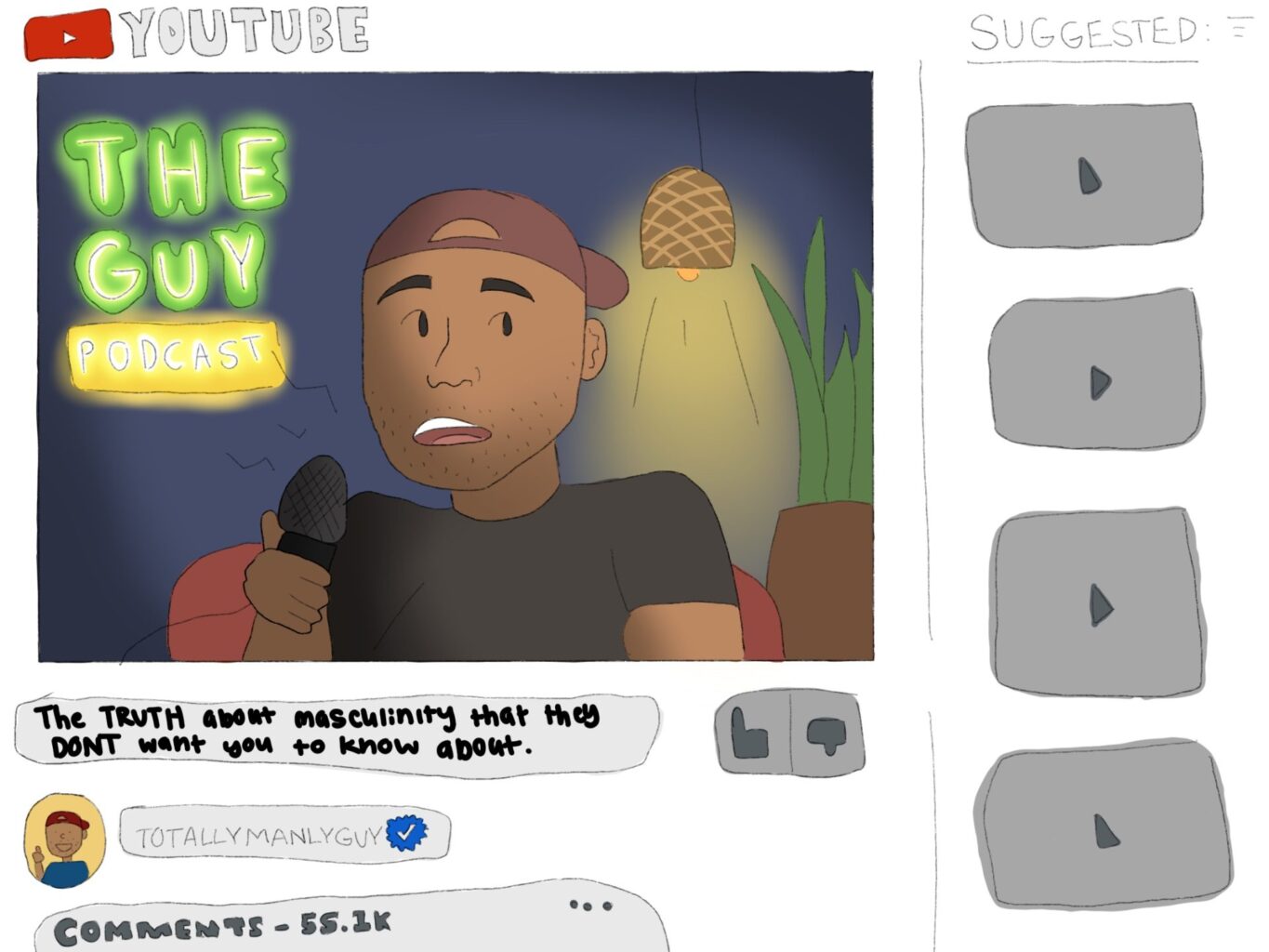
A YouTube video about masculinity is shown. The term “manosphere” originated in the early 2000s and refers to an online network of influencers who make content about contemporary masculinity.“While some argue that (the manosphere) serves as a safe space for men to voice their problems, in reality, it makes them worse by promoting harmful stereotypes and destructive behaviors,” Variety Editor Adah Hamman wrote. Illustration by Sylvia Robinson
The manosphere, a network of influencers making content about contemporary masculinity, promotes harmful stereotypes and destructive behaviors.
When the psychological crime drama miniseries “Adolescence” was released on March 13, it captivated audiences and critics alike. The show, which received eight Emmy awards, follows Jamie Miller, a teenage boy who murders his female classmate after she rejects him.
Although the series wasn’t based on a true story, it drew attention to the growing issue of toxic masculinity and the emergence of the “manosphere.”
The manosphere is a network of influencers who make content about subjects regarding contemporary masculinity, like gender roles and dynamics. While some argue that it serves as a safe space for men to voice their problems, in reality, it makes their problems worse by promoting harmful stereotypes and destructive behaviors.
The term “manosphere” originated in the early 2000s, but its roots trace back to the 1970s and ’80s with the men’s rights movement. The campaign began in response to the rise of feminist ideas and politics, which advocates claimed were anti-men. This same argument has been popularized by figures like Andrew Tate, who has garnered billions of views across various platforms.
According to the Anxiety and Depression Association of America, “Nearly one in 10 men experience depression or anxiety, but less than half receive treatment.” There are several reasons for this, but one of the main ones is due to the stigma surrounding men’s mental health.
“(There are) old patriarchal values that prescribe confining expectations for how men are supposed to behave and how they’re supposed to appear to others, and the same (goes) for (women. They) are allowed to express emotions, and men are not,” Clarke Central High School mental health counselor Dr. Meg Dion said. “When men say something is wrong emotionally, it is seen as a weakness rather than a strength.”
This stigma drives many young men online, where the manosphere exploits their vulnerabilities by perpetuating stereotypes. For example, one argument is that women are shallow and that they only value men for their money, social status or physical appearance. This narrative not only distorts young men’s view of relationships, but also fosters hostility towards their female peers.
In the most extreme cases, this kind of rhetoric can lead to outbreaks of violence. For instance, on Aug. 12, 2021, in Plymouth, England, Jake Davison, a 22-year-old apprentice crane operator, shot and killed six people, including himself. According to CNN, Davison had expressed strongly misogynistic views online for months before the attack, including calling women “very simple-minded” on his YouTube channel, which has since been taken down.
To counter the manosphere’s influence, a conversation must be held between parents, teachers and peers when they witness the men around them voice harmful beliefs. Challenging misogynistic rhetoric early on can prevent it from evolving into something dangerous. This approach can help promote a safer environment for all, where everyone feels heard.