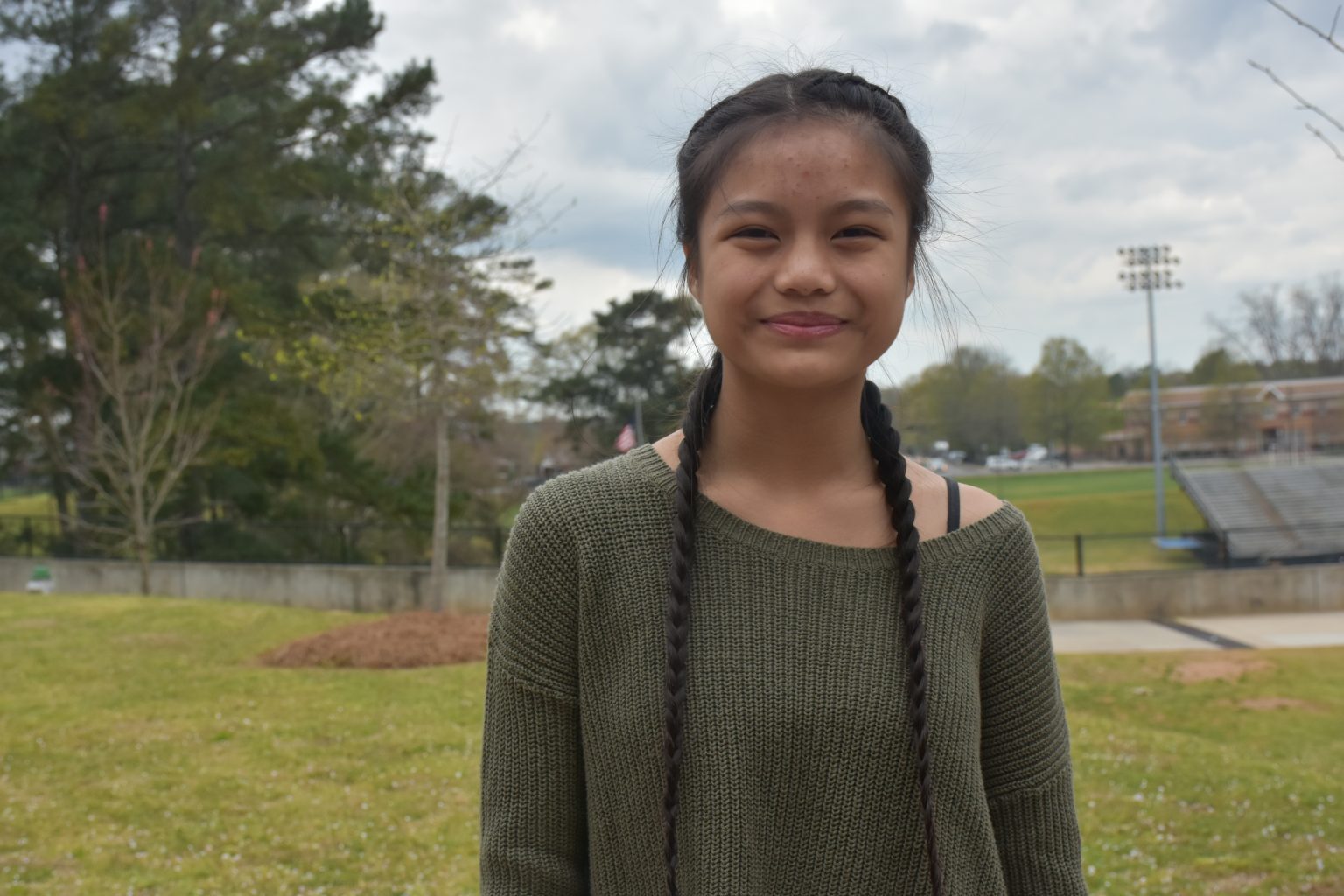
Clarke Central High School Sophomore Sa Blue Wah, poses in front of the Billy Henderson Stadium. Wah moved to Georgia from Thailand around the age of five and has experienced many changes and challenges since. “As a 5-year-old, I just thought that my mom brought me over here for the better,” Wah said. “(She wanted) me to learn English, but still keep my nationality and respect my own culture, but at the same time learn about America.”
Growing up in a war-ridden country, Clarke Central High School sophomore Sa Blue Wah faced many hardships as a child. After moving to the United States and adapting to her surroundings, she experienced a different set of challenges.
Clarke Central High School sophomore Sa Blue Wah’s childhood was not one that can be compared to that of many of her American peers. Born in Thailand during the Karen Conflict, an ongoing civil war in Burma, Sa Blue grew up in a world full of war. Because of the harsh war, she lived in a refugee camp in Thailand.
“The reason we’re at war is because Myanmar (wants) to take the other part of the border. But my people, we aren’t going to give up our land because that’s where we came up and we brought it up. They just want to force it upon us and they’ve killed many people,” Sa Blue said.
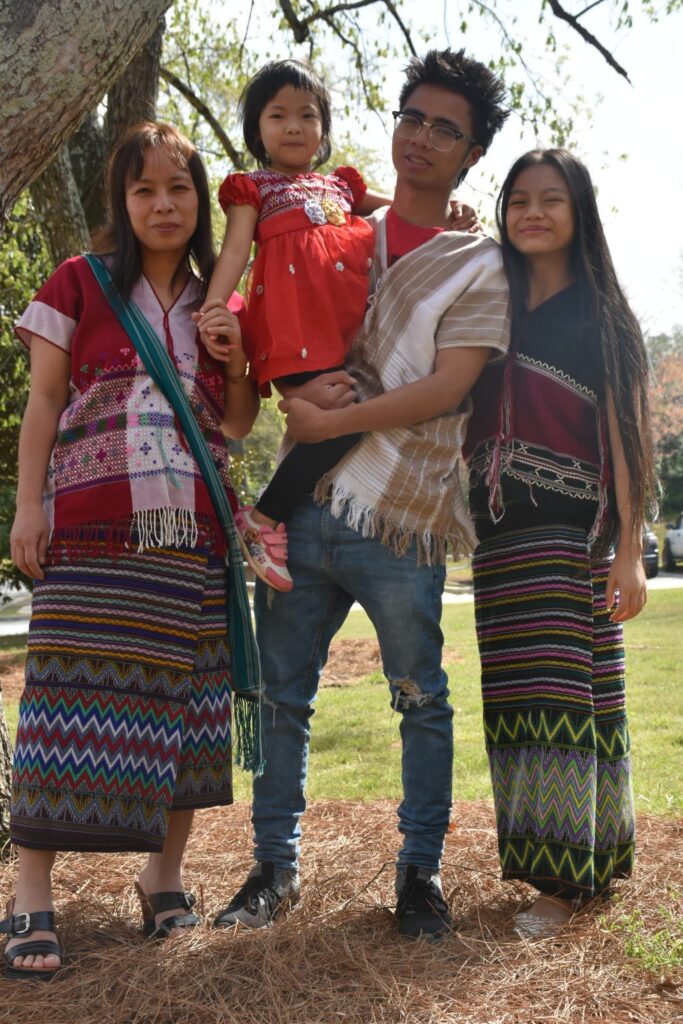
Naw Wah, Nafaf Thaw, Cha See and Sa Blue Wah (left to right) pose at Clarke Central High School on March 30. At the age of five, Sa Blue and her family moved from Thailand to Georgia to escape an ongoing war. “Right now the war is still going on,” Sa Blue said. “My grandma and grandpa are living in a refugee camp right now and we’re trying to get them to America, but we don’t even know if Myanmar is going to attack anytime soon.” Photo by Krista Shumaker
At this time, Karen people resided close to the border between Thailand and Myanmar. Throughout grade school, Sa Blue experienced adult hardships. Every day, she took a long journey to-and-from school.
Her daily life at school consisted of armed guards at almost every entrance point, and a lack of resources including food. Finding basic everyday needs was not only a struggle at school but also at home due to the restrictions placed on the Karen people.
Sa Blue’s mother, Naw Wah, found it difficult to raise children in that kind of environment.
“In the refugee camp, we had to stay in our designated spots and we couldn’t go outside of it. We had to stay inside the camp,” Naw Wah said. “We couldn’t get food, we couldn’t get jobs.”
By the time she was four, Sa Blue recognized the message behind everlasting hatred. She wanted an escape, a way out.
At the age of five, Sa Blue, her four siblings and her parents packed their belongings to head to a better destination, hoping to leave the adversities they faced behind.
They traveled from Karen to China, through Japan, until finally, they reached Chicago. From there, they flew to New York, then to Atlanta, Georgia, where they would stay for five years.
In Atlanta, Sa Blue attended Indian Creek Elementary School. When she arrived, she knew little to no English and had to take an English Language Learners (ELL) class.
“They were going to put me in first grade at first, but then they decided to put me in second grade. I didn’t understand English, so I was like, ‘What?’ At that time, I would like to watch American movies and observe other people. Like, when they’d say, ‘Excuse me,’ I’d see the movements and I’d be like, ‘Oh, that’s what that means,’” Sa Blue said.
Throughout elementary school, Sa Blue suffered from many stereotypical jokes from her classmates. Despite not being able to understand much English, she quickly learned that words like “China” and “Asia” were stereotypical phrases directed at her.
“I cried sometimes at night when people would call me stereotypes, you know, saying I eat dogs and stuff,” Sa Blue said.
Since she faced prejudice on a day-to-day basis, Sa Blue built up an emotional wall. She was tired of the name-calling and the presumptive glares.
When she moved to Athens, she hoped for a more forgiving community. She attended Whitehead Road Elementary School, where she was surrounded by people who didn’t look like her. The majority of her classmates were white and she was unsure how to respond to the new environment.
“It was weird for me and different for me. I felt like I was below them or I wasn’t as good as them,” Sa Blue said. “I thought I wasn’t worth it. I could never fit in with them.”
In the sixth grade, Sa Blue attended Burney Harris Lyons Middle School (BHL). She began to open up more, and found a life-long friend in Kimberly Palomino, now a CCHS sophomore.
Palomino was someone Sa Blue could relate to, because they were both faced adversities due to things they could not change, such as their ethnicities. However, after being ridiculed since she had moved to the US, it was refreshing to have a classmate she could confide in.
“She talked to me first. She was like, ‘Oh hey, where are you from?’ and I didn’t want to tell her, but she eventually found out because of my teacher,” Sa Blue said. “At first, I was hesitant to really talk to her, but she was like, ‘I love you. I’m going to be friends with you.’”
For Sa Blue, Kimberly started out as a shoulder to lean on and eventually became a long-lasting friend. But that didn’t stop the harassment and racism Sa Blue faced.
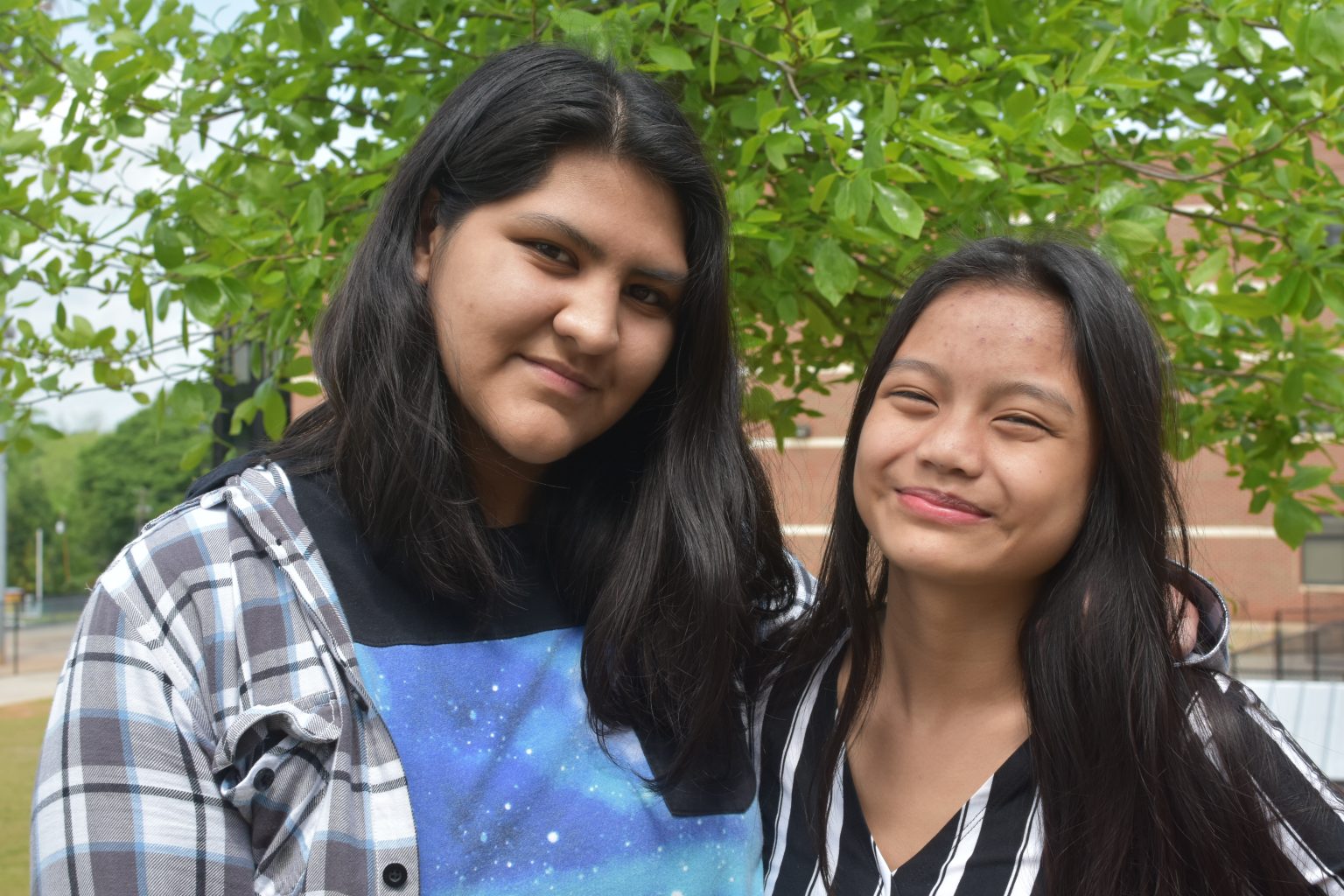
Sophomores Kimberly Palomino and Sa Blue Wah (left to right) pose together at Clarke Central High School on April 14. Kimberly and Sa Blue both attended Burney Harris Lyons Middle School and have been friends since then. “I think (not having any classes together) proves that even though (Sa Blue and I) don’t see each other, we still are really closer than other people,” Kimberly said.
While Sa Blu was used to hurtful comments, she was shocked when in seventh grade a classmate wished death upon her and her family.
“This boy told me, like, ‘Your parents and your family should crash in an airplane.’ I didn’t understand and I kept wondering if it was because I was another race or just because of how his family’s mindset was built up,” Sa Blue said. “At that time, I was speechless and I didn’t really know what was going on, so I didn’t cry or anything, but the next day I did cry.”
Without noticing it, Sa Blue distanced herself yet again. Luckily for her, Palomino took the initiative to get her to open up.
“She told me, like, ‘Sa Blue, we might be different races, but you should never tell yourself that you’re below anyone. There’s no such thing as ‘(fitting) in,’” Sa Blue said. “That’s when I realized she was right. All this time I used to think that you had to be a certain way or act a certain way.”
For Sa Blue, high school was a game-changer, as she didn’t have any classes with Palomino.
“When we didn’t have any classes together, it proved that our friendship is stronger than just a school friendship, because we still stayed in touch,” Palomino said. “ More than (anyone) else, I would say, I’m (close) to her and it’s really nice that I see her a lot.”
As a ninth-grader, she attended CCHS, where she was surrounded by students of all different backgrounds. With more people of her ethnicity in her environment, she began to feel at home. She didn’t have to worry about judgemental glares at her traditional Thai lunches or unique attire.
Although she has always been her own biggest advocate without the support of her brother, Chasee, she would not be where she is now.
“I make fun of her a lot and I don’t know how she feels about it, but when I tell her to work hard in school, she listens,” Chasee Wah said. “I know she really doesn’t understand, but I do love her and I want her to push harder.”
As a student, Sa Blu has excelled in all her classes. Despite knowing little English, she took Spanish II as a freshman and became partially fluent.
“Actually, being that she speaks a few languages, she caught on to Spanish really quickly because she knows the process of language learning and we see that with students,” Foreign Language department teacher Julia Duncanson said. “Even though English is not her first language, she learned English as a second or third language, so for Spanish, she knew what she needed to do to acquire the language and so that’s why she was such a good student in my class.”
With the many challenges that she faced throughout her life, Sa Blue still manages to remain positive no matter what.
“I was an outcast in my situation,” Sa Blue said. “I had to realize that, you know, it’s OK. if I don’t fit in. These people are all human like me, and just because we’re different races doesn’t make us any different from each other.”
Story Tecoya Richardson
Photos by Krista Shumaker
Package by Owen Donnelly