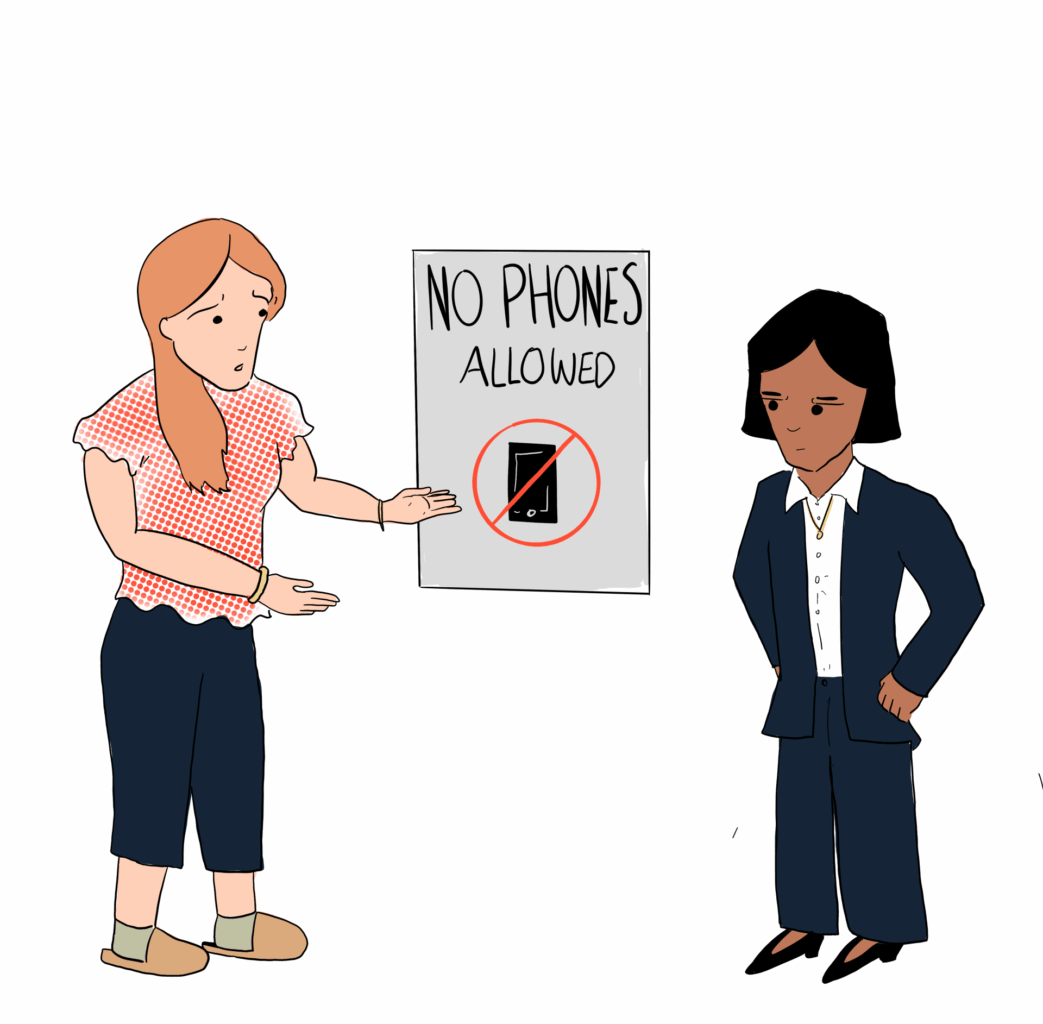
An illustration showing the conflict between parents and Georgia legislators over student phone access during school is shown. In May 2025, Georgia passed the Distraction-Free Environment Act which bans students’ personal devices from being accessible during the school day, which neglects the full context that Georgia students face everyday. “If I had my choice to amend that law, I would have added gun regulations to (it), I would say, ‘if we’re going to address the fact that phones are a distraction, we need to also give parents the sense of security that their children are going to be safe in schools.’” State Representative for GeorgiaHouse District 38 (D), RaShaun Kemp, said. Ill ustration by Sam Harwell
As Georgia lawmakers crack down on student cell phone use, they risk ignoring the realities of school safety and silencing parent concerns.
Over 860 school shootings have taken place in American schools since the 2023-24 school year, according to the K-12 School Shooting Database.
In this climate, a phone ban in all public K-8 schools in Georgia is unrealistic, as a student’s phone is often the only direct line families have in emergencies.
The Distraction-Free Environment Act, passed by Georgia legislators, requires all K-8 public schools to ban devices, such as cell phones, smartwatches and headphones, from the first bell to dismissal.
This law won’t be in place until July 2026, but the backdrop of school shootings rising, coupled with growing parent anxiety, is creating a conflict among school communities. Lawmakers and educators want a distraction-free environment for public schools, but parents and students fear losing vital communication.
“On the very day this (law) was being voted on in the House, my 14-year-old son texted me that his school was on lockdown and he didn’t know why. I didn’t get an email from the school explaining the situation until two hours after he was already home,” State Representative for Georgia House District 86 (D), Imani Barnes, said.
While a K-8 phone ban will not directly impact all high school students in Georgia, Clarke Central High School has already seen bans in place. As far back as 2012, CCHS has engaged in several cell phone bans with various degrees of implementation by staff. Likewise, in the fall of 2023, former Clarke County School District Superintendent Dr. Robbie P. Hooker provided phone pouches for the collection of phones for CCSD middle and high schools.
Some teachers collect them during the period, while others mandate they stay put away. Meanwhile, families must rely on the school’s communication system to contact students, a system that has worked in the past according to CCHS Assistant Principal Alexis Scott.
“When I was in school. If my parents needed to get a hold of me, they called the front office. They talked to my teacher or my counselor, whoever, and that’s who talked to me,” Scott said.
Phones may distract in class, but in a crisis, they are lifelines for students and families
Ideally, a school’s emergency contact system would work perfectly in any situation, but school contact systems are not infallible. One such example of school emergency contact systems failing was during the 2022 Robb Elementary School shooting in Uvalde, Texas, which claimed 19 lives.
“(Police) were alerted, they knew what threat was happening. They knew lives were being taken, and they did not act,” State Representative for Georgia House District 38 (D), RaShaun Kemp, said. “It was elementary kids reaching out to 911 and their parents, letting (police) know where the shooter was. As a parent, I totally understand the fear.”
Despite the reality of this imperfect system, Kemp and Barnes still voted for this law, Kemp acknowledging the clear benefits of restricted phone access in classrooms.
“If we want our schools and educators and students to be successful, we have to remove some of these distractions that are taking away from students being able to focus,” Kemp said. “If we can cut down, our students are able to be much more productive, and teachers feel much more supported.”
While it’s clear that phones are a distraction in the classroom and that phones in students’ hands can increase the spread of misinformation, families must have access to their children in times of need.
In order to address this need, Georgia lawmakers must revisit this ban to prioritize parent and student safety concerns as much as educational ones.
Phones may distract in class, but in a crisis, they are lifelines for students and families.