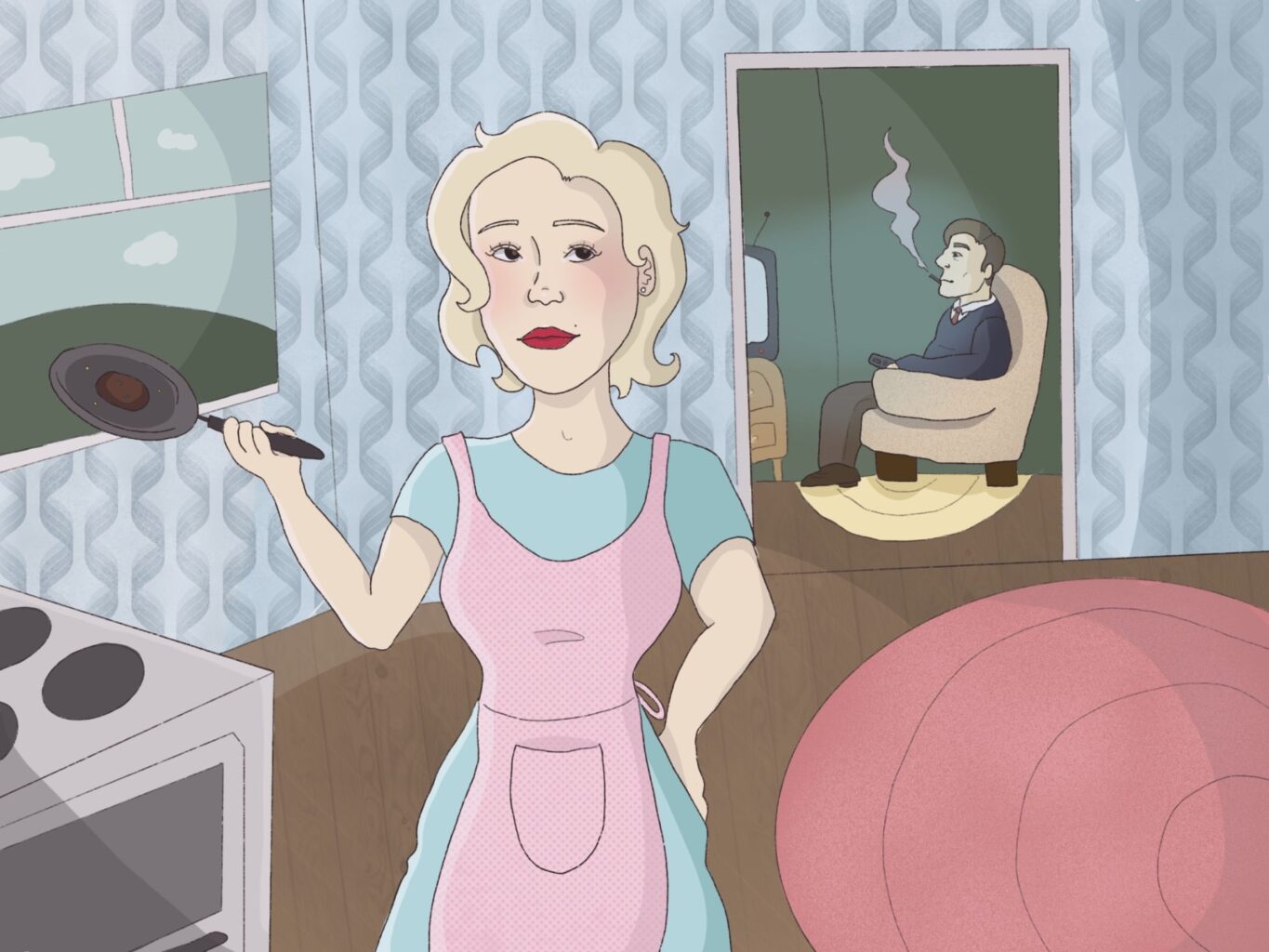
A woman stands in her kitchen cooking while her husband lounges in a different room. Variety Editor Adah Hamman discussed the importance of letting women choose whether or not to embrace traditional ideals. “Women should be encouraged to make informed decisions, whether that means pursuing a career, raising a family or both. Additionally, respecting these decisions is essential in order for society as a whole to move forward,” Hamman wrote. Illustration by Sylvia Robinson
Traditional gender norms aren’t inherently harmful, but shouldn’t be adopted at the expense of individual autonomy.
“I was going to be a ballerina. I was a good ballerina.”
These words, spoken by social media influencer Hannah Neeleman and recounted in a July 2024 The Times article, sparked online outrage. Users flooded the comments of her Instagram and TikTok with unwarranted hate, claiming that Neeleman’s husband was controlling and had forced her to abandon her dreams of becoming a professional dancer. They baselessly accused her of being complicit, anti-feminist and a tradwife.
According to the Cambridge Dictionary, the term “tradwife,” short for traditional-wife, is “a married woman, especially one who posts on social media, who stays at home doing cooking, cleaning, etc. and has children that she takes care of.” The concept has become increasingly popular over the past few years, especially on TikTok, where creators like Nara Smith have built platforms around it.
Smith has also received her fair share of backlash. After participating in a TikTok trend where couples share their relationships “unspoken rules,” multiple articles were published by different tabloids analyzing the pair and their marriage.
“I just think it’s weird to have rules preventing your spouse from doing anything in general…but hey, that’s just me,” Buzzfeed’s Larry Fitzmaurice wrote.
Empowerment means supporting every woman’s choice, and dismissing some as “outdated” does more harm than good.
Some argue that these influencers are “setting women back” by perpetuating stereotypes and promoting an outdated lifestyle. While this is true in some cases, critics are missing one key component: when a woman chooses to stay at home and raise her children, she is not falling victim to the patriarchy.
Instead, she is exercising the very right that generations of women have fought for: the right to determine their own path.
“Some of the narratives around (traditional gender roles) that are getting picked up by mainstream media (are) demonizing the fact that this is a chosen path, and for a lot of people (it) is (in) the same way that (others) might not want to live in that way,” Clarke Central High School English department teacher Molly Dorkey, who teaches the elective Introduction to Women’s Literature, said. “I think that a lot of it has been almost like a reaction to a feeling that things (have gotten) too liberal or too open-minded in some way.”
Instead of being shamed, women should be encouraged to make informed decisions, whether that means pursuing a career, raising a family or both. Additionally, respecting these decisions is essential in order for society as a whole to move forward.
Empowerment means supporting every woman’s choice, and dismissing some as “outdated” does more harm than good.