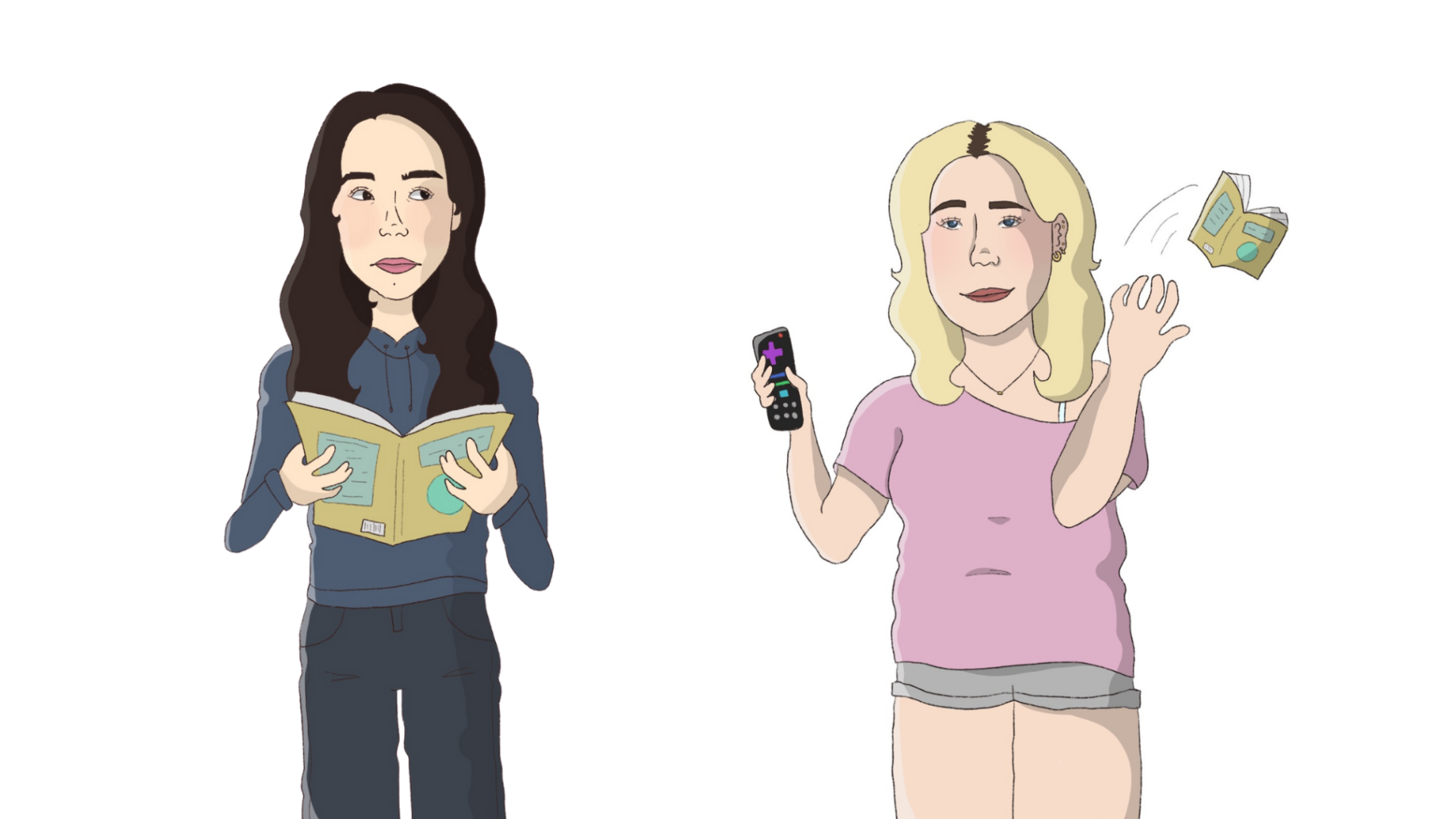
Digital Editor-in-Chief Lea D’Angelo (left) holds a book and looks at Viewpoints Staffer Sylvia
Robinson (right) as she throws a book away in favor of watching its movie adaptation. D’Angelo argued against the adaptation of books into movies or shows due to the changes characters and storylines often go through in order to make them more appealing to a wider audience. “Books should stay just that: words on a page,” D’Angelo wrote. “Creators are doing a disservice to audiences by turning them into anything else.” Illustration by Sylvia Robinson
Digital Editor-in-Chief Lea D’Angelo and Viewpoints Staffer Sylvia Robinson debate the issues with and benefits of book adaptations in media.
Books
Walk into most English classes at Clarke Central High School and you’ll hear this phrase uttered at least once: “Why read the book if I could just watch the movie?”
While movies and television shows are a valuable form of entertainment, adaptations force viewers to put their trust in creators who might not have the story’s best interest at heart.
“There are books that are able to do things that movies are not going to be able to do,” Clarke Central High School U.S. History in Film teacher Drew Wheeler said. “There’s more leeway in books, so (producers) had to figure out how to get it past the ratings boards and things like that. So, they’ve got to make some changes.”
By adapting, creators have the right to stray from the predetermined road map they’re given, however this has often resulted in sanitization of characters or plot points that might be unappealing to a wider, screen-based audience.
While this change, and ones similar to it across the industry, aren’t necessarily harmful, they shatter the images readers have built up in their mind and suggest the original material wasn’t socially acceptable.
For example, in American author Rick Riordan’s “Percy Jackson” book franchise, female protagonist Annabeth Chase is portrayed with blonde hair and blue eyes with an intelligent persona. However, in the 2010 adaptation, filmmakers made Chase more physically combative than intellectual, not to mention the actor’s brown hair and eyes.
Crucial plot points of the story were also overlooked and rushed, leading to the displeasure of readers and even the Riordan himself, which he described in a letter to producers after reading the script in 2009.
While this change, and ones similar to it across the industry, aren’t necessarily harmful, they shatter the images readers have built up in their mind and suggest the original material wasn’t socially acceptable.
Books should stay just that: words on a page. Creators are doing a disservice to audiences by turning them into anything else.
Adaptation
There are many reasons why media adaptations of books can be beneficial to people everywhere. Whether it’s a TV series or film accomodation in theaters, adaptations make stories more accessible than relying on original books.
This can apply to old books that don’t age well at all, especially those involving controversial issues. Creating adaptations can help lift or change those issues in the original storyline to make it acceptable in today’s society.
Although people may prefer the original book because it requires readers to imagine everything themselves, some have a difficult time picturing characters and settings visually or struggle with reading comprehension. Alternative media forms can help viewers build these pictures.
“There are benefits (of adaptations). You can see new things, engage people in a different way than the book, and still get that story out there,” Clarke Central High School U.S. History in Film teacher Drew Wheeler said.
“impairments. The inclusion of sounds or visuals can help them focus better on what’s happening, offering a richer and multisensory experience to reinforce the narrative of the plot for all and build a more diverse community for every book lover.”
These adaptations can help improve the viewing experience for people who have disabilities like dyslexia or visual impairments. The inclusion of sounds or visuals can help them focus better on what’s happening, offering a richer and multisensory experience to reinforce the narrative of the plot for all and build a more diverse community for every book lover. Because films are watched by people across the globe, people with disabilities who can watch these adaptations can also share their thoughts and opinions on stories with others.
Media adaptations of books are important to many even though the book may be preferred as the “original.” It’s important to offer a variety of ways to visualize and explain a story, making it more diverse and accessible to everybody.