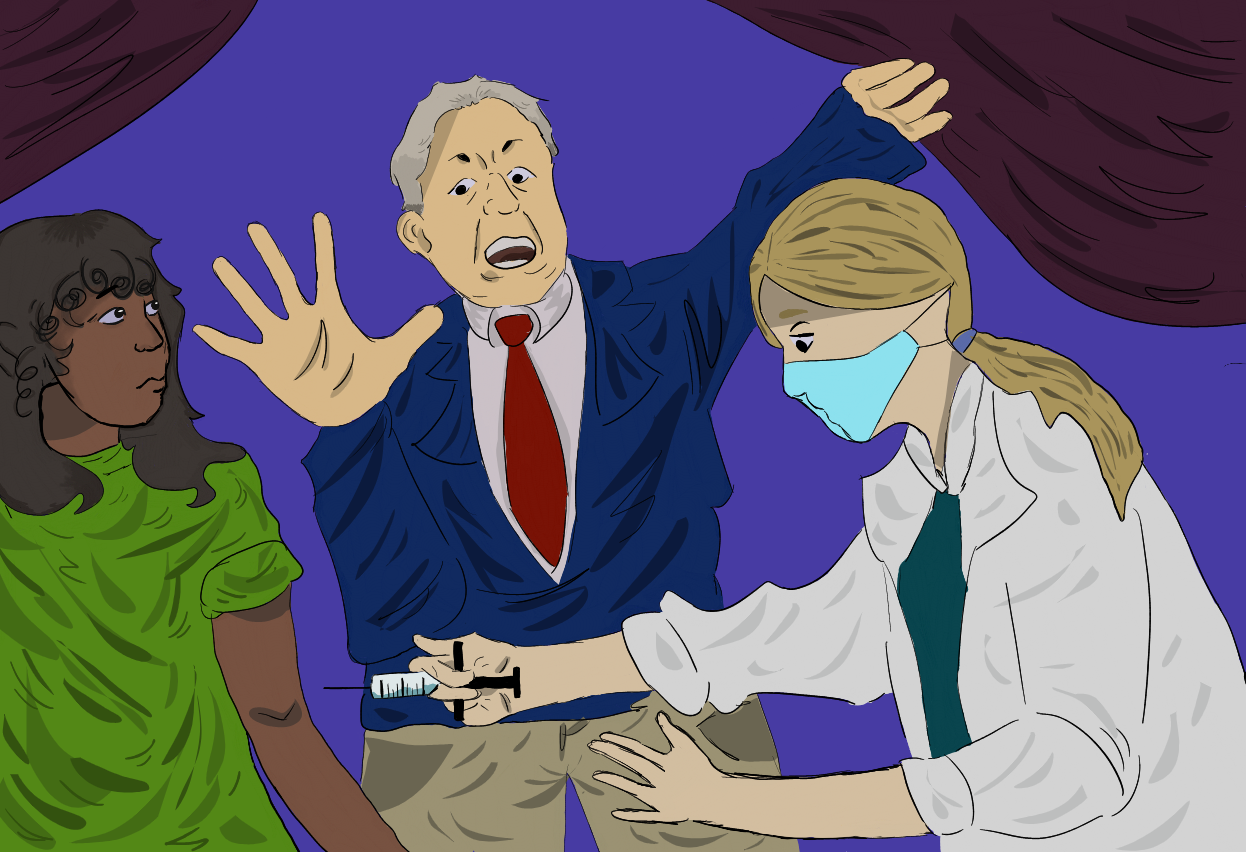
An illustration shows United States Health and Human Services (HHS) Secretary Robert F. Kennedy Jr. trying to prevent a person’s vaccination. Kennedy, who has promoted misinformation about vaccines in the past, was appointed as the HHS secretary on Feb. 13. “The Trump administration’s appointment of Robert F. Kennedy Jr. has only increased negative attitudes towards vaccines,” Variety Staffer Mzée Pavlić wrote. “Before his appointment to HHS secretary, Kennedy even founded Children’s Health Defense, a group which falsely claims that vaccines have caused an ‘autism epidemic.’” Illustration by Lucca Fleenor
Vaccine skeptics in the U.S. government like U.S. Health and Human Services Secretary Robert F. Kennedy Jr. have inspired anti-vaccine sentiment and policy across the country.
The first successful vaccine was created in 1796, and over the following 229 years, vaccines have expanded to prevent illness such as polio, measles and, more recently, COVID-19.
According to a 2024 study led by the World Health Organization, global vaccination efforts have led to at least 154 million lives being saved over the past 50 years. Despite the apparent positive effects of these vaccines, skepticism is reversing these accomplishments.
While vaccine skepticism is not new, the administration of United States President Donald Trump is empowering these sentiments. For example, on Feb. 14, Trump signed an executive order barring schools mandating the COVID-19 vaccine from receiving federal funding.
“(It) doesn’t matter what I feel, you feel or the president feels, it’s the mountain of data that (says), ‘Is this vaccine safe or not?’”
— Dr. Karen Norris,
University of Georgia professor in the Department of Infectious Diseases
Furthermore, the Trump administration’s appointment of Robert F. Kennedy Jr. as the U.S. Health and Human Services (HHS) Secretary, on Feb. 13, has increased negative attitudes towards vaccines. Before his appointment to HHS secretary, Kennedy often criticized the measles, mumps, and rubella (MMR) vaccine and even founded Children’s Health Defense, a group which falsely claims that vaccines have caused an “autism epidemic.”
“We have the president and the secretary of Health and Human Services saying things like, ‘I feel like the vaccine is not safe,’” University of Georgia professor in the Department of Infectious Diseases Dr. Karen Norris said. “That doesn’t matter. (It) doesn’t matter what I feel, you feel or the president feels, it’s the mountain of data that (says), ‘Is this vaccine safe or not?’”
An infographic shows the number of confirmed measles cases in the United States over the past five years. Due to a decrease in the number of people vaccinated against measles, the number of cases has exploded in 41 U.S. states since the start of 2025. “About the year 2000 in the United States, the cases of measles were so low it (had) basically been eliminated,” University of Georgia professor in the Department of Infectious Diseases Dr. Karen Norris said. “What has happened since (2000) is this spread of ideas that vaccines are not safe for babies and children and so just enough people have chosen not to immunize their children or their babies.” Graphic by Mzée Pavlić
This anti-vaccine sentiment is not exclusive to the U.S. federal government. For example, on Sept. 3, the Florida Health Department announced the ending of vaccine mandates for dangerous diseases like Hepatitis B., pneumococcal disease, Hib, and chickenpox. The removal of these mandates in environments like schools, where viruses can spread easily, has the potential of putting students and their families at risk.
“For your friends or family, especially people with higher risk of getting sick easily, it’s better for them to get vaccinated when they’re supposed to,” Lindsey Pinto-Alvear, CCHS senior and former Athens Community Career Academy Allied Health and Medicine (phlebotomy) pathway student, said. “I have a grandma who has diabetes. It’s good for her to get her vaccines because (the) flu affects her really (badly).”
The present day would be unrecognizable without the work of vaccines. Without vaccines, children in the U.S. would be worrying about paralysis by polio and life inside an iron lung. Without vaccines, influenza would be killing hundreds of thousands in the U.S. as it did during the 1918 pandemic. And finally, without vaccines, students would still be stuck in virtual lessons.
If this anti-vaccine wave spreads to more state governments, the safety vaccines once provided may be at risk of collapsing.