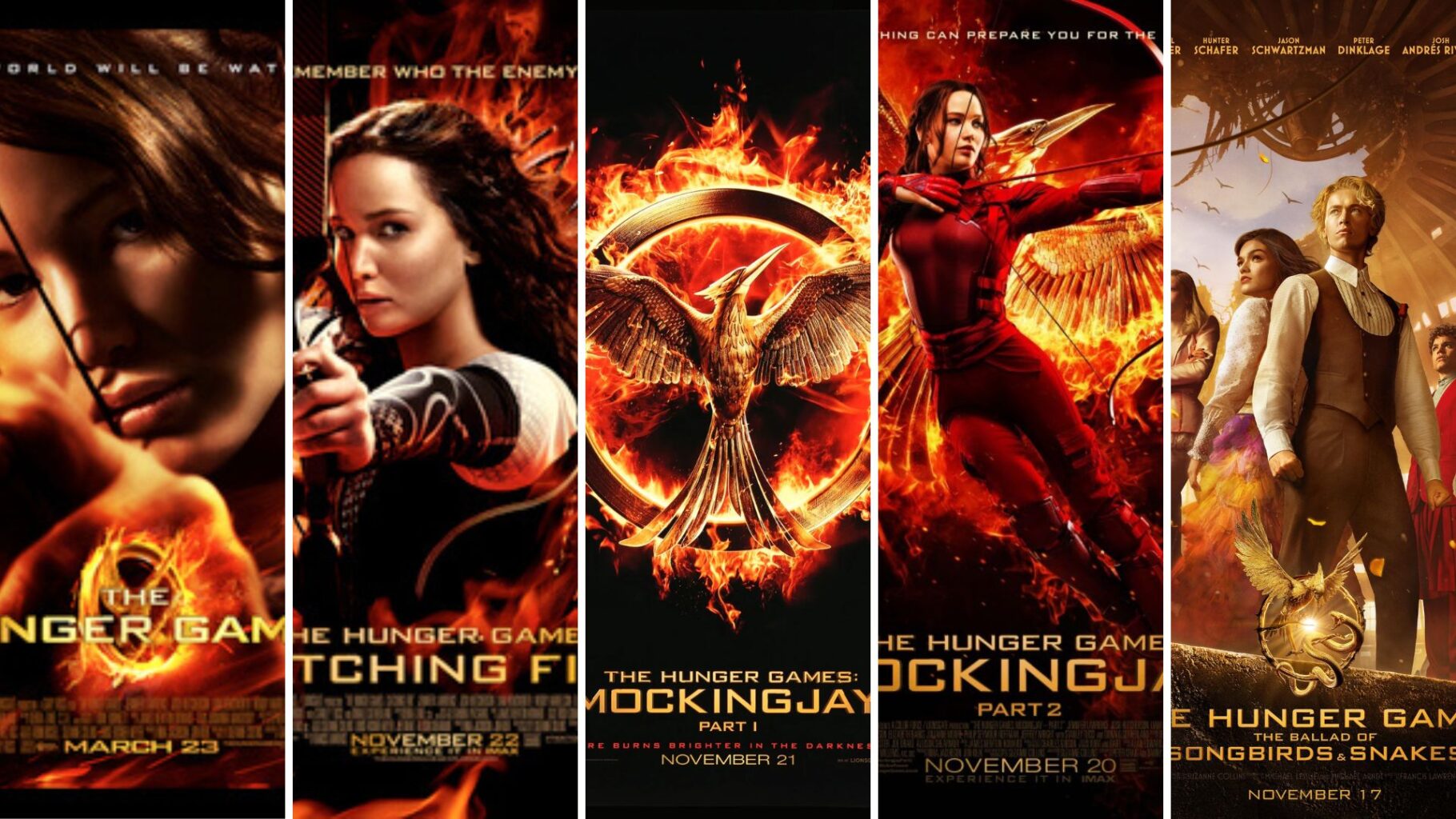
A graphic features the posters for all five “Hunger Games” movies. Since the creation of the “Hunger Games” series in 2008, it has served to show a hypothetical of what could happen when the United States crumbles. “The story that was originally set in a post-collapse U.S. is seeing its cautions come to fruition in modern-day America,” Digital Feature Writer Abigail Holloway wrote. Graphic by Lea D’Angelo
During a tense political era in the U.S., “The Hunger Games,” originally written as a dystopian warning for dictatorship in post-collapse America, is coming closer and closer to reality.
“What you’re seeing and what you’re reading is not what’s happening.”
Pop quiz: Which “Hunger Games” book or movie is this line from? “Catching Fire?” Maybe “Mocking Jay Part 2?” Or perhaps “The Ballad of Songbirds and Snakes?”
Wrong. This is actually United States President Donald Trump in 2018, criticizing the media’s reaction to him placing tariffs on the U.S.’s largest trade partners.
It is no secret that the “Hunger Games” series, originally written by Suzanne Collins and later adapted into a five-part film series, holds political messages. But since its creation, the fictional post-collapse U.S. setting has evolved from a warning to a reality. Similar to President Trump’s anti-media sentiment, in “The Hunger Games” the leaders work to dismiss any media that goes against them.
The series follows main character Katniss Everdeen (Jennifer Lawrence) as she participates in and wins the 74th Hunger Games, an annual competition where 24 children fight to the death to remind the 12 districts of the bloodshed that occurs when they attempt to revolt against the wealthy Capital government.
Throughout the story, viewers see protests being covered up and those who speak out as leaders in the revolt punished. The series shows the Capitol blocking almost all footage of these protests, trying to silence any beliefs that go against theirs.
“Fear does not work as long as they have hope, and Katniss Everdeen is giving them hope,” President Snow (Donald Sutherland) said in “The Hunger Games: Catching Fire.”
Over the summer of 2025, the U.S. saw a similar reality in regard to protests against President Trump’s mass deportation initiatives. People in every state took to the streets to show their outrage with the policies and how they would go out to support their neighbors possibly facing deportation.
Despite the First Amendment stating that everyone in the U.S. has the right to free speech, press and assembly, during these protests there were clear attempts to limit those rights. At a protest in Downtown Los Angeles, Australian journalist Lauren Tomaski was shot in the leg with a rubber bullet while live on-air.
It is no secret that the “Hunger Games” series, originally written by Suzanne Collins and later adapted into a five-part film series, holds political messages. But since its creation, the fictional post-collapse U.S. setting has evolved from a warning to a reality.
“A little hope is effective, a lot of hope is dangerous.” President Snow said in “The Hunger Games” movie when discussing how he kept the districts content until Katniss appeared in the public eye as a voice for change. Letting the districts feel like they could make change, but not with enough power that they could actually do something.
This same sentiment can be seen with protests in the U.S. For example, according to a May 2025 article from The Guardian, The U.S. has changed a lot since the large volume of protests in 2020 that were for a variety of issues, but not in the way activists had hoped.
According to the U.S. Department of Defense, President Trump has a $1.01 trillion national defense budget request for 2026. A 13.4% increase from 2025 for a military which is already ranked in the top five for global military power.
“Try not to look down on people who had to choose between death and disgrace,” Coriolanus Snow (Tom Blyth) said in “The Ballad of Songbirds and Snakes.”
Change doesn’t happen without people who are willing to put themselves on the front lines of political opposition, to be labeled “rioters” in the news like Katniss and to risk their lives for the change they want to see.