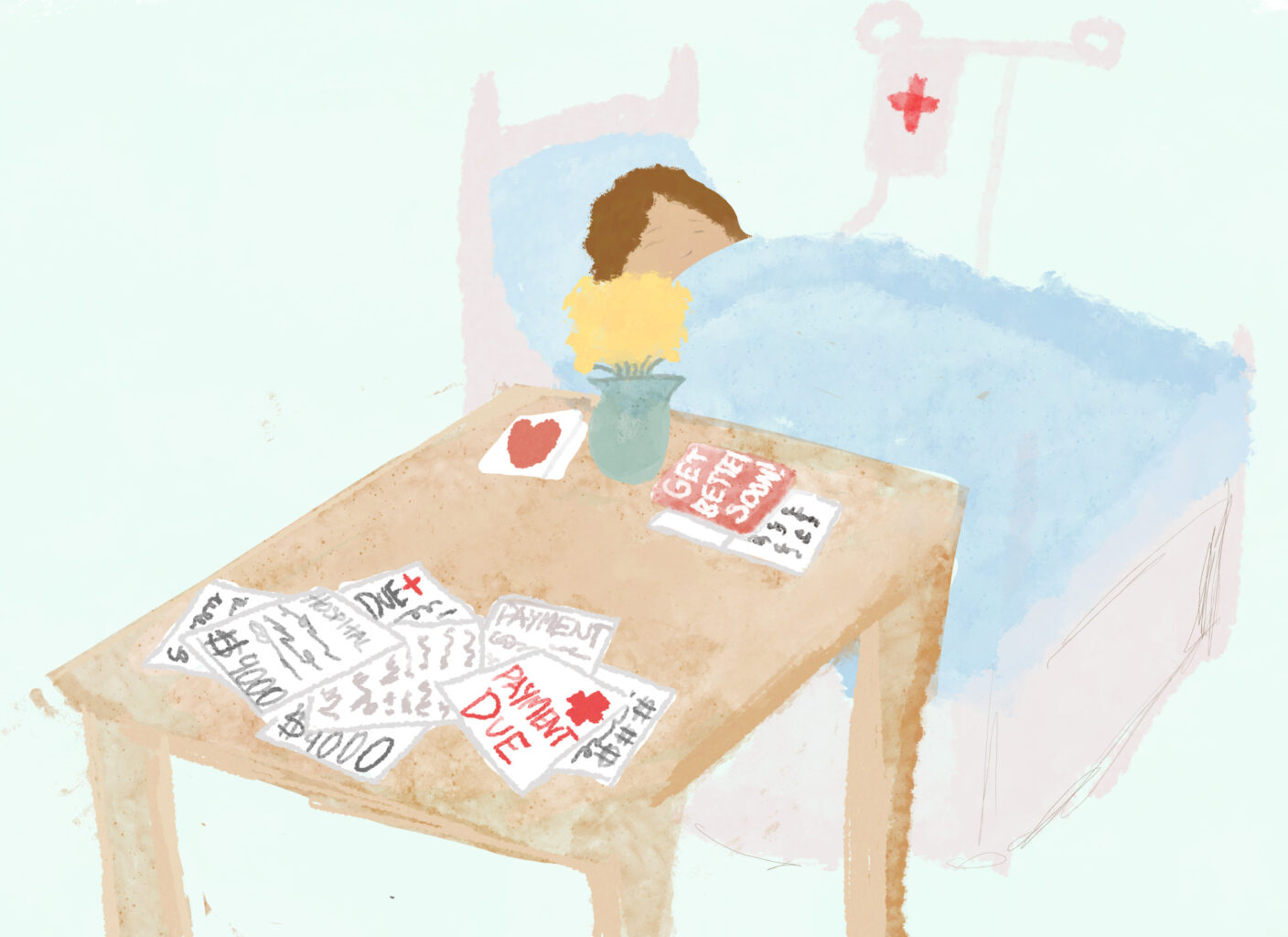
A patient sits in recovery, overwhelmed with medical expenses. According to the American Bankruptcy Institute, medical debt was the leading cause of bankruptcy for United States citizens. “Private companies like UnitedHealthcare, which are supposed to offer support in dire times, refuse to shelter their customers from the steep prices of medical coverage.” Managing Editor Jane Ripps wrote. Illustration by Sam Harwell
The United States healthcare system is fundamentally flawed, and rebuilding it will take extreme efforts private companies and politicians refuse to address.
One shot.
That’s all it took for a masked man to shoot and kill Brian Thompson, the Chief Executive Officer of UnitedHealthcare, on the streets of Manhattan on Dec. 4, 2024.
According to Northeastern Criminologist James Alan Fox, Thompson’s murder is a “symbolic takedown” of the company he represented: the greed infesting in the United States healthcare system that burdens the everyday citizen.
According to the Peter G. Peterson Foundation, medical care in the U.S. is estimated to cost a whopping $12,742 per person, which is the highest healthcare costs per capita across wealthy countries. But, regardless of the expensive coverage, Thompson’s UnitedHealthcare denied approximately one-third of claims in 2023, tying for the largest denial rate from a health insurance company in the nation.
Consequently, medical debt is the leading cause of bankruptcies for U.S. citizens, as reported by the American Bankruptcy Institute.
U.S. healthcare, which is supposed to be a resource for survival, is a cash grab
Healthcare companies like UnitedHealthcare, which ostensibly aim to provide medical services, instead are focused on profit to the detriment of their constituents. So, although Thompson’s murder was a pivotal moment, it didn’t just take one shot to take down this healthcare system. Rather,the flaws are deeply ingrained in the capitalistic values of the U.S.
“The United States has always bought and sold healthcare as if it’s a commodity, where everybody else in a developed nation really believes that it’s a human right to access healthcare and a human right to have good health. There’s a fundamental difference in the belief systems,” Dr. Grace Bagwell-Adams, associate professor at the University of Georgia College of Public Health, said.
Let’s face it: U.S. healthcare, which is supposed to be a resource for survival, is a cash grab.
Due to the expense, the percentage of uninsured households increased from 13% in 2016 to 19% in 2022 in Athens-Clarke County, as per Athens Wellbeing Project’s Health Report.
According to the report, “Families who are low income and employed were significantly less likely to have health and dental insurance through their job, and thus were less likely to have access to the healthcare they need.”
Given the complexity of healthcare policy, the real systemic change needs to come from companies such as UnitedHealthcare. Unfortunately, as the nation faces a new political era — one with a president determined to eliminate affordable healthcare initiatives — the hope for improvement is only growing grimmer.
Contrary to narratives being pushed by politicians, this one shot wasn’t the first of its kind nor a new breed of barbaric protest. Instead, it represents the pressure on the healthcare system that has been building for decades.
It will only keep building. Until it can’t be ignored.
