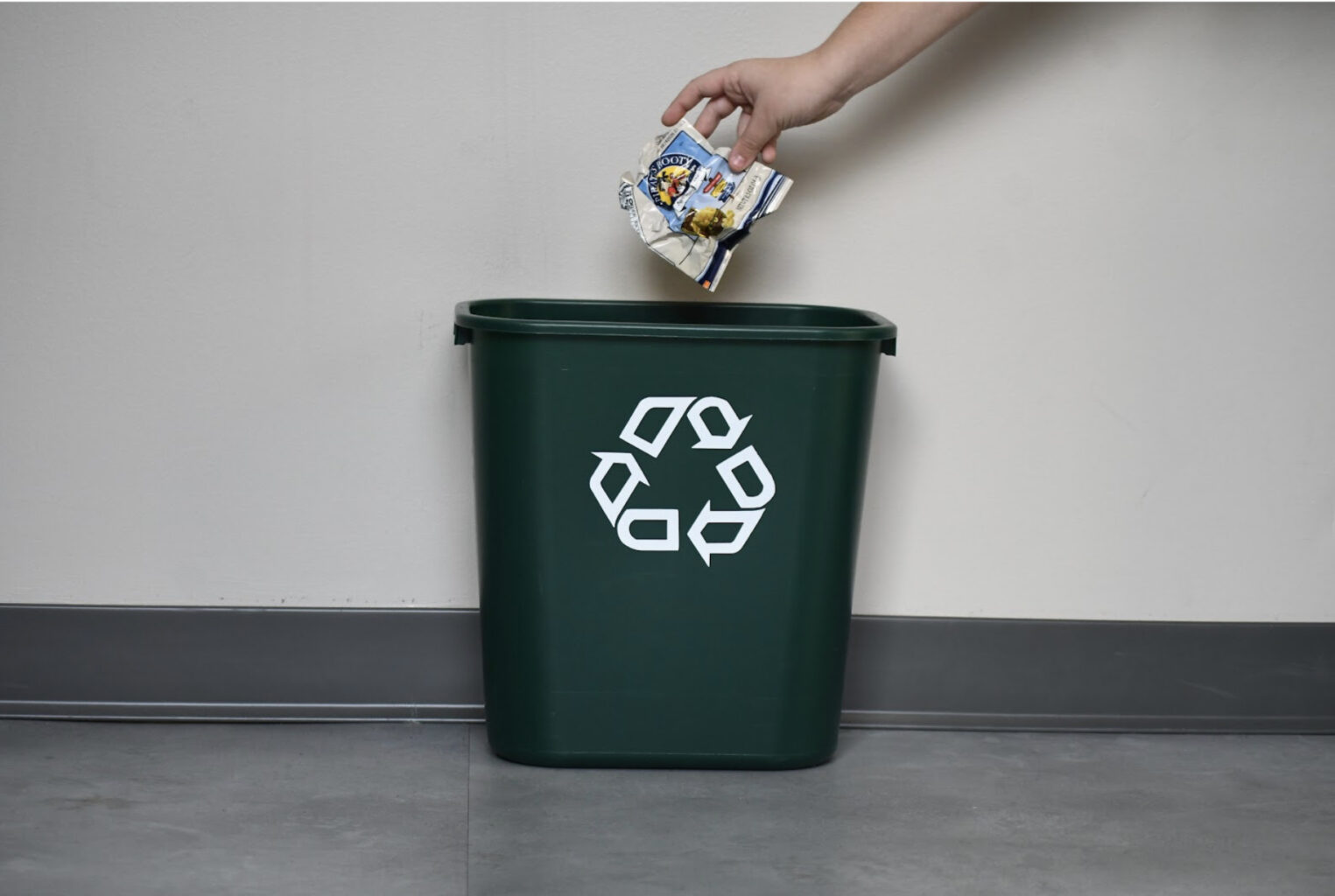
A Clarke Central High School student throws a chip bag into a recycling bin outside of Room 261 on Dec. 16, 2025. CCHS science department teacher Matthew Shuman, who has worked with Ecology Club students to form a recycling program inside the club, has seen students throw away non-recyclable items in the school recycling bins and knows how affects both the CCHS student body and people collecting the bins. “I don’t do nearly as much work on a regular basis as the Ecology Club (members). Those are the (kids) who are getting out and doing what’s necessary,” Shuman said. “(CCHS Recycling would be) yet another program that fell apart because no one really did the work, then the recycling wouldn’t (happen).” Photo by Miriam Silk
The mixture of trash and food products dispensed into recycling bins prevents recycling for Ecology Club students and the CCHS student body.
On a Wednesday after school, members of Clarke Central High School’s Ecology Club can often be found walking through the halls, emptying the recycling bins and ensuring the contents are clean and recyclable.
This Student-led Recycling Program, which formed after Ecology Club students assumed the role of taking out recycling, was started by CCHS science department teacher Matthew Shuman in the 2022-23 school year when he saw that the original CCHS bins for waste dispensed trash and recycling into the same trash can. However, since the initiative began, an ongoing problem of non-recyclable waste being thrown into the bins have made it hard to effectively recycle at CCHS.
“I have to stop (Ecology Club students) and say, ‘This is all contaminated. This is all trash.’ They want to go through (every bin) and sort, which (is) a phenomenal amount of work that wasn’t required and just inappropriate to ask (of) them,” Shuman said. “Going through people’s trash is not what students who are actively changing their community should have to do.”
There are currently over 45 recycling bins throughout CCHS for students to discard recyclable items, such as paper, cardboard, glass and metal. However, according to Ecology Club member Cineret Cervantes-Palma, a CCHS senior, who volunteers on Wednesday afternoons from 3:35 to 4:30 to empty recycling bins, many bins end up being full of food waste and trash items.
“(The Ecology Club) usually finds trash. I remember one time we found a Chick-fil-A biscuit in one of the science (department) halls, (where) bins tend to have a lot more food. I think (this problem) stems from the fact that it’s tempting to put trash in recycling. Once, we even found an entire chip box,” Cervantes-Palma said.
“Going through people’s trash is not what students who are actively changing their community should have to do.”
— Matthew Shuman,
CCHS science department teacher
The recycling program depends on CCHS students taking accountability for their actions, and for Athens-Clarke County Solid Waste Department Office Assistant Jay Beatty, a junior, that responsibility means bringing more attention to the consequences of those actions.
“Education about (recycling) would help, but you can’t educate people who don’t care about it in the first place,” Beatty said. “It’s complicated, because there’s not an easy fix, but I think there should be more field trips to (the Solid Waste Department), because (when) you see where your trash and recycling end up, it makes (the problem) more real.”