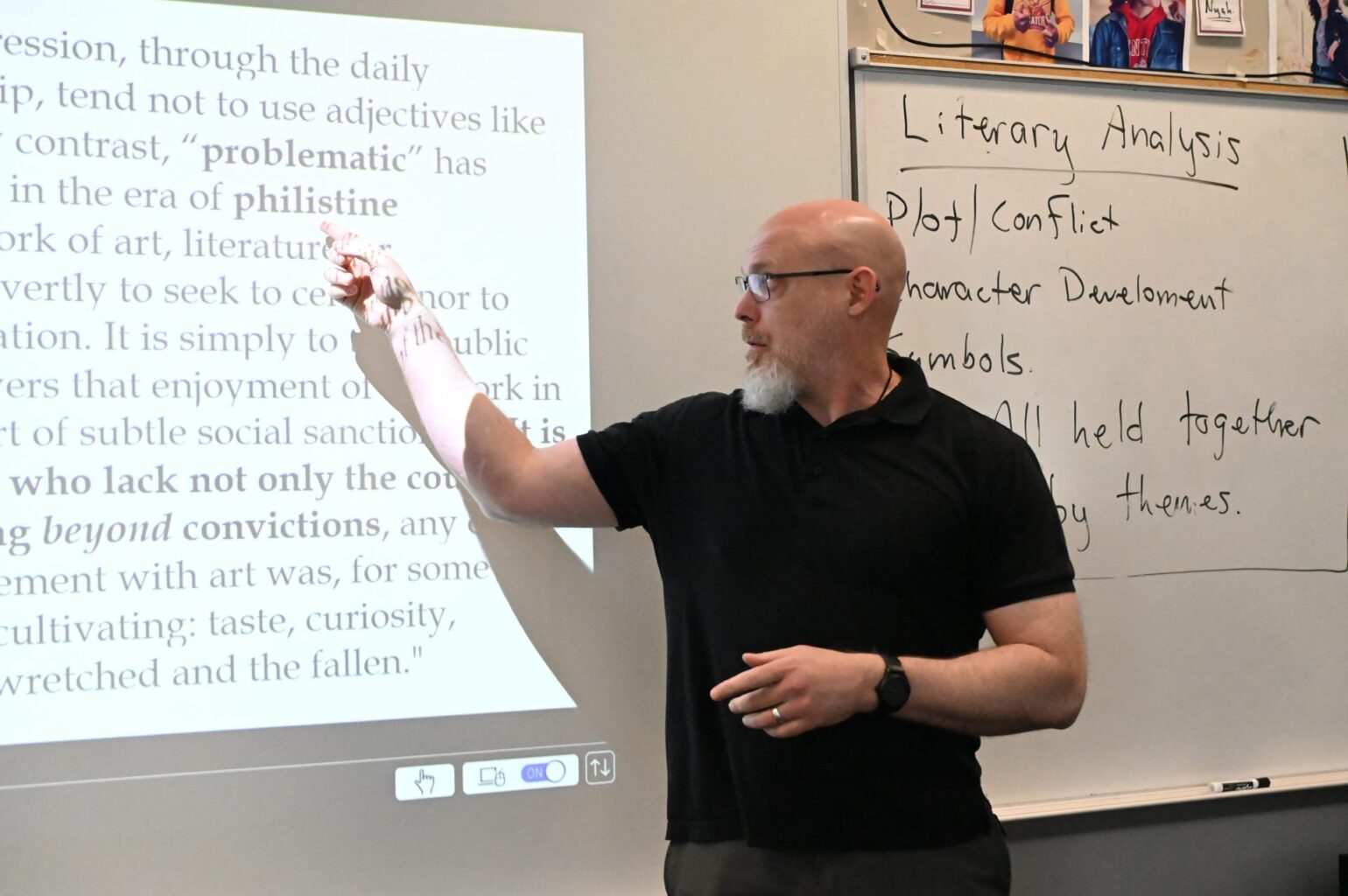
Clarke Central High School English department teacher Ian Altman teaches in Room 229 on Oct. 16, 2025. Altman earned his Masters degree in Philosophy from UGA after spending 11 years taking extra classes, purely out of a desire to learn more. “I wasn’t taking a full load (of classes) each semester since (1998) or so. I would take one or two classes per semester and just save money and pay as I could for whatever classes that I wanted to take, and just refuse to take that one class that would force me to graduate,” Altman said. “I was fine being poor, I had enough (money) from working odd jobs around (Athens).” Photo by Maypop Wren
CCHS English department teacher Ian Altman’s curiosity shines through in his teaching, influenced by a lifetime of education and philosophy.
Walking into Clarke Central High School English department teacher Ian Altman’s Advanced Placement Language and Composition and American Literature classrooms, nothing seems out of the ordinary.
The room is lined with philosophical textbooks, and Altman can be found with straight posture, matching the stoic manner in which he meets with his students.
Nothing about the room suggests that Altman picked up “Irrational Man” at 15, a book that sparked his interest in philosophy and taught him the idea that nothing is sacred enough to not be questioned.
Nothing suggests that Altman would attend the University of Georgia for 11 years for a degree in Philosophy, working odd jobs to pay for literature classes purely out of a desire to know more.
Beyond the textbooks in his classroom, nothing suggests that his philosophy professors would go beyond teaching him arguments or research, but also model how to instruct students in unbiased ways that encourage curiosity. Such guidance would eventually lead him to pursue teaching in the English department at CCHS after graduating with a Masters degree in 2006.
Nothing suggests how Altman’s passion for philosophy would assist him in 2021 when he suffered from a stroke due to a blood clot in his brain. It was unexpected and required six months of frustrating recovery, but left him with an understanding of the freedom of thought.
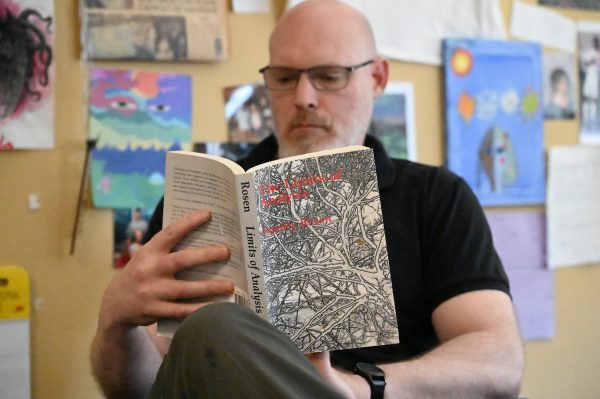
Clarke Central High School English department teacher Ian Altman reads “Limits of Analysis” by Stanley Rosen at his desk in Room 229 on Oct. 16, 2025. In 2021, Altman suffered from a stroke that affected his memory, speech and physical ability and required six months of recovery. “Feeling absolutely free to think whatever I want allowed me to emotionally deal with my stroke, because it is kind of funny that nature is so imperfect,” Altman said. “At that point, I was living a very healthy life. The (stroke was due to) a blood clot in my brain, and that was it, no one ever figured out what caused it. Nature played a cruel joke. That doesn’t mean it wasn’t funny. The freedom of saying that (helped me recover).” Photo by Maypop Wren
No object could show these things, but when looking deeper, signs of Altman’s philosophical and educational journey shine in his otherwise simple teaching techniques.
Because Altman helps students with many things, but most especially, with questioning why.
To push students to truly think about their answers and interpretations of class material, to never lead with assumptions and to question everything, a style of guidance that stems from how philosophically Altman leads his own life,
This is seen with how he was able to turn the stroke and its aftermath into a real-life learning example of what he learned in high school from “Irrational Man”, though perhaps he hadn’t understood it at that time: sometimes, nature is imperfect.
“I don’t have a single principle by which I live my life, because philosophy is not seeking answers, it’s clarifying further and further questions,” Altman said. “In my teaching and my own life, I think that absolutely everything should be questioned, and absolutely nothing is sacred.”