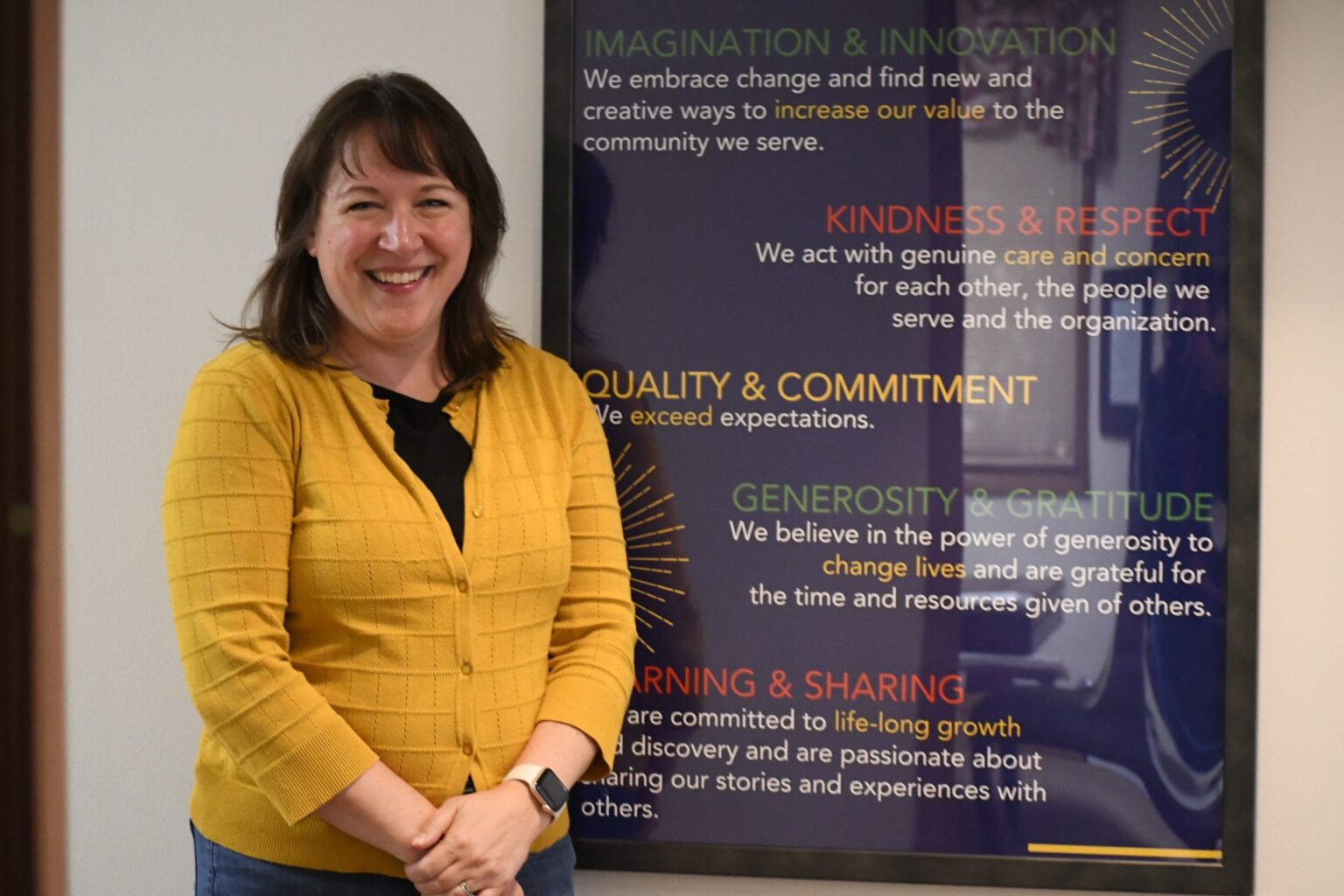
Athens Community Council on Aging Vice President and Director of Operations Erin Beasley stands in front of a poster denoting the ACCA’s mission and values at the ACCA, located at 135 Hoyt St. on Oct. 14, 2025. Beasley’s participation in the ACCA began when she was a student pursuing a baccalaureate degree in Health Promotion and Behavior at the University of Georgia from 2002-05, and it has greatly affected her view on ageism, which is unfair discrimination based on age. “We’re trying to work to change (the ageist) narrative a little bit,” Beasley said. “(The ACCA) both lifts up the idea that getting older is not something to be afraid of, but something to celebrate, and that older people are incredibly active, involved in their communities and that they bring a lot of value to their communities.” Photo by Miriam Silk
Athens Community Council on Aging Vice President and Director of Operations Erin Beasley discusses the organization and her role within it.
News Staffer Sasha Barkan: How would you describe the Athens Community Council on Aging?
Athens Community Council on Aging Vice President and Director of Operations Erin Beasley: We are a community organization that works to make sure that everyone in our community has the opportunity to age well. That looks different for different people. That can be as simple as, “I want to stay engaged in my community through volunteering and want to continue to give back once I’m retired,” to, “My situation means that I need a little extra support, and it’s helpful for me to have a meal delivered every day at lunchtime and have a volunteer to visit and talk with.” We are a hub for aging services, and anything that somebody needs or (wants) to do as they get older, we want to have that opportunity for them here.
SB: Can you tell me about your role at the ACCA?
EB: I oversee a handful of our programs from an administrative level. Our leadership team splits up our programs and groups that we oversee. I’m also responsible for a lot of our policy management, academic partnerships, community partnerships, bringing new projects and programming ideas, and) helping our staff bring those to life.
SB: How did you become the vice president and director of operations?
EB: It’s been a long road. My (baccalaureate) degree is in Health Promotion and Behavior from (the University of Georgia and) when I was a student at UGA (from 2002-06), I had the opportunity to do a practicum in the Adult Day Health Program at the ACCA. I really enjoyed that. When I graduated (in 2006), (the ACCA) had a position open as the activities coordinator in that program. I jumped at that and was fortunate to be hired. I had another position at (The Red and Black, a news publication) for a little while, and then came back to the ACCA in 2013 and have worked in some different programs, and then I’ve been (in) my current role for about nine years now.
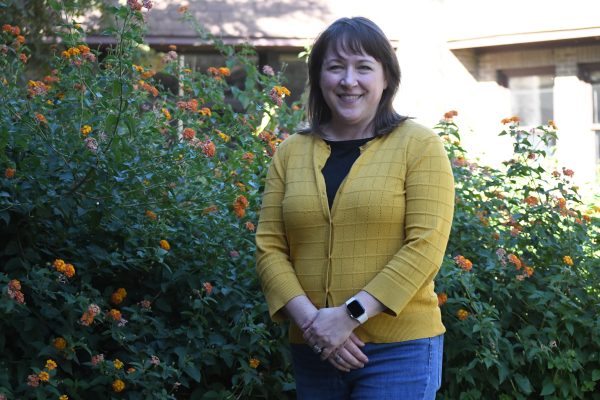
Erin Beasley, the Athens Community Council on Aging Vice President and Director of Operations, stands outside Athens Community Council on Aging’s office building at 135 Hoyt St on Oct. 14, 2025. Beasley has worked to foster an inclusive community for older adults throughout her tenure at ACCA, which she worked at from 2005-06 and rejoined in 2013. “We are a vibrant hub, and (our goals are) building up that vibrant hub and creating a space where the entire community is welcome, and where older (people are) able to get any service or support that they need, but where they’re also able to stay active, stay engaged (and) thrive alongside us,” Beasley said. Photo by Miriam Silk
SB: What do you think are some of the biggest misunderstandings about aging?
EB: The perception of aging has changed with this new generation of older adults. (When) the show, “The Golden Girls,” came out (in 1985, the actresses’) average ages were between 45 and 50. I’m 48. What I want at my age is very different than what the Golden Girls wanted. There is still a perception that older folks are frail (and) can’t do things that they can still very much do. A lot of people, when they think about an older person, that age has gone up and up and up and up. If you ask a 55-year-old, “Do you consider yourself an older adult?” they’re probably going to say, “No.” A lot of people think, “That’s great that (the ACCA does a service) but I’m not old enough for that.” We’re trying to work to change that narrative a little bit. (We) both lift up the idea that getting older is not something to be afraid of, but something to celebrate, and that older people are incredibly active, involved in their communities and that they bring a lot of value to their communities.
SB: How does the ACCA push that message into Athens?
EB: That is something that we’re in the middle of addressing, (the idea that) “Well, (the ACCA does) great work, but I’m not old enough for it,” or, “They help people, but I don’t need help.” We’re trying to do a lot of outreach and marketing to really celebrate older adults and make (sure) that we’re providing opportunities within the community for people of all ages to either serve together or socialize together, so that we can break down some of those barriers.
SB: What do you think is driving negative perceptions of aging?
EB: There is a lot of light ageism. As far as discrimination goes, ageism is still kind of accepted. Just, “Oh well, when you get old, you can’t do this,” or, “When you get old, this happens.” When my kids were younger, (on) the 100th day of school in kindergarten, you would dress up like (an) 100-year-old. You would see all these little kids coming in with little fake walkers and wigs and walking with canes and things like that. If you had any other day where you said, “Dress like this type of person,” that would be horrible. You can’t generalize and stereotype like that. I think (ageism) is still (an) accepted form of discrimination.
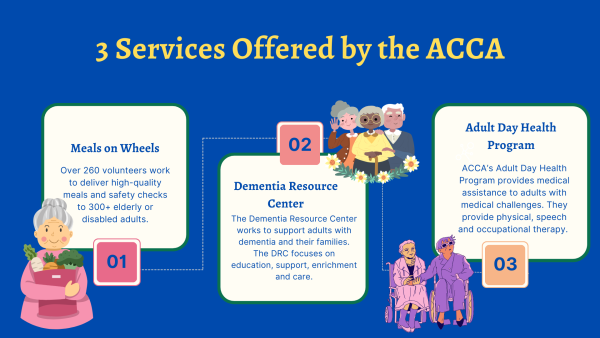
An infographic shows three services offered by the Athens Community Council on Aging. The ACCA was founded in 1967 and works to engage the older adults it serves through a variety of enrichment activities. “When we’re doing outreach events, we like to make sure we invite our participants to share their stories, because that’s the most impactful thing for people to hear,” ACCA Vice President and Director of Operations Erin Beasley said. Graphic by Sasha Barkan
SB: How do you encourage ACCA adults to socialize?
EB: Our Center for Active Living (does) a lot of trips and travel experiences with members in that program. They actually just got back from their first international trip to Athens, Greece, so they were out in the world enjoying themselves. When we’re doing outreach events, we like to make sure we invite our participants to share their stories, because that’s the most impactful thing for people to hear. (We aim to be) shining a light on unexpected things people part of our organization are doing. Adventures in Dining Club folks try new restaurants once a month within our Center for Active Living. We have our Dementia Resource Center, and they do some combined programming where they have a monthly “Happy Hour”, as well. (Sometimes, when) you see a group of older people out having a great time, those are some ACCA folks.
SB: Can you describe the variety of supports that the ACCA offers?
EB: We can serve any older adult wherever they are on the health spectrum. Obviously, we’re not a skilled nursing facility or a medical facility. However, (we welcome) anyone, from the most incredibly active, engaged and fit 55-year-old who’s just retired to our oldest client, (who) is 108 and a member of our Adult Day Health Program. If we said, “Find the 108-year-old,” you would not find her. She is still incredibly active, sharp (and) engaged because she has those additional supports that we provide.
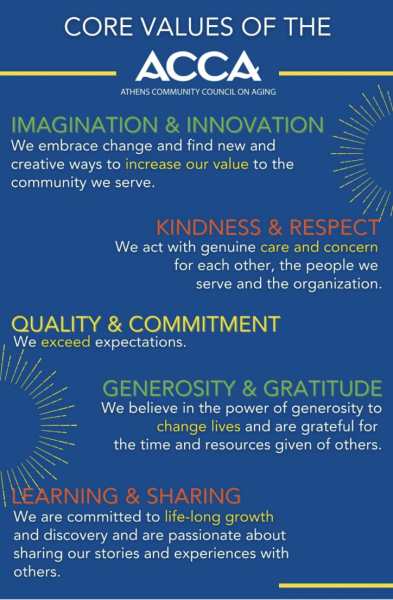
A poster shows the Athens Community Council on Aging’s core values. The ACCA has a variety of services and programs, ranging from a Dementia Resource Center to an Adventures in Dining Club. “We can serve any older adult wherever they are on the health spectrum. Obviously, we’re not a skilled nursing facility or a medical facility,“ ACCA Vice President and Director of Communications Erin Beasley
said, “However, (we welcome) anyone, from the most incredibly active, engaged and fit 55-year-old who’s just retired to our oldest client, (who) is 108 and a member of our Adult Day Health Program.” Poster courtesy of Erin Beasley
SB: Is it ever challenging to facilitate so many different kinds of support?
EB: We have 14 different programs and services. Athens is our core, so everything that we do is provided here in Clarke County. As you go into the 12-county Northeast Georgia region, a lot of our programs also touch (there), as well. Our Long Term Care (Ombudsman) Program is our largest geographic program, and those are folks who advocate for the rights of people living in residential facilities (and) personal care homes. We’ve got a big footprint, so trying to shrink all of that information down into a digestible “Here’s what we do” has been challenging for us. (However), we’re working on ways to make sure people know if you are an older adult, you’re caring for an older adult or you might become an older adult, reach out to us. We can either help, and we have the service, or we can get you connected with the people who do.
SB: How do you support clients who are facing challenges unrelated to aging, like homelessness?
EB: We work with anyone regardless of what their situation is, but we do have clients who have chronic conditions that they’ve been managing for quite a while. We have folks who may have developmental disabilities that (have) contributed to their situation. A lot of times, the support that they had throughout their time in school, (like) special education programs, once they become an adult, those supports go away, and that’s where programs like our Adult Day Health Program can step in. Even though we are the Athens Community Council on Aging, that program does serve people 18 and up, (including disabled adults). Homelessness is an issue that we see with older people. A lot of times, the needs of those folks are much higher, because if they’ve been living unsheltered for an incredibly long time, (that) creates lots of other issues.
We’re trying to do a lot of outreach and marketing to really celebrate older adults and make (sure) that we’re providing opportunities within the community for people of all ages to either serve together or socialize together, so that we can break down some of those barriers.
SB: Where would you like to see ACCA in 10 years?
EB: Those are the questions that we are asking ourselves right now. “What does the future look like for us?” We are a vibrant hub, and (our goals are) building up that vibrant hub and creating a space where the entire community is welcome, and where older (people are) able to get any service or support that they need, but where they’re also able to stay active, stay engaged, (and) thrive alongside us.