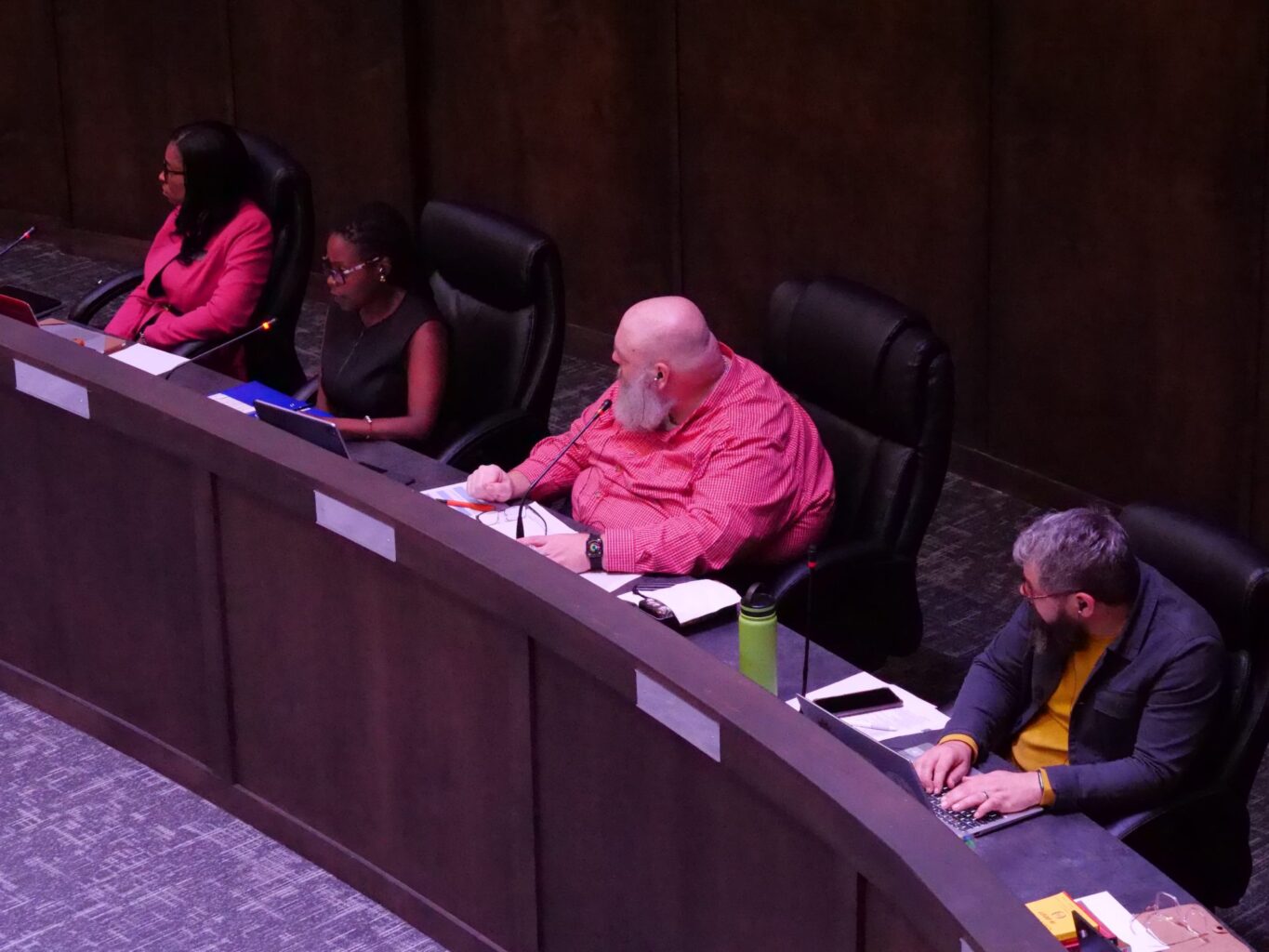
Clarke County School District Board of Education District members sit at the CCSD Administrative Offices, located at 595 Prince Ave., during the Oct. 9 BOE meeting. Clarke Central High School English department teacher Cat Mills spoke during public comment at the Nov. 13 BOE meeting to raise concerns over the CCSD’s partnership with CommonLit 360, an English teaching software after teaching a unit of its curriculum and receiving feedback from her students. “The overwhelming response was (students) either liked it because it was easy or they hated it because it was easy,” Mills said. “Many of the honors students were like, ‘This was such a waste of time, I would much rather read an entire book. This felt childish and unnecessary.’” Photo by Sasha Barkan
CCHS English department teacher Cat Mills argued against the use of CommonLit 360, an English curriculum, at the Nov. 13 CCSD BOE meeting.
Clarke Central High School English department teacher Cat Mills spoke during the public comment portion of the Clarke County School District Board of Education’s Nov. 13 meeting, raising concerns about the use of CommonLit 360, an English curriculum software for middle and high school students.
This semester, CCHS Literature and Composition I teachers piloted one unit of the six-unit curriculum CommonLit 360 at the requirement of CCSD leadership. The program aims to promote class engagement and help students reach grade-level proficiency in understanding and analyzing texts. The unit doesn’t include any books, something Mills criticized during the meeting.
“(Students) need to be exposed to a wide variety of texts and to be given time to read. To change English into a test prep subject removes it from the power that the written word can have,” Mills said. “When I taught 11th grade (literature at CCHS from 2022-25), I integrated test prep, but to make that the totality of what we do bastardizes what (teachers are) here for.”
“We’re losing students (and) losing funds. No Child Left Behind is putting pressure on (teachers) to perform according to the state standards.”
— Dr. Patricia Yager,
CCSD BOE District four representative
During the meeting, the BOE also reviewed performance data from Comprehensive Support and Improvement and Targeted Support and Improvement schools, which are federally identified as having a low-performing population or low-performing demographic group, respectively. CCSD BOE District four representative Dr. Patricia Yager acknowledged the identification of these schools as a motivator for the use of test preparation materials, such as CommonLit 360.
“Ever since No Child Left Behind, (the federal government can) judge schools by how well their students do on tests. We federally categorize schools that are failing, (and students) in a federally failing school can get money from the state to go to (a) private school,” Yager said. “We’re losing students (and) losing funds. (NCLB) is putting pressure on (teachers) to perform according to the state standards.”
CCHS senior Bryce Johnson, who attended the meeting and witnessed Mills’s speech, has experienced this push to test during his time at CCHS, causing him to recognize both importance and concerns in test preparation.
“(Test preparation) can be valuable, but (curriculum) should have some type of balance,” Johnson said. “You’re going to take tests in life. You take tests for college (and) to get your (driver’s) license. Those are (important) tests, but (curriculums) should be able to balance it out to where you can have test prep and actual (content) that we’re learning.”