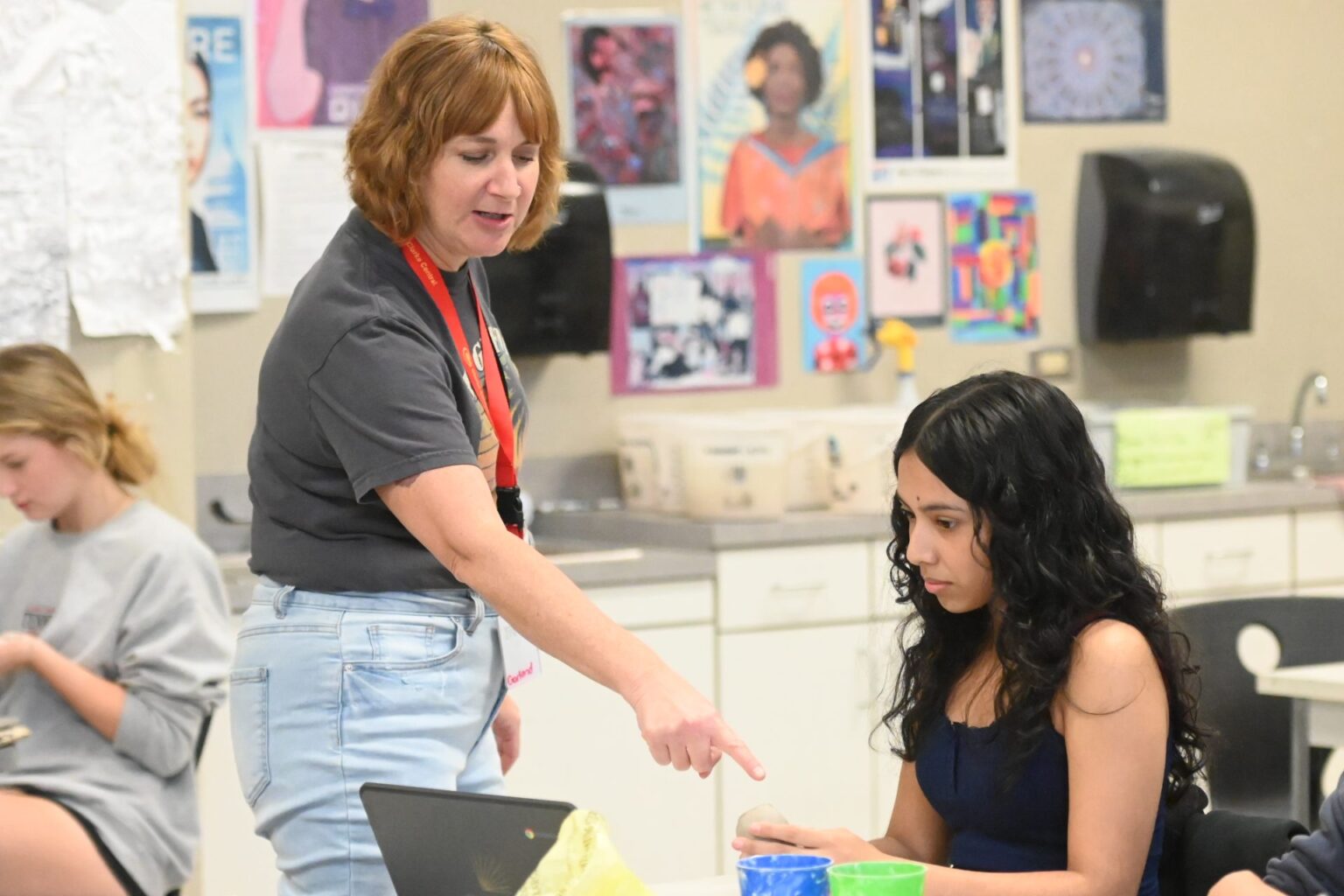
Clarke Central High School fine arts department teacher Heather Garland helps a student in Room 164 on Sept. 24. Garland has taught her students to be able to express themselves within their artwork, as well as to connect their work to memories they’ve had. “We really tap into (the students’) personal interests and their personal experiences when they’re brainstorming their ideas and coming up with a new idea for a project. We give them a lot of props, and we really cater to all students, no matter what their experience is,” Garland said. Photo by Iliana Tejada
CCHS fine arts department teacher Heather Garland shares the rationale behind hands-on learning within her classroom.
Viewpoints Staffer Sylvia Robinson: What is sculpture?
Clarke Central High School fine arts department teacher Heather Garland: Sculpture is art that takes up space. 2D art is drawing, painting, photography and then 3D art is sculpture. Any sort of artwork that takes up space, (like) fiber arts, clay, paper (or) paper-mache, anything like that.
SR: What made you decide to teach sculpture?
HG: This is my sixth year (at CCHS), so when I started, I was asked to teach Sculpture I and Ceramics I classes. (CCHS fine arts department teacher) Jessica Shelden was the first teacher to kick off a really good 2D (art) program. Then, (former fine arts department teacher Dr. Amanda Price) came a couple years after (Shelden) and decided at some point in time to start a 3D program. Then, eventually, I decided to start a ceramics program, so I got a grant to get consumable ceramics materials or supplies. I started off with just Ceramics I, and then I was like, “We should have a Ceramics II, (and so on.)” So, now we have Ceramics I, II and III on top of sculpture classes, which is a little bit of everything. I really enjoy teaching it.
SR: How does working with physical materials differ from how many other classes listen to lectures?
HG: I feel like hands-on learning is crucial to assisting with anything in your life. There’s so many skills that you learn by having tactile projects that really help you in other areas of your life. I realize everybody has to take lecture classes and whatnot, but I also feel like they should be incorporating hands-on (activities) in those classes as well because (if) students have something in their hands, then they’re getting into (the lesson) more. They’re less likely to get distracted by outside forces, and being able to hold something and to create it is really beneficial for you to figure out how to problem-solve and how to keep pushing yourself through your ideas. (Students) care so much about being on their phones and (are) so interested in social media, I’m just like, “Okay, how do we change that mindset?”
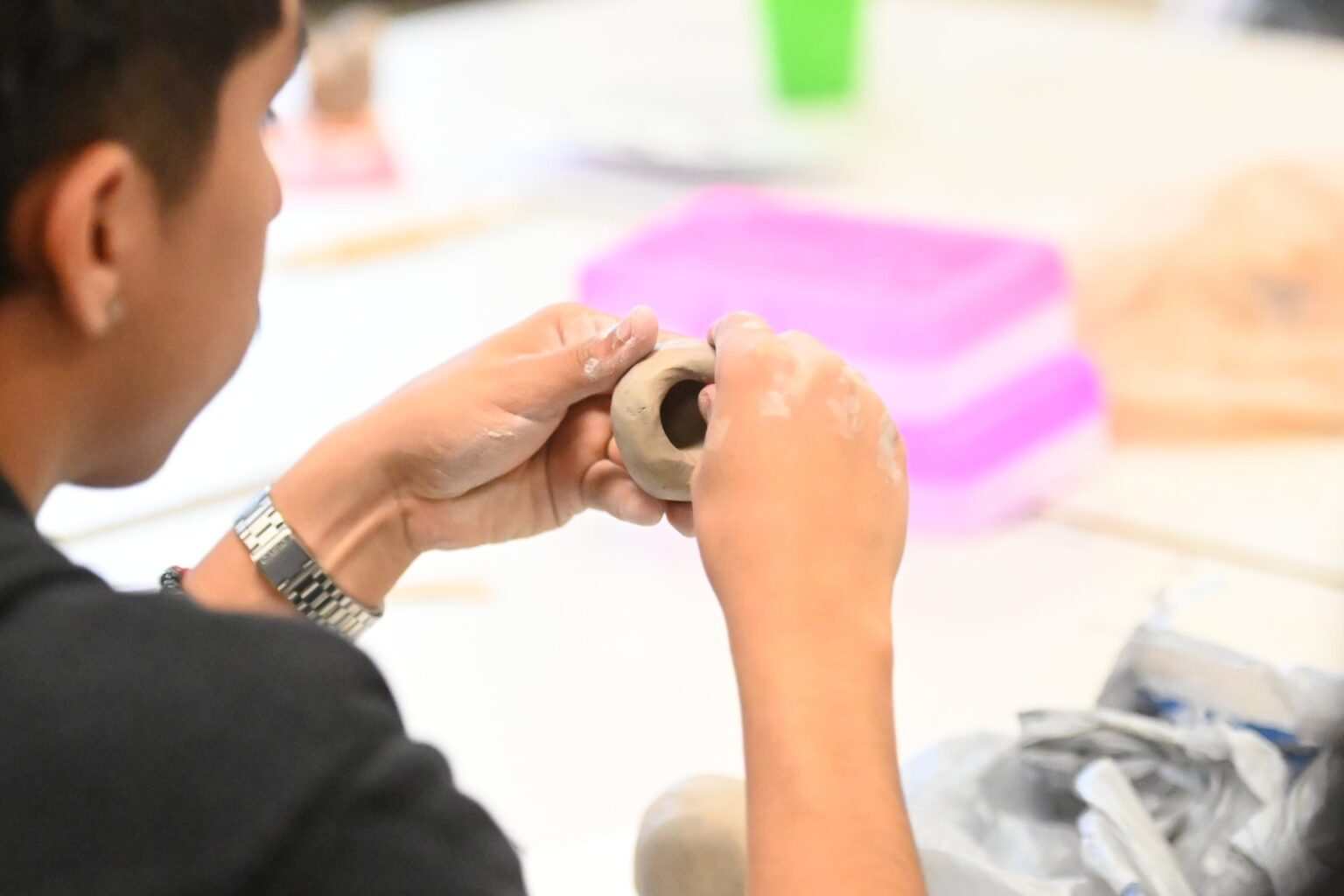
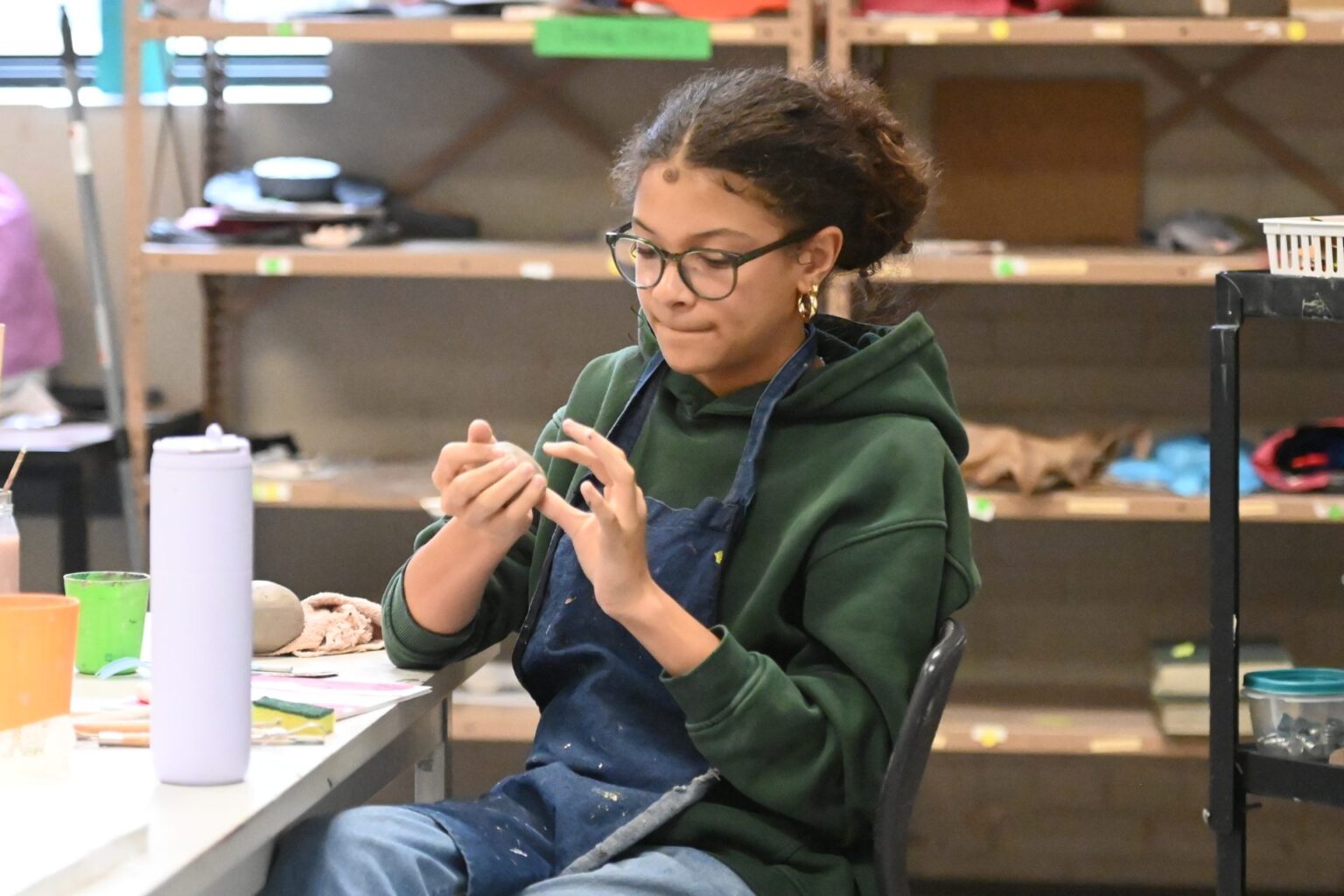
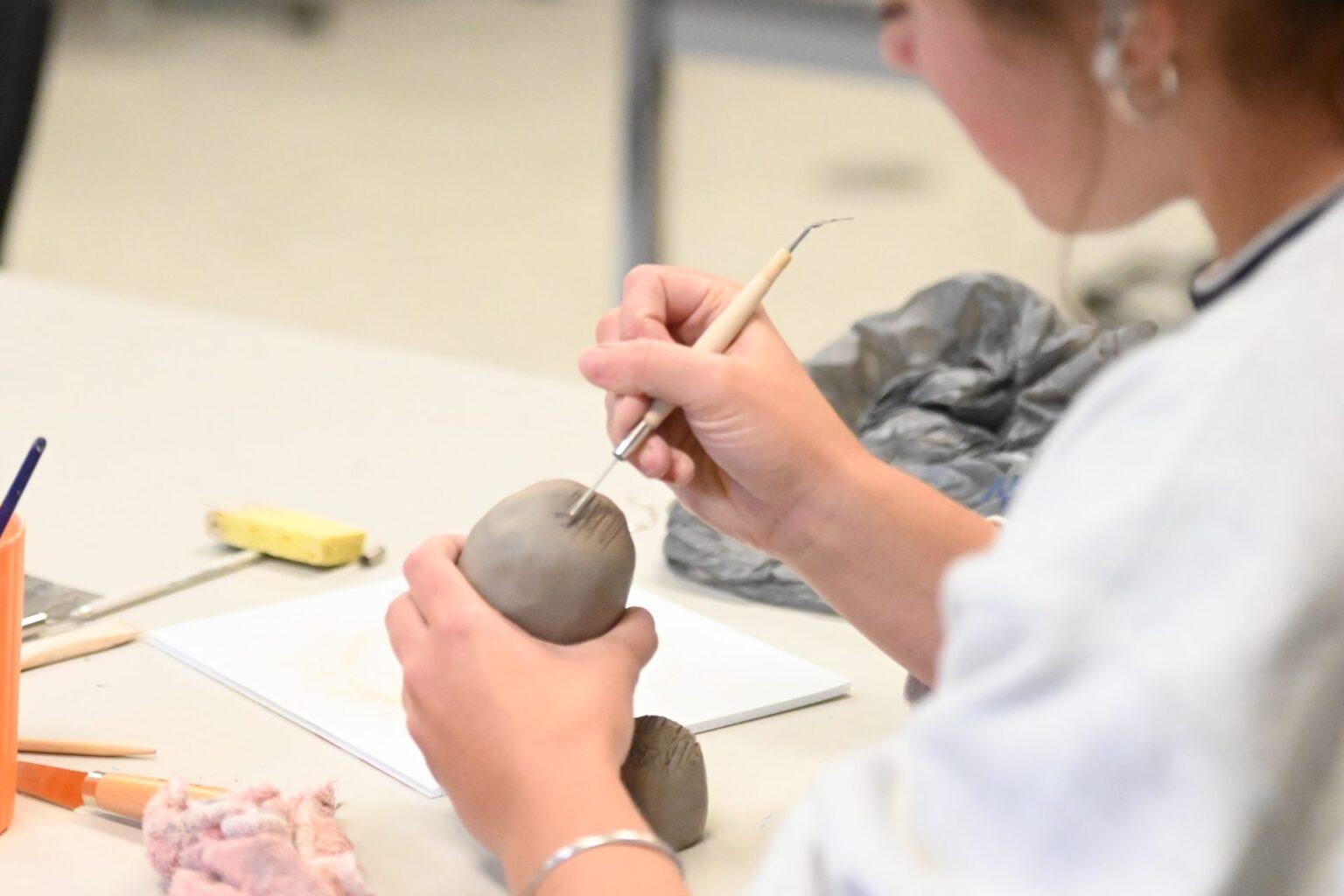
Clarke Central High School students work with clay during their Ceramics I class in Room 164 on Sept. 24. CCHS fine arts department teacher Heather Garland saw the importance of doing 3D work in school, how it impacted students and what it evolved to. “It is so different than their other classes, (where) they’re not doing anything with their hands,” Garland said. “I think (it’s) so important for them to be able to work through their problems without having to memorize something for a test.” Photos by Iliana Tejada
SR:How can hands-on activities such as 3D projects spark creativity?
HG: (With) any sort of art project, whether it be 2D or 3D, we give (students) the resources to come up with their own idea. So, it’s not like, “Make a sculpture of a person.” We go a little bit further into that. We really tap into their personal interests and their personal experiences when they’re brainstorming their ideas and coming up with a new idea for a project. We give them a lot of props, and we cater to all students, no matter what their experience is. I’ve had kids that come in here and they’re like, “I can’t do (art). I don’t know how to make that.” I’m like, “Well you’re about to learn, (and) you’ll be great.” We give them those opportunities (to have creativity), so seeing the kids come up with these ideas, and bring it to life into some sort of art form, whether it be 2D or 3D, is pretty fun, and they usually surprise themselves. It’s fun to watch that process unfold and to see them generally surprised at what they were able to do.
SR: What is the process behind sculpture projects in the Sculpture II and Ceramics I classes?
HG: (With) my ceramics class, they have a unit on pinch pots. Each unit is based on a technique. (Pinch pots) seem basic, but you can do so many cool things with it, (like) adding feet, texture, etc. (After they’re finished,) we’re (going to) donate them to (The Food Bank of Northeast Georgia) (because) they have a luncheon in February, (which) is (one of) the formatives (the class is doing). I always make sure I have plenty of practice for them leading up to the (summative), so once they get to (it), they know exactly what they’re doing. They’ll plan out their project, and) I give them lots of props to choose from. Then, they’ll create the summative, which is a larger bust. For this particular project, they’re coming up with their own myth
SR: In what ways do you see sculpture connect with students’ other classes?
HG: I think it kind of goes back into problem-solving. Students come in and think, “Oh, it’s an art class, so easy.” But really, we are enabling you to come up with your own ideas. (When) working through the process, you’re going to have problems (and need to know) how to fix those problems. (It’s) really applicable to other classes. With any other class, you’re gonna get stops, you’re gonna not know how to move forward, and (it) is so important to be able to work through that. You’re building the confidence to be able to take on bigger tasks. We’re also connecting to artists outside of the classroom, and I feel like that’s important in other classes, (as well as how) it’s applicable in the real world. We do (these lessons) because there’s so many opportunities. If you’re taking art classes, what kind of opportunities are (you there) for? There’s plenty. There’s so many different places you can go, (and) I don’t think a lot of students realize that. It’s limitless.
SR: Could you share a memorable experience with a student where a hands-on project made a difference to them?
HG: I bring this story up a lot. It’s sweet. (This student) was a junior when I taught her three years ago. They were making these oversized papier-mache projects, and she made this gigantic pie. It was pretty cute. It was a memory that she had of her grandmother. That’s why (CCHS art teachers) find it so important to tap into their personal experiences, so they have a reason to make what they’re making. So, she made this gigantic paper mache pie that had to do with a memory of her grandmother. When she finished it, she showed it to me (and) goes, “I didn’t think that I could make something like this.” These kids, they’re coming in and doing things that they’ve never done before. I’ve had students that will start my classes (that have) never touched clay before and they (find their) calling. Seeing the students grow as artists from wherever they were on day one of the classes is really uplifting.
This is totally different (from) those classes, but equally as important. I think it’s good for (students) to see that (they’ve) got this class that is not just memorizing information, (but a class that’s) working a different part of their brain.
SR: What challenges have you seen students face when using physical materials?
HG: It seems like the biggest issue I have is kids not wanting to (work with me). As a teacher, that’s frustrating to me, (and) a lot of them are gonna have (that mindset) because they’re just not used to getting their hands messy, so just getting (them) comfortable with it. With sculpture, you can’t always skip a step. Right now, (students) are making plushies, (and) if they don’t read the directions, they might put something together incorrectly. I have a student in my second block that’s making a little practice plushie, but she didn’t attach it correctly in one spot, so she (had) to go back and start over. A lot of them are not patient (and) the biggest challenge they’re going to come in with is not having that patience. It’s not gonna turn out perfect the first time, and that’s okay. And I try to tell my students, “It’s gonna take you a few times to (like the way) it (looks). You can’t just sit down and expect to just be able to do something like that.”
SR: Why is it valuable for students at this age to have opportunities to create things with clay or 3D art?
HG: Because it is so different than their other classes. They’re not doing anything with their hands. They’re (usually) taking a class where they’re just gonna have to memorize information, (but) I don’t have quizzes (or) tests in here. Their summatives are their projects. I think (it’s) so important for them to be able to work through their problems without having to memorize something for a test. It’s so different, and a lot of kids think, “Oh, this class isn’t as important as the one that has the (End-of-Course Exams).” Why do you think that? You’re not having to learn information and just regurgitate it. You’re being provided an experience where you get to come up with an idea and actually bring it to life and work through your problem-solving. This is totally different (from) those classes, but equally as important. I think it’s good for them to see that (they’ve) got this class that is not just memorizing information, (but a class that’s) working a different part of their brain.
SR: What are your goals for your students choosing the Sculpture II and Ceramics I art pathway?
HG: They do have a digital portfolio that they create at the end of the class, and I try to encourage them to sign up for (the next courses). So, usually when they’re choosing a pathway, I’m like, “Okay, would you prefer clay (some) days, (or) clay all semester?” (There are) some students that would do it all day, every day. So, that’s a big question for them, it’s like, “Okay, what are you more interested in? What’s your favorite medium to work with?” So, I have a lot of students signed up for Sculpture II because they like the variety in the day, and I think that’s great. Each semester, I want them to be confident enough to move to the next class, so I need to make sure everything feeds into each other, and that is something I’ll be getting used to.