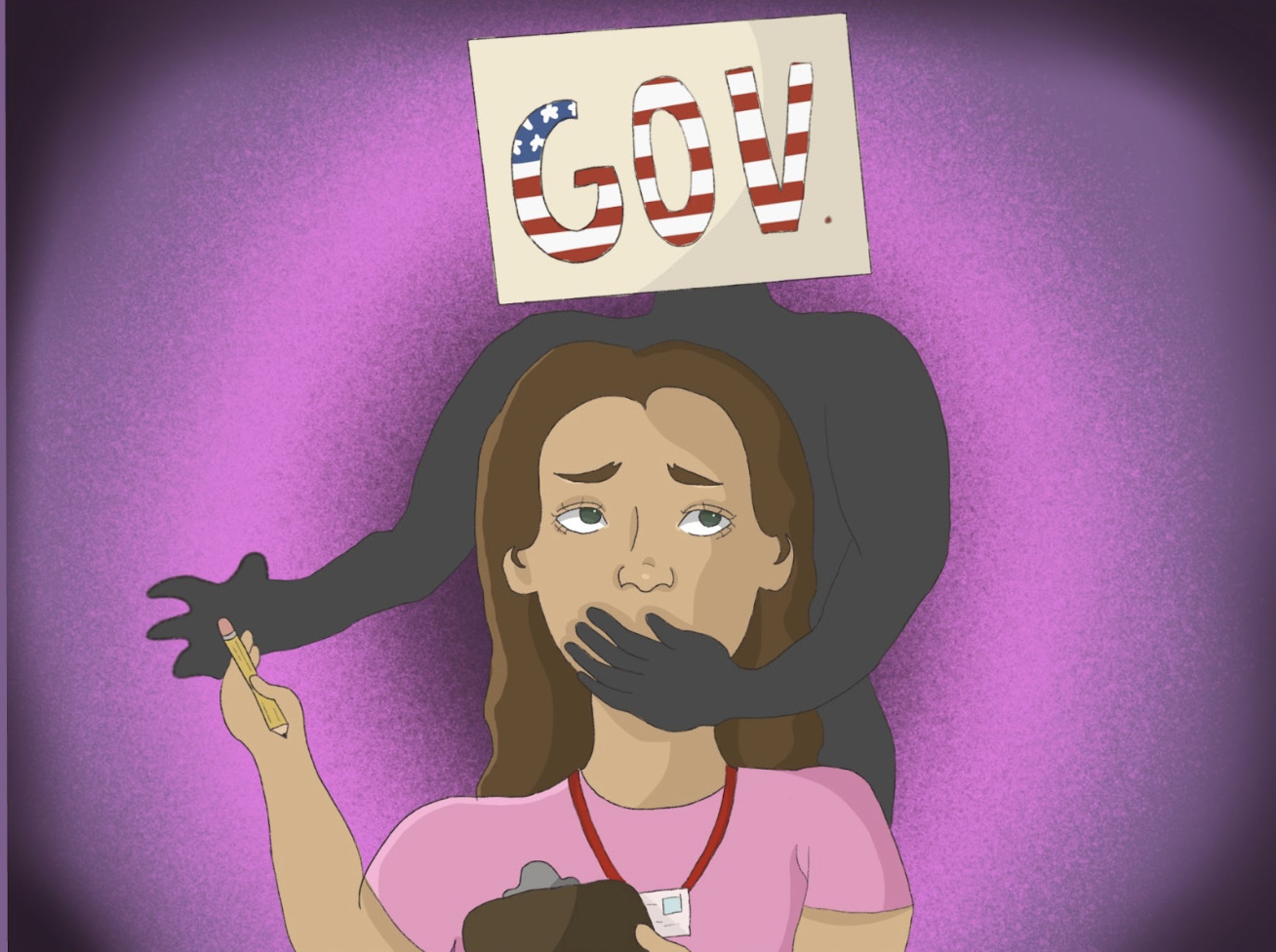
An illustration shows a student being censored by the government. As restrictions on classroom have increased, the rise in censorship sparked concerns about transparency.“Silence may make schools
more comfortable, but it does nothing for accountability,” Larson said. Illustration by Sylvia Robinson
With support from administrators, some student journalists thrive under the First Amendment. But for others, quiet forms of censorship still stifle the truth.
Who gets to decide which voices are heard?
For student journalists, that question isn’t abstract, it’s the reality. Censorship, in any form, chips away at democracy.
The First Amendment protects speech from government interference, but in practice public schools often serve as the government, deciding what young people can and cannot say.
At my own school, I’ve had the opposite experience. Administrators in my district have respected the role of student media, and I’ve been able to publish stories without interference. That support has given me a deeper appreciation for what student journalism can do when it isn’t silenced.
But not every newsroom is given that freedom.
Clare Norins, director of the First Amendment Clinic at the University of Georgia’s School of Law, says outright bans on speech—called prior restraints are rare.
“Prior restraints are presumed to be unconstitutional. By and large, prior restraints are stricken down as violating the First Amendment,” Norins said.
But censorship doesn’t need to come with a red pen to be effective. One tac-tic is jawboning, when officials lean on private companies to do the censoring for them.
“The government cannot pressure private parties to censor speech that the government itself could not directly censor,” Norins said.
Schools mirror these dynamics. Censorship of student media usually falls into three categories:
“The real cost falls on students, who are left believing censorship is normal.”
Direct censorship — when administrators kill a story outright. In 2022, a Nebraska principal shut down a student newspaper after it published LGBTQ+ coverage.
Indirect censorship — when advisers lose their jobs, budgets get cut, or students are punished for what they print. Student Press Law Center attorney Jonathan Gaston-Falk says these hidden tactics are becoming more common. “I’ve been seeing a lot more indirect censorship. The more nefarious, oblique ways of getting at student publications,” Gaston-Falk said.
Self-censorship — when reporters decide not to write a story at all. In a 2021 SPLC survey, many admitted they avoided topics like race or sexuality to sidestep conflict with administrators or their community.
Silence may make schools more comfortable, but it does nothing for accountability.
“If you’re the censor, the benefit to you is that you are shutting down speech you don’t like. By and large, censorship doesn’t have a lot of upside,” Norins said.
The real cost falls on students, who are left believing censorship is normal. And that’s dangerous.
“I think the greatest threat right now is that there’s not a lot of respect for the rule of law,” Norins said. “When you throw out respect for the rule of law, you just have chaos and authoritarianism.”
Free expression is messy. But silence is worse. My own experience shows how powerful student journalism can be when schools trust students to tell the truth. But Gaston-Falk is right: the more subtle forms of censorship are growing, and not every newsroom is given the freedom mine has.
If schools teach students that truth exists only when it’s convenient to those in charge, they aren’t teaching democracy at all.