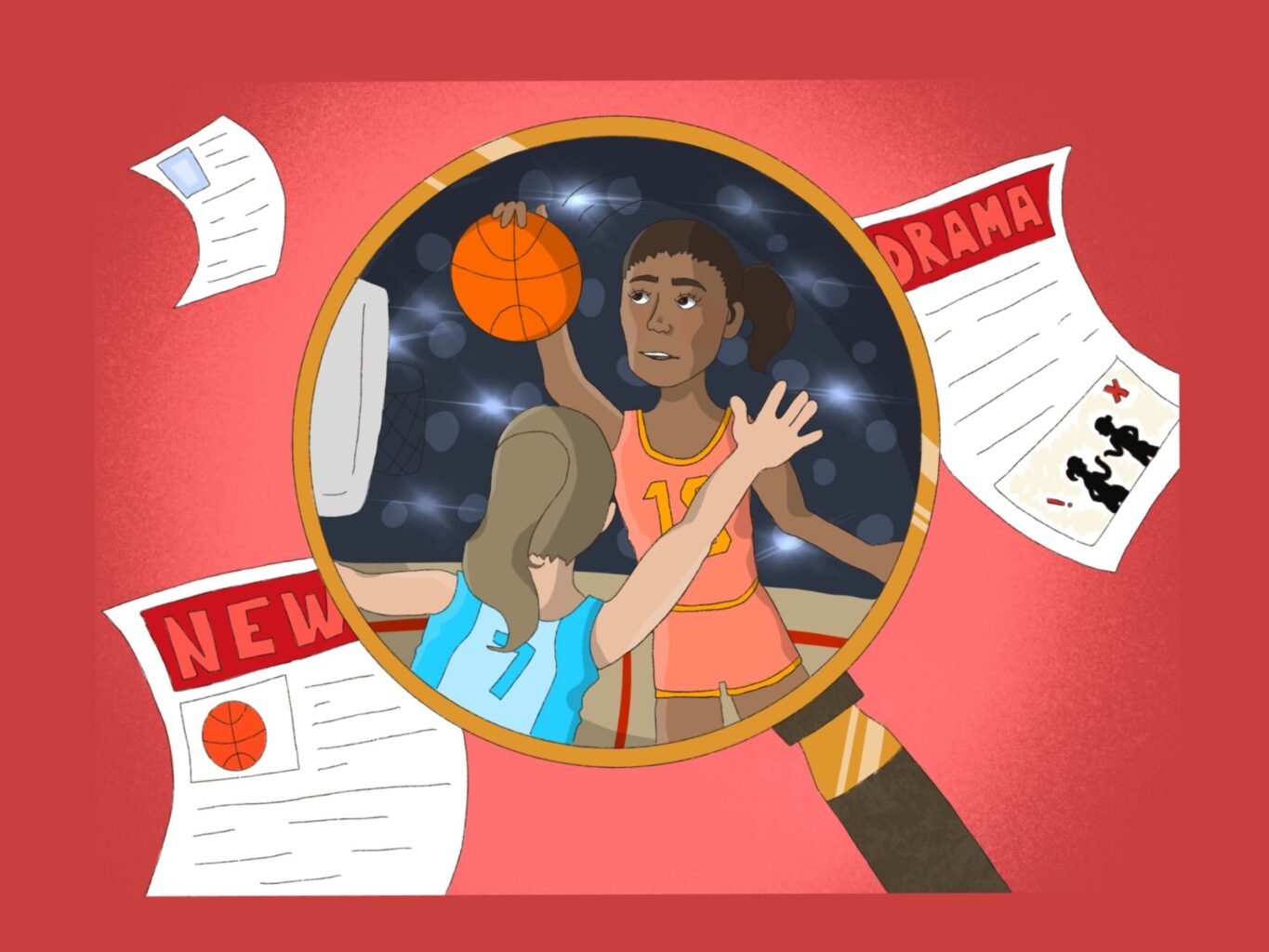
Two Women’s National Basketball Association athletes compete while media organizations highlight supposed drama between the players. Sports Editor Liya Taylor discussed how as the Women’s National Basketball Association grows, fans and the media must prioritize the competition itself instead of focusing on drama. “Rivalries are a natural part of sports, but when they overshadow competition, athletic excellence is reduced to tabloid headlines. This not only disrespects the athletes, but also risks weakening the league’s ability to build a respected, sustainable fan base,” Taylor wrote. Illustration by Sylvia Robinson
As the Women’s National Basketball Association experiences growth in audience engagement, fans and the media must ensure the spotlight stays on athletic excellence.
The Women’s National Basketball Association has existed for nearly 30 years, and while some frame its recent growth in attention as overdue, history shows that this is right on track in comparison to the National Basketball Association.
The NBA, founded in 1946, didn’t become consistently profitable until David Stern took over as commissioner in the 1980s – over three decades later. By that standard, the WNBA’s surge is historic. The 2024 season attracted an all-time record of more than 54 million viewers, sold out multiple arenas and drove merchandise sales up 600% from the prior season.
However, with new growth comes new challenges. If the spotlight isn’t directed towards WNBA athletes and their game, this momentum risks being undermined.
Too much coverage has revolved around drama rather than performance. For example, WNBA athletes Caitlin Clark and Angel Reese, both record-setting rookies, are often shown as bitter rivals – with headlines fixating on gestures, trash talk and supposed beef instead of their impact on the court.
Too much coverage has revolved around drama rather than performance.
“Media sources with integrity have to act as those. There’s always going to be those soap opera type headlines, especially when it involves women. (But) it’s important for people to lean to the facts because those come first,” Cassie Chantel, Clarke Central High School Class of 2009 alumna and Social Media Specialist, said.
When rivalries are reduced to tabloid headlines, they overshadow competition and strip athletic excellence of its meaning. This not only disrespects the athletes but also risks weakening the league’s ability to build a respected, sustainable fan base.
“I worry that there’s too much emphasis on drama (and) building up personal animosities between players. A lot of coverage on social media is silly, frankly. I hope that as the league matures, it can build rivalries on the court all about how players play and how teams play, not about supposed personality clashes and drama,” Dr. Welch Suggs, University of Georgia Associate Professor of Journalism and the Carmichael Sports Media Institute, said. “Building up the drama is (not) going to get you more clicks, notice or clout in the long run.”
After nearly 30 years, the challenge is no longer proving the league’s worth but ensuring its growth endures. Keeping the spotlight where it belongs – on the athletes, their competition and their communities – will make sure that women’s basketball doesn’t fade as a temporary trend but secures lasting respect. The game is the headline, not the noise.