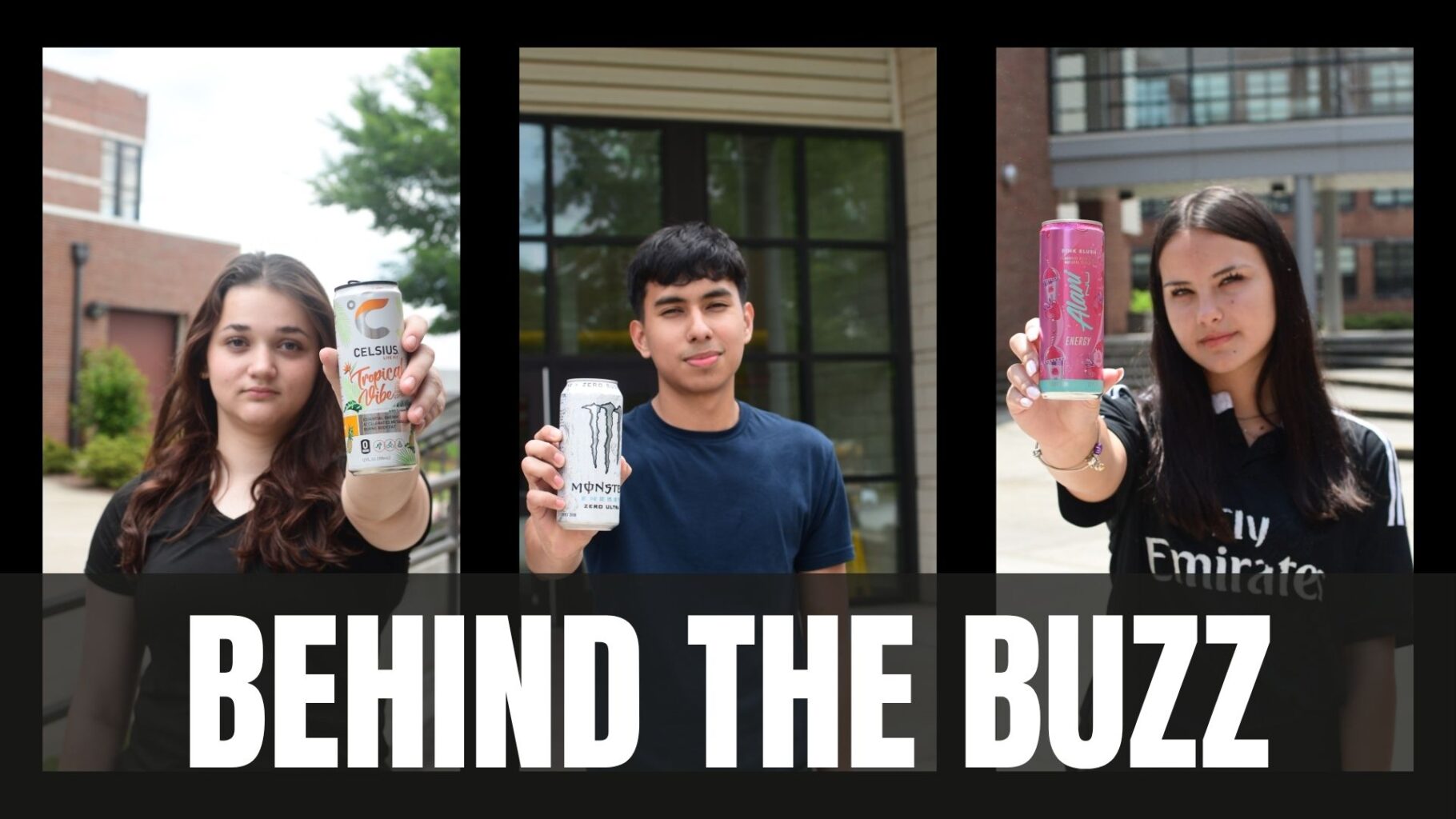
Clarke Central High School students Clara Pardue, Rene Rodriguez and Marley Dipietro Bonilla (from left to right) pose with different energy drinks. University of Georgia Professor of Human Development and Family Science Dr. Steven Kogan expressed that the root cause of adolescents’ consumption of energy drinks is their increasingly overcrowded schedules. “Kids are too busy. A lot of young people are anxious (that) they’re not (being) perfect, or they want to make every team and (their) parents kind of play into that cycle. I know of a lot of young people whose days are just ridiculous,” Kogan said. Photos by Grady Dunston
While caffeinated drinks can seemingly benefit CCHS students, they come with negative side effects.
Crushed cans. Racing hearts. Sleepless nights.
At Clarke Central High School, energy drinks such as Celsius, Red Bull, Monster Energy and Alani Nu are a common sight. For CCHS varsity girls soccer left wing Clara Pardue, a junior, starting the day with a can of Celsius is more than just a preference: it’s a habit.
“School starts so early and with the amount of work and interactions that (I) have to deal with throughout the day, energy drinks (are) the only way I am able to get through school,” Pardue said.
Pardue isn’t alone in this. CCHS varsity softball catcher Marley Dipietro Bonilla, a sophomore, often turns to these drinks as well, especially on days when she has morning practice.
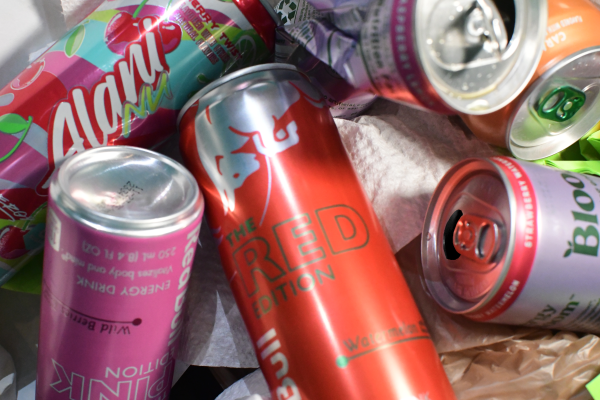
A collection of empty energy drinks in a trash can is shown. While energy drinks have helped CCHS junior Rene Rodriguez finish class projects in the past, they have also affected his sleep. “One time I took (an energy drink), I think it was about 9 or 8 p.m., and I just could not go to sleep,” Rodriguez said. “I eventually went to sleep, but I woke up maybe an hour and a half later and I had the worst headache of my life.” Photo by Grady Dunston
“When I drink them, since I have so much energy, I get to use it for running or catching balls. (Energy drinks) are definitely good in that way,” Dipietro Bonilla said. “It makes me more productive because I know what I’m trying to do (when I drink) a Celsius or Alani (Nu).”
But it’s not just athletes, it’s also the average student. CCHS junior Rene Rodriguez sees energy drinks as essential, specifically when school work piles up.
“If I have something due, (like) a big project, then I’ll go and buy (an energy drink) to get me through those next hours,” Rodriguez said. “I know they’re not the healthiest drink out there, but sometimes it’s just necessary for me.”
However, behind this buzz, researchers are growing concerned.
According to the Centers for Disease Control and Prevention, more than one in three teens consume energy drinks regularly, a trend that’s increasingly apparent at CCHS. Many energy drinks favored amongst teenagers derive their caffeine from sources such as green tea or guarana seed extracts. These ingredients often appeal to health-conscious teenagers marketed by energy drink brands as “clean” and “natural.”

A graphic shows common side effects of drinking over 300 miligrams of caffeine, which is equivalent to approximately four cups of coffee. Clarke Central High School School Nurse Jackie Coyle has seen the impacts of student use of energy drinks. “(Energy drinks) can increase your heart rate and if you (have) an increased heart rate, (it) can increase your breathing and all (of) that affects (one’s) anxiety,” Coyle said. “Also, it can cause you to have issues with attention span, being able to focus (and) being able to retain information.” Graphic by Lea D’Angelo
But according to CCHS School Nurse Jackie Coyle, this health halo is misleading.
“People think supplements are healthy and yes, some can be. But, you have to really know what you’re taking. You need to know your medical history, understand not all herbal supplements are safe and know what quantities are safe,” Coyle said.
Dr. Steven Kogan, a University of Georgia Professor of Human Development and Family Science seconds that these natural sources of caffeine don’t change the fact that consuming energy drinks isn’t healthy for adolescents. With common energy drinks containing over 100 mg of caffeine, they exceed the advised amount of 100 mg per day by the American Academy of Child and Adolescent Psychiatry for those between 12 and 18-years-old.
“There are some basic physiological things that go on when you use caffeine, and there’s a good bit of research showing that it can affect not only immediately how you feel, but aspects of development, like (your) behavior, your ability to go to sleep (and) how you pay attention in school,” Kogan said.
Unlike soda or coffee, many energy drinks fall into regulatory loopholes. With no distinct category for them as defined by the United States Food and Drug Administration, if the drink contains herbal ingredients, it can be marketed as a dietary supplement under the federal Dietary Supplement Health and Education Act.
This means energy drink companies such as Bloom Nutrition or Ghost Energy can skip FDA premarket approval entirely.
“I have people who come (to me) and say that they felt like their heart was racing, like they were having more palpitations (in) their chest, and we’d find out that it was because (they’re) drinking three energy drinks and haven’t eaten anything,” Coyle said. “A lot of people, especially teenagers, think it’s going to help them stay up so they can study more, or stay up during class, (but) actually it’s just going to raise your heart rate. It’s going to make (it) so you can’t focus as well because your body is in this high fight or flight mode.”
A study by Kogan and colleagues, surveying nearly 4,000 adolescents in West Virginia, concluded that higher caffeine intake is similar to the increased use of substances like alcohol, cigarettes and e-cigarettes. Kogan emphasized caffeine’s appeal, and danger, lies in its addictive potential, especially for adolescents.
“If you haven’t had good sleep, it’s really attractive to want to have some caffeine, which could be in an energy drink. The problem is (that) you risk coming into a cycle where using caffeine will generally make your sleep worse and while you can get a short-term benefit of wakefulness, it comes with a crash,” Kogan said. “Caffeine and cigarettes are extremely comparable; they are both quick at addicting you. Before you know it, you need caffeine.”
A chart shows the amount of caffeine in various energy drinks and coffees. After hearing stories about the dangers of consuming energy drinks from sources like the National Public Radio, Clarke Central High School world languages department teacher Emily Hulse became wary of these drinks. “I just don’t think that caffeine in that dosage is healthy for young people. I don’t think it’s healthy for adults either, but I think it’s worse for people who are still developing and growing,” Hulse said. Graphic by Lea D’Angelo
Students like Pardue, Dipietro Bonilla and Rodriguez aren’t alone. But as caffeine culture grows, people like Coyle and Kogan feel that the need for change does as well.
While Kogan says banning energy drinks outright is unrealistic, helping students understand what they’re drinking and how it affects them is an essential first step.
“The best thing we can do as a society to help young people is to stop selling caffeinated beverages to people under 18. We need to make sure they’re not in schools and create strong norms that this is just not good for you,” Kogan said. “There’s just no reason for kids to be ingesting caffeine. It can only do harm.”
Story by Liya Taylor
Story by Mzée Pavlić
Story by Sylvia Robinson
Photos by Grady Dunston
Package by Lea D’Angelo