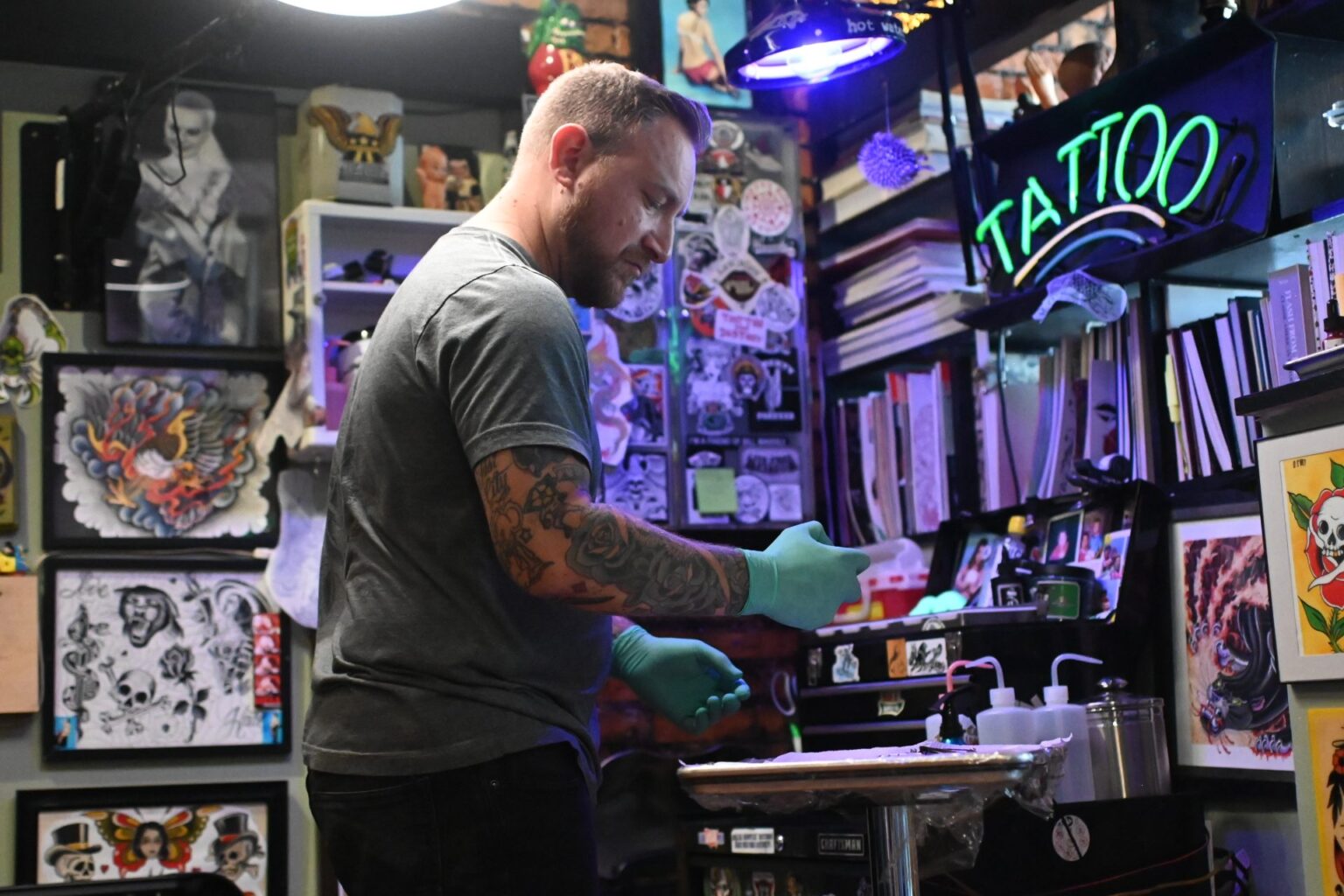
Lucky Cobra Tattoo owner Charley Ferlito sets up for a tattoo in his shop, located at 1377 Prince Ave., on Sept. 22. With multiple tattoo shops in Athens, Ferlito has worked to set Lucky Cobra Tattoo apart in appearance and experience. “We always try to do our best by the clientele, and maybe they’ve come in here with friends and they’re like (these shops), they’re all kind of different,” Ferlito said. “If you walk through every different shop in town, they have their (aesthetics, and they’re all) pretty different.” Photo by Iliana Tejada
Since the 90s, the tattoo industry in Athens has been a robust ecosystem of shops and artists who work to balance the legacies from past shops with their own artistic and business ventures.
How did Athens, a city with a tattoo shop ban in the early 90s, become a hub for the industry with a large community of artists and shop owners?
The answer lies in a culmination of various factors: the history of tattoos in Athens, the artistry that comes with the profession and the businesses that hold these careers together.
“Tattooing was all over TV for most of the early 2000s, and it just blew up. When I was growing up, my dad tattooed out of the house, so I was around tattooed people and people that were doing tattoos, it was kind of ingrained in me.” Lucky Cobra Tattoo Owner Charley Ferlito said. “I migrated toward tattooing and tattooers, whether it be about the art or being punk rock.”

“We actually have what you could refer to as a tattoo culture in Athens now, but I don’t think two studios (at the time) is enough to refer to as a culture.”
– Bethra Szumski,
Pain and Wonder Tattoo and Piercing Studio Owner
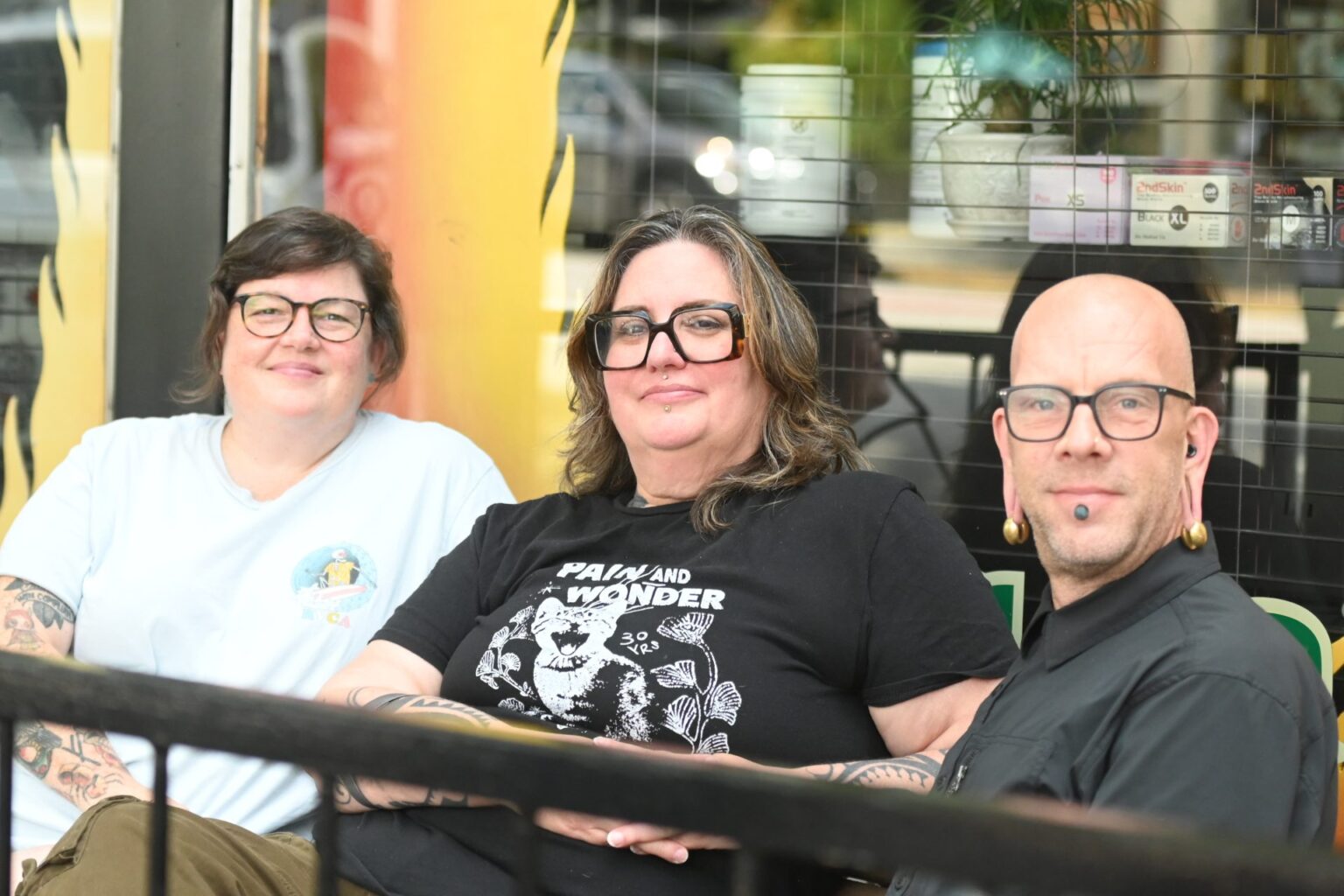
Pain and Wonder Tattoo and Piercing Studio General Manager Carolyn Rittweger, Owner Bethra Szumski and Piercer Randy Smyre, sit outside the shop on, Sept. 19. To keep up to date with societal trends, Szumski has worked to keep the shop environment fresh and promote what makes the studio unique. “We try to stay fresh with what we’re doing. We fully renovated last year, really breathed into who we are as a company,” Szumski said. “People aren’t going to celebrate you as a business if you don’t celebrate you as a business.” Photo by Iliana Tejada
On April 7, 1992, a ban on tattoo shops was put in place in Athens due to safety concerns. This angered the artists in the area, and while it took years to reverse this ban, on July 15, 1994, the artists were finally successful. But why?
In an attempt to make tattoo shops legal, local artist Savic Enn held a protest by tattooing an Athens citizen on the steps of City Hall. This public display against the law was enough to get the ban lifted. From there, the drive to create a tattoo culture in Athens was born.
“There was no culture (before tattoos) were legalized,” Pain and Wonder Tattoo and Piercing studio owner Bethra Szumski said. “We actually have what you could refer to as a tattoo culture in Athens now but I don’t think two studios (at the time) is enough to refer to as a culture.”
During the ban, only one tattoo shop existed: Midnight Iguana Tattooing. After it was lifted, Pain and Wonder Tattoo and Piercing Studio was opened in 1995 by twin brothers Mitchell and Watson Atkinson with the help of Enn after they assisted with his protest. In 2000, Szumski bought the shop and has been the owner ever since.
“(Pain and Wonder) has gone through a lot of changes. We are always doing something to make it nicer there, so that hasn’t changed from the very beginning,” Szumski said. “It was a bit of an uphill thing at first, but it leveled out.”
A timeline shows key events in the early development of tattoo shops in Athens. Timeline by Lea D’Angelo
During this time, tattoos weren’t a widespread fad, but were seen more as a counterculture initiative. Pain and Wonder’s proximity to 40 Watt Club, a popular music venue in the area, gave those in the alternative music scene another artform to explore.
“The people who got a lot of tattoos were more restricted than they are now. We’re talking about all the punk rock kids,” Clarke Central High School English department teacher Ian Atlman said. “These (were) super intelligent, highly creative, interesting people, and good for them for not bowing to normalcy.”
“We actually have what you could refer to as a tattoo culture in Athens now, but I don’t think two studios (at the time) is enough to refer to as a culture.”
— Bethra Szumski,
Pain and Wonder Tattoo and Piercing Studio owner
While Altman was never a tattoo artist, he was around during this era in Athens and was close with Enn. This allowed him to see the culture from an outside point of view, understanding that the tattoo shops were more than just a business, they were a meeting place.
“The vibe around tattooing in that time was free and fun,” Altman said. “The (artists) certainly took themselves seriously, they worked very hard. They were serious artists, it’s maybe not the kind of art that gets shown in (a) museum and in New York City. But, they were skilled and I always admired that.”

“Even if I’m working on a piece that’s for an art book, my brain still attacks the line weight or the way it’s colored, as if somebody was going to snatch that up and ask me to tattoo it on them.”
– Mike Groves,
Outpost 76 Tattoo owner
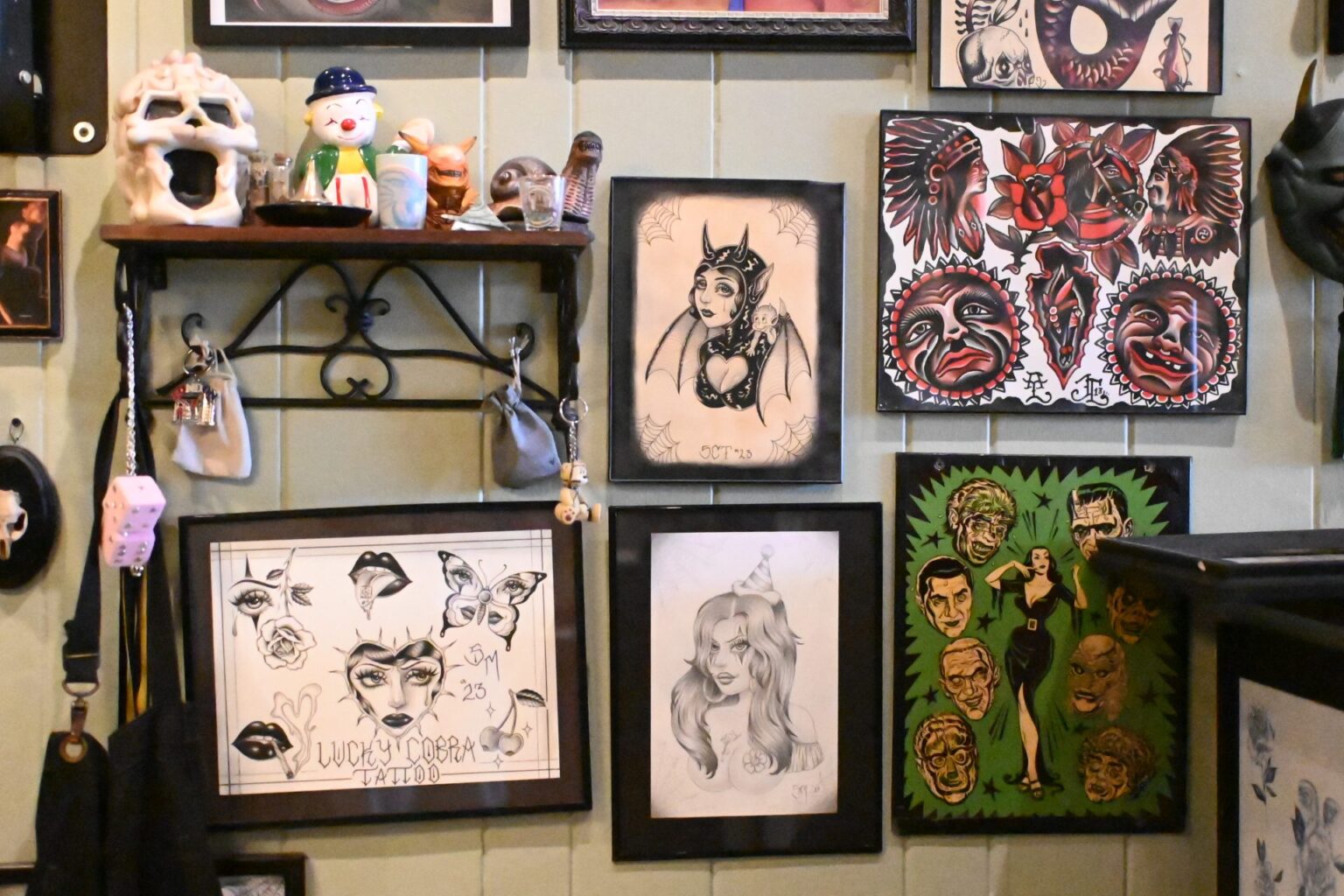
Art is displayed on the walls of Lucky Cobra Tattoo on Sept. 22. Owner of the shop, Charley Ferlito has worked throughout his career to find a balance between fulfilling client requests and expressing his creativity. “Some people are tattooists, which means that they’re tattoo artists. Some people are tattooers, which means that they’re tattoo doers,” Ferlito said. “I’m a tattoo doer, I’m very artistic, but I think it’s important to be able to help people with their vision as much as it is (the artist’s vision.)” Photo by Iliana Tejada
When one pulls back the layers of tattooing, disregarding the technical skills that come with learning how to use the machine, or the people skills that make someone good at talking to customers: art is at the center of the profession.
“Even if I’m working on a piece that’s for an art book, my brain still attacks the line weight or the way it’s colored, as if somebody was going to snatch that up and ask me to tattoo it on them.”
— Mike Groves,
Outpost 76 Tattoo owner
Once someone has decided that tattooing is in their future, whether they go the route of becoming an apprentice, or take a more self-taught approach, they will need their artistic abilities to back their skills.
“There are a couple different ways (tattooing) has been addressed in the art world. One is the work itself as art, and then the other side would be to address it as just simply another medium that employs a specific skill set, composition (and) color theory,” Szumski said. “There’s (2D) and 3D design elements at play, because you’re not working on a flat canvas, but you are working with a lot of design theory.”
Photos of the inside of Lucky Cobra Tattoo, located at 1377 Prince Ave., are shown. Photos by Iliana Tejada
For tattoo artist and owner of Outpost 76 Tattoo, Mike Groves, who got a Bachelor of Arts for painting from the University of Georgia, before ever considering tattooing, his art and his tattoos are very ingrained within one another.
“Even if I’m working on a piece that’s for an art book, my brain still attacks the line weight or the way it’s colored, as if somebody was going to snatch that up and ask me to tattoo it on them,” Groves said.
“I was always kind of against opening a shop, which is why I bought a pre-existing shop. I wasn’t adding a new shop to the mix, I was carrying something on.”
– Charley Ferlito,
Lucky Cobra Tattoo Owner
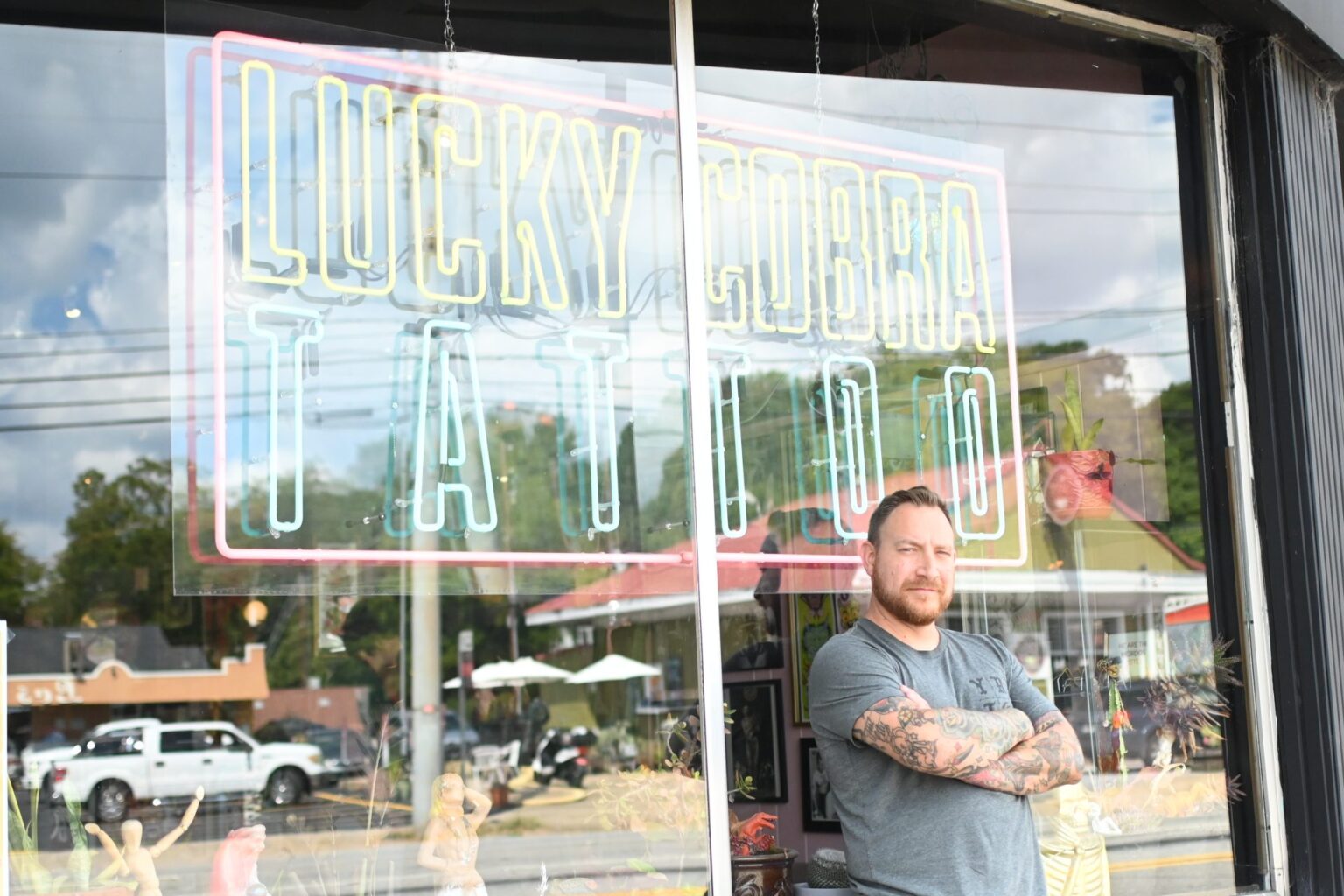
Lucky Cobra Tattoo Owner Charley Ferlito poses outside his shop on Sept. 22. When Ferlito bought the shop, previously named Mothership Tattoo, his goal was to take a more background approach while promoting the tattoos of those he cares about. “I definitely wanted to be able to take a step back from tattooing, and still have a place where I can come to work, but on my own terms,” Ferlito said. “(I wanted to) give my friends a place to work, which seems like it’s working out pretty good.” Photo by Iliana Tejada
While tattooing is a very art-driven industry, there is also a large business aspect that keeps the profession surviving. The community wasn’t just formed by enthusiastic tattoo artists in the area, but built on a foundation of people who came to the city with the intent of making a career for themselves.
Many artists who started in the early days of the Athens tattoo industry have stayed in the area, or kept in touch with those they were with in the beginning, forming long-lasting bonds centered around tattoos.
“I hired Radar (the owner of Walk the Line Tattoo), John Collins (artist at Mr. Lucky’s Panama City Beach Tattoo Club) worked in the town for a long time, Kim Deakins (owner of Pink Goblin Tattoo & Piercing) worked at Pain and Wonder (and) we brought her in from Statesboro,” Szumski said. “(I’ve known) most of these people since they moved to town and that’s just the nature of how any business works in any place in the world.”
A map shows the different tattoo shops around Athens. Map by Abby Holloway and Lea D’Angelo
Some of these artists have relocated, finding success in other places, but others have stayed, traveling between different shops or even starting their own businesses. But, there can only be so many shops before a town of 129,550 becomes saturated.
“When you’re running a business, half of your time is just paperwork and worrying about paying the rent, and it’s really hard to develop as an artist. If you don’t give yourself time to really nail down the (tattoo) skill set, you’re gonna struggle to build that (business) skill set,” Szumski said. “There’s only so many customers, and if the customer base dwindles, then the shops dwindle. There’s definitely a limit to how many shops are going to thrive.”
So, how does a shop thrive in such a competitive environment? For some, it’s updating the brand, keeping the shop relevant in changing times. It can also be an understanding of business and the work that goes into running a shop. For Ferlito, it came back to legacy.
“I don’t think tattooing is for absolutely everybody, you have to show that you’re actually interested in the history and tradition of tattooing,” Ferlito said. “I was always kind of against opening a shop, which is why I bought a pre-existing shop. I wasn’t adding a new shop to the mix, I was carrying something on.”
“I was always kind of against opening a shop, which is why I bought a pre-existing shop. I wasn’t adding a new shop to the mix, I was carrying something on.”
— Charley Ferlito,
Lucky Cobra Tattoo Owner
But, for those in Athens who have found success within the tattoo industry, whether it is as an artist or a shop owner, if they found their niche, there will be clients waiting for them.
“People have a romantic notion of what (being a tattoo artist) looks like. But, the people that do the best in the business don’t approach it that way,” Szumski said. “(If) they approach it like any job where you show up on time and you stay for a nice set of hours, and you do your homework, those are the people that actually make it in the business.”

“Most people in town I know because I’ve worked with them, (they are) people that I have a deep respect for.”
– Charley Ferlito,
Lucky Cobra Tattoo Owner

Pain and Wonder Tattoo and Piercing Studio piercer Erin Michelle shows piercing options to a client on Sept. 19. Studio owner Bethra Szumski has taken a methodical approach to tattooing, focused more on client needs. “In the art world, the closest thing I could approximate (tattooing) to would be to be a short order cook. The order comes in in one minute on one side, the cook makes the dish and delivers it to the client, and then it’s gone,” Szumski said. Photo by Iliana Tejada
There are still many people from the 90s and early 2000s that have stayed in Athens and become well known throughout the community. But as the industry has evolved in Athens, new groups who will leave new legacies have begun to form.
“Most people in town I know because I’ve worked with them, (they are) people that I have a deep respect for,” Ferlito said. “The other people in town I know because of the internet. If we didn’t live in a day and age where there was Instagram, maybe I wouldn’t know their work.”
“Most people in town I know because I’ve worked with them, (they are) people that I have a deep respect for.”
— Charlie Ferlito,
Lucky Cobra Tattoo Owner
Ultimately, the tattoo community in Athens has gone through many forms, moving from an underground scene, working around a city-wide ban, to a wide array of over 20 shops with all different atmospheres. But those who were here since the beginning don’t see it going anywhere.
“It speaks to the strength of the community and the way the community has grown. It’s not (as) restrictive as it was back then. Everyone gets tattoos now, not just the crusty punks,” Altman said. “It does speak to that lifelong camaraderie and to the strength of that community, and just the mere fact that a lot of the same people are still around.”