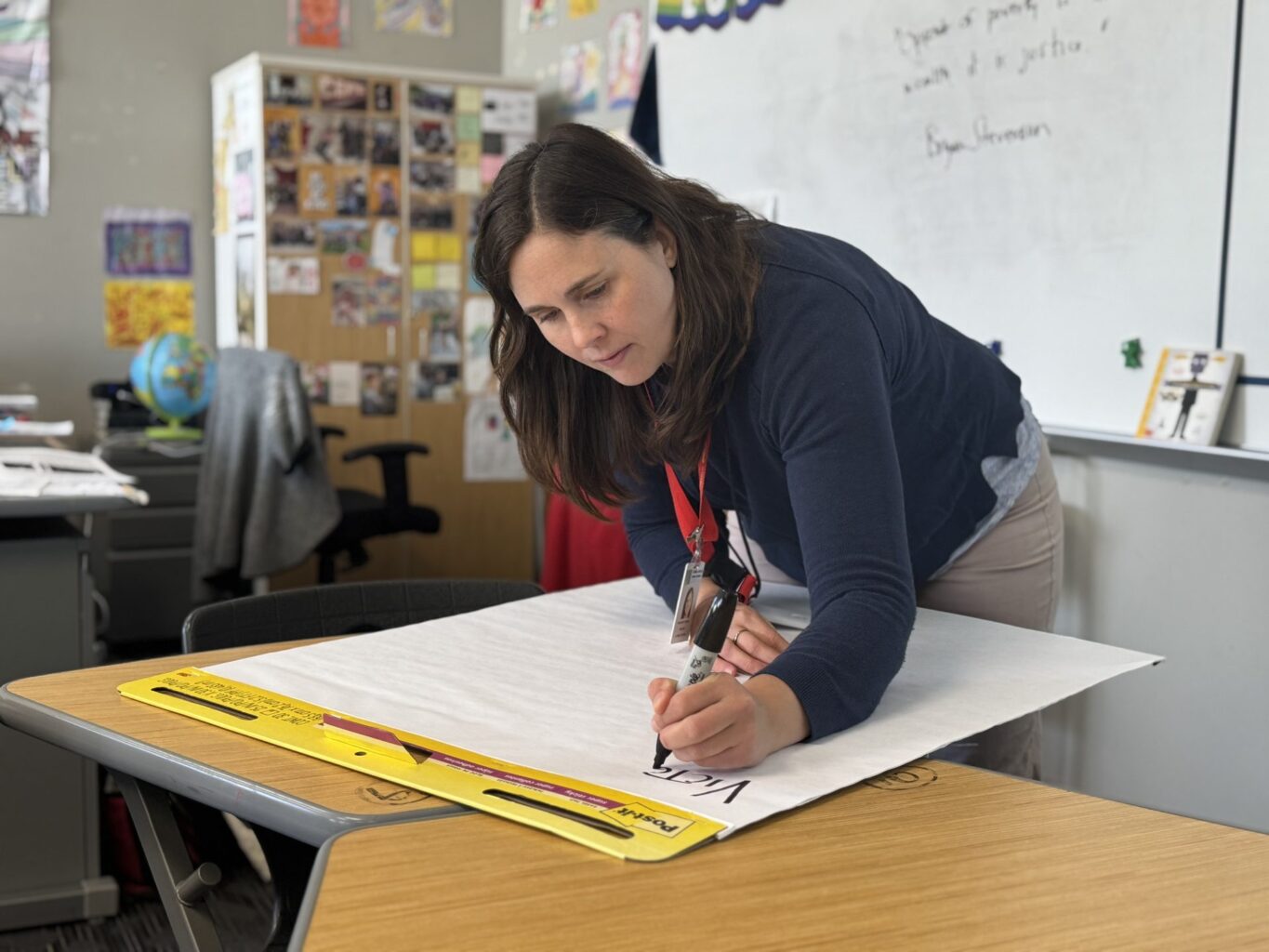
Clarke Central High School English department teacher Molly Dorkey works on a poster in Room 322 on Aug 20. Dorkey, who teaches Introduction to Women’s Literature, conveyed anticipation about presentations the class will produce towards the end of the 2025-26 fall semester, which is the only semester this year in which Introduction to Women’s Literature will be taught. “(The project) could be anything. It really depends on the student in terms of what their interest is,” Dorkey said. “If they’re a student that’s really interested in (science, technology, engineering and mathematics) subjects, maybe it’s looking into a discovery related to women’s healthcare.” Photo by Sasha Barkan
Introduction to Women’s Literature reclaims its place at CCHS under the direction of English department teacher Molly Dorkey with an emphasis on multimedia storytelling and class discussion.
Introduction to Women’s Literature, an English Language Arts elective, was reintroduced at Clarke Central High School for the 2025-26 school year under English department teacher Molly Dorkey with a focus on student-led discussion and multimedia exploration.
The course was initially established at CCHS during the 2020-21 school year by English department teacher Lindsay Coleman-Taylor and later taught by English department teacher Jennifer Tesler. Dorkey, who student-taught under Coleman-Taylor from 2021-22, wanted to maintain the use of student participation from prior iterations of the course through whole-class discussions.
“(The class is) about giving space for (women’s) voices and thinking about how students are connected to that,” Dorkey said. “A lot of the discussions tie to older texts, and some have contemporary issues embedded into them. A big part of the course is talking about issues and (letting) the students lead (the discussion).”
A slideshow displays five texts on the syllabus for Introduction to Women’s Literature. Clarke Central High School English department teacher Molly Dorkey expressed excitement towards discussing issues represented in “Frankenstein,” which was published in 1818 by a female author. “(‘Frankenstein’ author Mary Shelley) was a (female) writer when there were not as many (female) writers getting published,” Dorkey said. “I think ‘Frankenstein’ was very much a commentary on her times (and) the society that she was living in.” Graphics by Sasha Barkan
On Aug. 20, the class held a discussion on the book “Frankenstein” by Mary Shelley that Introduction to Women’s Literature student Ellie Reyes, a junior, found both interesting and educational.
“I love student discussions. We all see things differently, so it’s nice to hear everybody else’s perspective,” Reyes said. “(If) I agree with them, it adds on to (my opinion). If I disagree with them, (I can) debate it. That’s something I really love.”
“Us having conversations about ‘Frankenstein’ isn’t just about the way (things were) 200 years ago, it’s looking at how it relates to their own lives. (I want students to) see themselves in the context of (what) we’re reading.”
— Molly Dorkey,
CCHS English department teacher
Introduction to Women’s Literature student Bella Ramirez was first drawn to Introduction to Women’s Literature through her love of poetry, but has also enjoyed learning about history through literary texts.
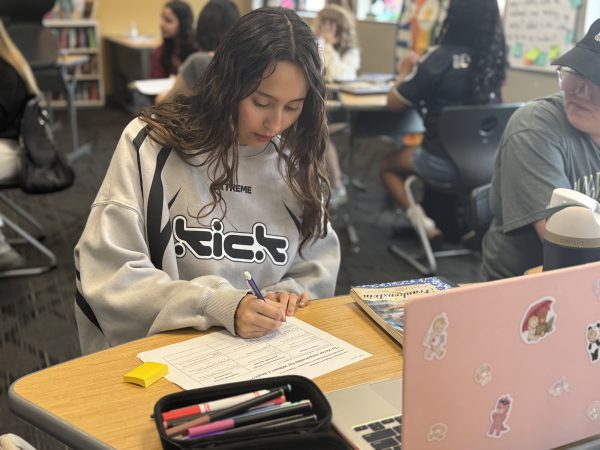
Introduction to Women’s Literature student Bella Ramirez, a Clarke Central High School junior, works in Room 233 on Aug. 20. Ramirez has found that the texts within the class catalyzed her growth as a songwriter for her indie-pop band lucky girl. “From reading like an older text, I’ve learned new words I would never use before, (similar to the language of) Chet Baker (who used) pretty words like summer breeze and windy night sky,” Ramirez said. “I’ve learned how to add more flavor (while) writing.” Photo by Sasha Barkan
“‘Frankenstein’ (is) about science and about how women haven’t really had a say within the scientific field. It’s good learning about the differences between now (and the past), how there’s more female scientists and (more) women who are trying to expand the (scientific) field,” Ramirez said. “I’ve definitely learned more about it in this class.”
Connections of class material to students’ personal lives, such as Ramirez’s connection to historical women science, are the things Dorkey hopes to foster from this course.
“I want the students to come away with (the idea that) their voice is part of this discourse,” Dorkey said. “Us having conversations about ‘Frankenstein’ isn’t just about the way (things were) 200 years ago, it’s looking at how it relates to their own lives. (I want students to) see themselves in the context of (what) we’re reading.”