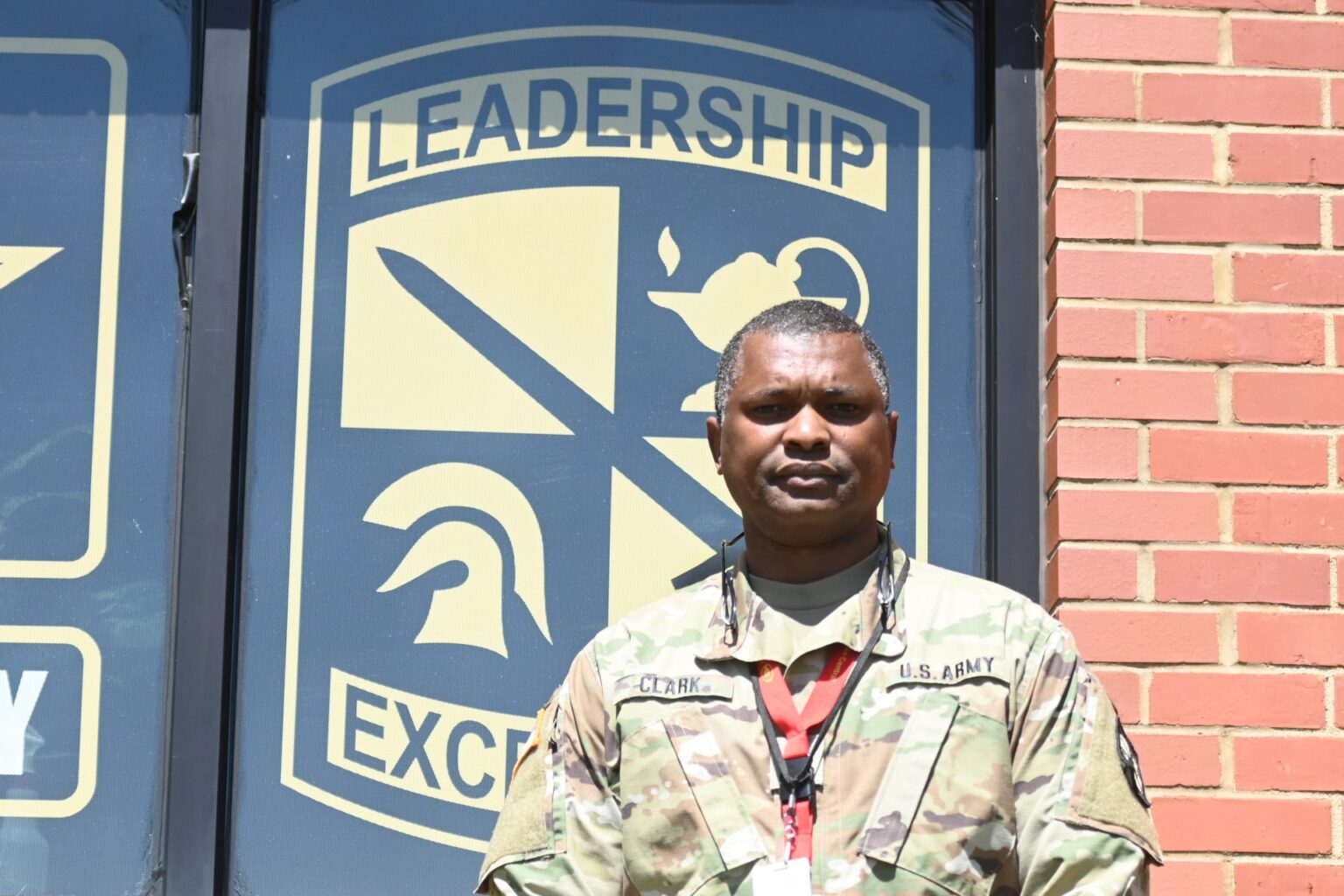
Army Instructor First Sergeant Antione Clark stands in front of the JROTC Building on Sept. 9. As a student at Ritenour High School in St. Louis, Clark was a procrastinator, but learned the importance of time management when he joined the United States Army in 1990. “You can never manage time because what you do with your time, no matter what, the clock is still ticking, so don’t manage the time, manage what you do with that time,” Clark said. Photo by Iliana Tejada
JROTC Army Instructor First Sergeant Antione Clark embodies the lessons the United States Army taught him in the instructional role he holds today.
The United States Army has seven Core Values that its soldiers abide by: loyalty, duty, respect, selfless service, honor, integrity and personal courage.
These are the values JROTC First Sergeant Antione Clark has carried with him since he enlisted in the Army in 1990, fresh out of Ritenour High School in St. Louis.
He carried them through his service, moving up the ranks from private to sergeant. As he was sent on deployments, going as far as Asia, Europe and throughout North America, he met new people from different cultures, making lifelong friends along the way.
He carried the values as he learned from those ranked above him and led the soldiers under his command to greatness. As he spent 17 years engaging in different versions of the same systematic routine: Wake up. Train. Repeat.
You can never manage time because what you do with your time, no matter what, the clock is still ticking, so don’t manage the time, manage what you do with that time.”
— First Sergeant Clark,
CCHS JROTC Army Instructor
After retiring from the Army in 2010, he carried his commitment to service to Cedar Shoals High School before moving to Clarke Central High School in 2019. Now, every day is unpredictable and each student is unique. Despite these differences, Clark’s experiences with leadership prepared him for the role.
Through JROTC, Clark passes these values onto his students through tangible lessons such as preparing for job interviews and setting attainable goals, his being to set future generations up for success.
For Clark, goals aren’t just ideas but action steps. The foundation starts with the life someone wants to have and how they want to carry the morals and values they’re taught. After that, it’s figuring out how to get them there.
“You plant seeds,” Clark said. “You’re watching the crop grow, you harvest the crop their senior year, and (then) they’re sprouting in other places. That’s how I see it.”