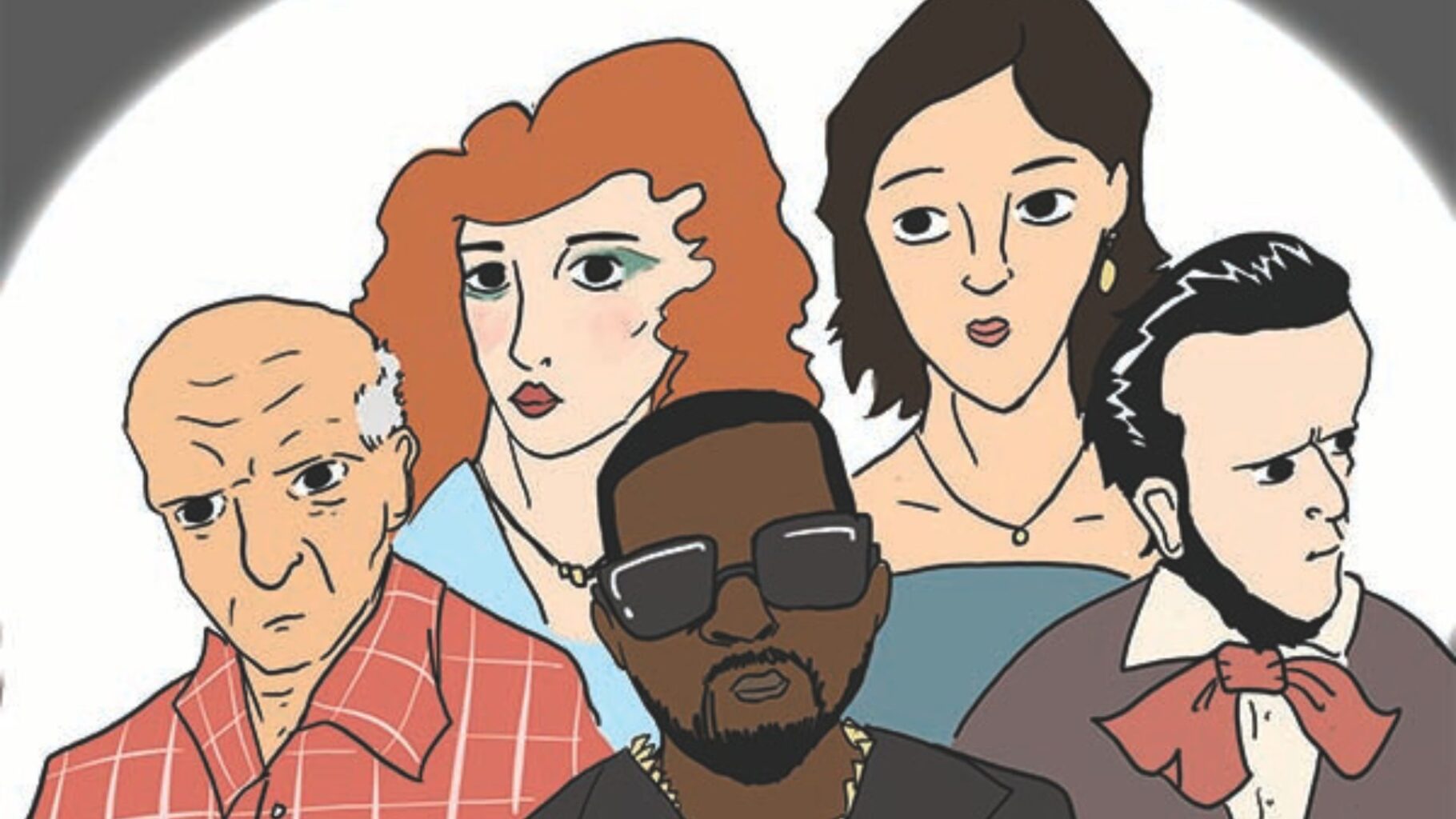
An illustration depicting artists in front of a spotlight is shown. Though some artists have performed wrongful actions, their work should be analyzed seperately. “(Gracie) Abrams and many other artists prove that, despite their personal life or background, a great piece of work is still a great piece of work,” Gresham wrote. “Inherently bad actions do not diminish what an artist has accomplished.” Illustration by Sam Harwell
An artist’s work should be separated from the creator to commemorate historical and modern pieces.
Nearly every genre of music includes an artist who has succumbed to some sort of controversy or cancellable offense.
As defined by Merriam-Webster, “Cancel culture is the practice or tendency of engaging in mass canceling to express disapproval and exert social pressure.” From the most extreme cases like Kanye West down to mild ones like Chappell Roan, artists have continuously fallen victim to cancel culture. But at what point does one too many inappropriate comments, actions or accusations lead to boycotting the artist’s work in an attempt to diminish their value? When does this extreme cancellation become rightfully justified? How can artists be held accountable?
Though an artist’s opinions or actions may be defined as cancellable, a notable piece of work remains significant and should not receive the same repercussions as the creator.
However, convoluted artwork should be viewed with a censorious lens.
While the line can blur, music and artwork continue to become popular for a reason. Even if the artist isn’t morally sound, that doesn’t determine the quality of their artwork.
Throughout history, great artworks have been commemorated despite the artist’s background. For example, Spanish painter and sculptor Pablo Picasso’s famous paintings, like “Les Demoiselles d’Avignon” or “The Young Ladies of Avignon,” have been appraised for decades, though these works represent misogyny.
“The artist, as an artist, has no ethical obligations, whatsoever. As human beings, they do. If you look at a composer like Richard Wagner, (he was) a great opera composer, but he was a rabid anti-Semite. He was a racist. He was a terrible human being. That does not diminish his greatness as a composer,” Clarke Central High School English department teacher Ian Altman said.
This construct is present in the media today through modern artists. American singer and songwriter Gracie Abrams, who was 18 at the time, posted an inappropriate and nearly predatory comment to her Instagram account in 2018 about a then 14-year-old Finn Wolfhard. Regardless, she has served as the opening act for American singer and songwriter Taylor Swift’s “The Eras Tour” 49 times in 2023.
Abrams and many other artists prove that, despite their personal life or background, a great piece of work is still a great piece of work. Inherently bad actions do not diminish what an artist has accomplished.
Picasso’s work is still displayed and highly appraised. Wagner’s music composition still revolutionized opera. Abrams has still exploded as a new artist and continues to grow her fan base despite her inappropriate comment.
While the line can blur, music and artwork continue to become popular for a reason. Even if the artist isn’t morally sound, that doesn’t determine the quality of their artwork.
However, in today’s society, where the world is dominated by social media and cancel culture is rampant, it’s important to approach opposed artwork cautiously, with a censorious lens.
“(An artist’s actions) might color the lens at which you’re examining the piece. I think (music from a cancelled artist) definitely needs more consideration,” University of Georgia Assistant Professor of Music Education Alison Farley said. “If you’re gonna be putting it forward as an artifact to be admired or to be performed or appreciated, then you need a pretty strong rationale as to why the music, itself, is worth importance in isolation from who composed it.”
The audience should indulge in artwork critically, know when immoral opinions or actions bleed into the artwork and choose to stay away from particularly negative pieces.
Quality artwork should continue to be commemorated, but it’s important to view it critically to avoid celebrating immoral people.