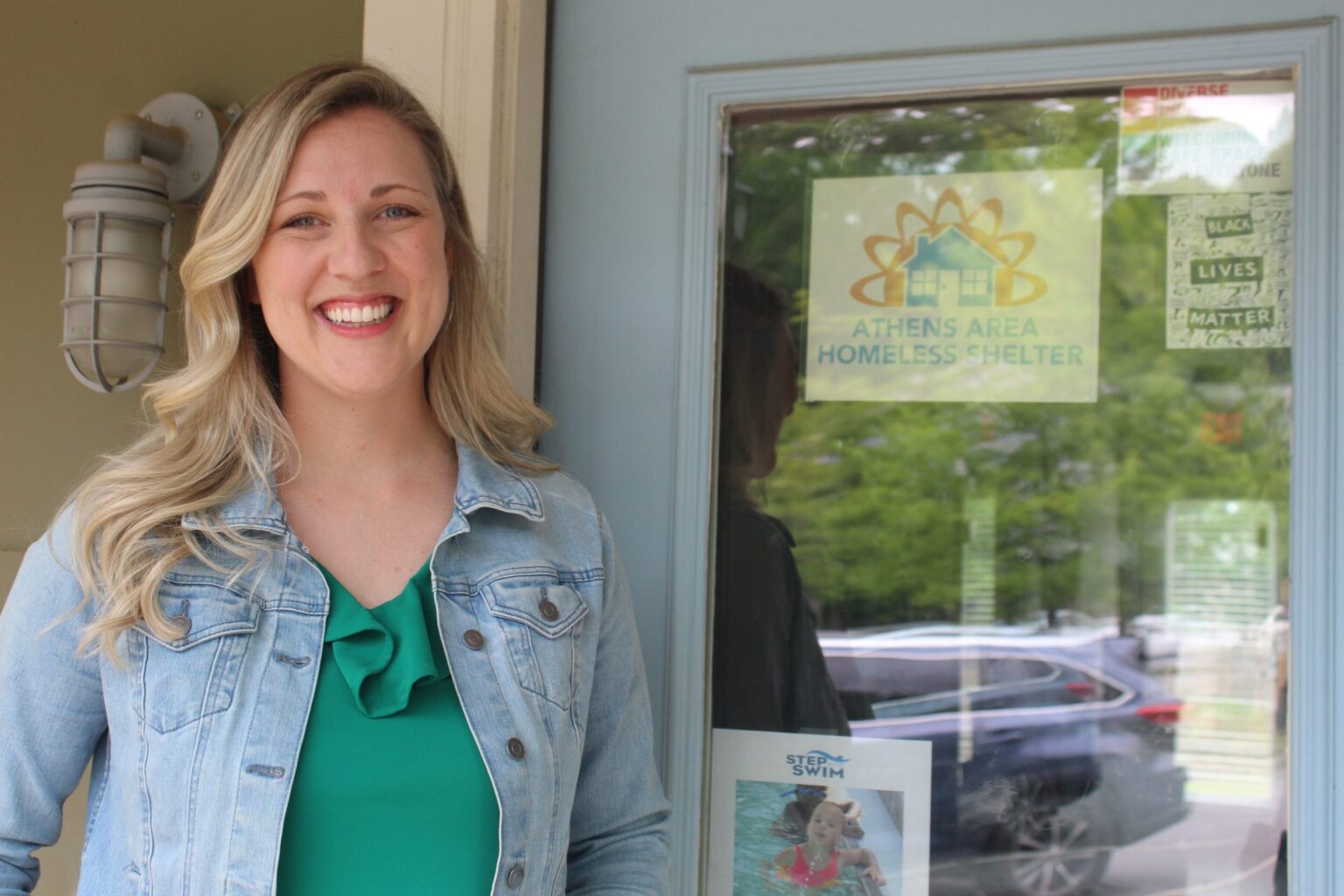
Athens Area Homeless Shelter Executive Director Olivia Amato poses at the AAHS ARCH Village location at 205 Bray St. on April 29. Amato left the organization in 2023 after six years interning and on its staff to later rejoin in 2024 after former AAHS director Shea Post left. “Shea Post retired from the organization after 13 years. She and our collaborative efforts are the reason that (the two AAHS locations) exist because of the strong collaboration and the network that she built up when she started,” Amato said. “When she retired over that summer, I reconnected with the organization, and then they brought me on as the executive director.” Photo by Iliana Tejada
Athens Area Homeless Shelter Executive Director Olivia Amato discusses her involvement with AAHS and how the organization aids in sheltering the Athens community.
Viewpoints Editor Isabella Gresham: What brought you to the Athens Area Homeless Shelter?
Athens Area Homeless Shelter Executive Director Olivia Amato: The pursuit of helping people is what brought me to get my (master’s degree in) social work (from the University of Georgia), and from there, that’s what led me to the shelter. Growing up, helping others and being involved in the community was always a big part of who (my family was). My mom was an elementary school teacher, so I grew up at the school. My dad owned his own small business, and in my (middle school and) early high school years, we had a lot of family disruption, and so it was me and my mom for many years. We received a lot of community support to be able to afford where we were living and get the things that we needed. It wasn’t easy, but I also learned through that what community support can look like. I spent so much time at community events that helped me feel cared for, and that really shaped what I wanted to do. I wanted to care for people like I had been cared for.
IG: What did your educational journey look like in relation to your role at AAHS?
OA: I got my undergrad in psychology (from UGA) because I wasn’t quite sure what helping others would really look like. (I) learned more about the impact that foster care child welfare is having in our communities. The more I learned about that, the more it connected me to housing because housing is at the crux of a lot of what is affecting our communities. If you’ve got a strong home base, if you know where you’re going to be sleeping that night, (it) really helps with your mental health. It helps with your family dynamics. It helps you succeed in school. So, the more I learned about how social work is stepping in to help in a way that I saw happen for me as a kid, that’s what led me here.
IG: What does your leadership role as the AAHS Executive Director look like to you?
OA: As a leader, my goal is to provide support, reflect what my team is doing and lead with integrity and with compassion. So, I’ve tried to do that in all the roles that I’ve been in my entire career since I graduated college, and even before that. If we can take time to listen and respond with compassion, it impacts everything that we do. So, this specific role became open because the former director was retiring and stepping down into a different line of work, and my connection with the community and my connection with this work made it a clear path forward.
IG: Can you talk about what your position at AAHS entails?
OA: My job is to shine a light on all the incredible things that the team here is already doing and provide as much support for the team as I can. Day-to-day, I might be doing community events where I’m raising awareness about the experiences that families are facing. I might be in (a) budget meeting, making sure that we’re preparing financially so that we can continue to care for families with the same level of integrity and the high standard that we set, or (I) could be writing grants to help support the programs. (I) could be creating and engaging the community in events like fundraising events or even helping (to) support and engage our incredible board.
When you’re facing the incredible, scary situation of homelessness, you come into a program and you start to be connected with other people in the community (who) care and (can) make a difference.
IG: One of AAHS’ two locations is the ARCH Village location. Can you explain what that means?
OA: ARCH, the Athens Resource Center for Hope, (is) a member organization, and we are one of the voting members. We applied (to collaborate with ARCH and) we were approved. (There was a) long time between the approval (of) the application to the actual existence of the buildings. This village piece of it was meant to be a community that was supportive of families and those experiencing homelessness (who are) on their way to stable housing. It’s built like an apartment complex. The goal is for this to feel like a supportive space where families can thrive while also, being a stepping stone. It models that community living experience but also provides a protective factor, so it supports the time in between the experience of homelessness and stability.
IG: How have you seen the organization evolve since you’ve been a part of it?
OA: I was a part of the organization for about six years before coming back as (the executive) director. I started just after this ARCH village (location) opened, so I got to see a lot of the ebbs and flows of that. I also have gotten to see the development of our Bridge to Home program, the focus on education to support families. I’ve gotten to see and was a part of the development of our Strengthening Home program, which has) helped provide so much hope and warmth. I’ve gotten to see over the years (that) not only are we responsive, but we’re also being innovative, so that families can not only just not experience homelessness again, but (also) be in a better place to become homeowners. What I’ve seen over the years is that we have paid attention to the data (and to) how we can support families in a way that will help them sustain that independence. I was working here during the (COVID-19) pandemic, and it was incredibly hard, so I’ve gotten to see not only how we have sustained and supported hundreds of families over the years, but (how) we also have pivoted during a global crisis, and we didn’t shut down. In fact, we sheltered three times the number of families during that time, and it wasn’t easy, but what I’ve seen is that our organization has continued to bob and weave to make sure that we’re supporting families well, and that we have this incredibly strong team, and it has only strengthened over time. I’ve seen the way that the roles have developed, and the folks that we have on this team right now is that it’s truly the strongest team in Athens.
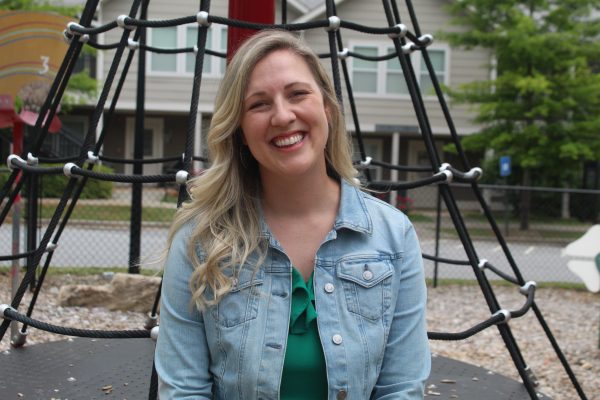
Athens Area Homeless Shelter Executive Director Olivia Amato poses at the AAHS ARCH Village location’s playground at 205 Bray St. on April 29. Through their Racial Justice Commitment, the organization has aimed to recognize housing discrepancies. “As an organization that is supporting families experiencing homelessness, we have to recognize that there is a racial disparity in housing,” Amato said. “So, we have to keep that in mind, not only in our service provision, but in the way that we structure our staffing, the way that we support our staff and recognizing that more Black families are experiencing homelessness than white families in Georgia (by) an alarming rate.” Photo by Iliana Tejada
IG: You spoke about responsive versus innovative programs. Could you explain what AAHS’ responsive programs are?
OA: (For) our two more responsive programs, we operate (an) emergency shelter for seven families at a time experiencing homelessness. That could be up to eight parents, and it can (hold) anywhere from 20 (to) 25 kids at a time. Then, we operate a rental assistance program, and that is for families that are moving from experiencing homelessness into an approved rental. That program can support anywhere from 12 to 15 families at a time. So, right now we have 12 families that we pay 100% rent from the start of the program all the way through their lease. So, they’re building that rental capacity (and) they’re getting time to build their credit. We’re trying to give families the resource of time.
IG: Could you explain AAHS’ innovative programs?
OA: Our more innovative programs, one of them is called Bridge to Home. It’s for parents who are getting a degree or certificate. We can have up to seven families in that program at a time, and it is for parents (enrolled in a school program) for the duration of their program. The goal is to increase income. Then, we have an on-site trauma-informed program called “Strengthening Home.” Te program is set up in a way that we have multiple kids’ groups a week led by volunteers and an incredible case manager, who connects kids with fun but engaging family-building activities, and also parent-centered activities like credit repair workshops, financial planning and things like that. So, it’s this opportunity to build a bond and also reduce the trauma of experiencing homelessness. It was started with a partnership with the Athens (Area) Community Foundation and their community resiliency program.
IG: How are all of these different programs funded, considering AAHS is a non-profit organization?
OA: About 20% of our budget is through federal funding (from) the (United States Department of) Housing and Urban Development (HUD), which is passed down through (the) Georgia Department of Community Affairs (through a) program called Rapid Rehousing. The HUD Emergency Solutions Grant funds a portion of our emergency shelter which also means that they determine how long we can offer emergency shelter. The Bridge to Home program is largely funded through the Local Community Partnership Program. It also provides us the flexibility to make that program as long or short as we need to help support families, and then we have monthly donors. They’re a huge, huge support because it’s a regular donation that we can depend on. We have our fundraising events where we aim to raise funds, and then we have multiple other private foundations.
IG: What is the organization’s mission, and how does the board carry that out?
OA: Our mission, to put it simply, is to help families find (a) home, and we do that through emergency shelter. We do that through rental assistance. We do it through these educational transitional housing and also those supportive environments through strengthening homes. When you’re facing the incredible, scary situation of homelessness, you come into a program and you start to be connected with other people in the community (who) care and (can) make a difference. We’re not only helping families find (a) home, we also help them develop (a) home while they’re here.
View this post on Instagram
An Instagram reel from the Athens Area Homeless Shelter of AAHS Executive Director Olivia Amato speaking about what the shelter is doing to help families is shown. AAHS is split into two locations, the original located on Barber Street and new branch on Bray Street. “When you visit the (Barber Street location), even though it’s older, a lot of times people think it’s a daycare because it is kid-focused. There (are) playgrounds, there (are) bikes (and) there (are) murals,” Amato said. “We love (murals) because art really can inspire. We want families to feel inspired and hopeful in the spaces that they’re with us.” Instagram reel fair use of the Athens Area Homeless Shelter
IG: How can people become connected with AAHS?
OA: If you’re a family that’s needing shelter, there’s a couple different ways. (The) best way is to call us and let us know what’s going on, and we need you to call us pretty regularly so we can know what’s going on. Because there’s only so much shelter availability, we are working our hardest to connect the most vulnerable situations to shelter as quickly as possible. We have a contact form on our website, so you can fill that out, and we will be in touch, and when we let you know, we want you to call us. That’s the best way to seek shelter. We also are going to talk you through other resources, and our team does a really great job with that.
IG: What would you say your goal is as the AAHS Executive Director?
OA: If I were (going to) sum it up into three words: integrity, sustainability and responsiveness. I think we have a really solid reputation for those things, and I want to shore up our sustainability. No matter the decisions that are being made beyond our control, I want to make sure that this organization can continue to respond in the way that it does to the changing need of family homelessness. Ideally, ten years from now, we don’t have a need for emergency shelter, but there (are) financial challenges. So, when a family needs emergency shelter, what I want five years from now (to look like) is that they don’t have to wait, they are able to access emergency shelter when they need it, and there is a faster path to getting into more affordable housing. So, it takes way more than just our organization, and we have some incredible partners that help with that.
IG: Ideally, what would you say the future of the organization will look like?
OA: One year from now, I would like our team to feel supported, and I would like our team to feel like they can do their jobs well with what they have, whether that’s investing in the materials that they have to work with, as well as the connections in the community. When we’re talking like five (to) 10, years (from now), I’d like for families to be able to, when they have a crisis, know that they can access support quickly, and that the team that’s here is able to connect them to housing quickly, and that we can expand this Bridge to Home initiative in a way that provides more pathways out of paycheck-to-paycheck living for families.