A map shows the states in which New Voices Laws have been enacted. Dr. PJ Cabrera, University of Texas at San Antonio Assistant Professor of Instruction, has been both a student and advisor in the scholastic media world, and discussed how to get the New Voice law in place in more states. “Go to your school board meetings, go to your city council meetings. Invite a lot of your local politicians into your schools to let them know what you’re doing, and while you have them tell them, educate them on these new voices, laws and why they’re important. So a lot of it is outreach.” Map by Lea D’Angelo
In an era of increased student press censorship, 18 states have enacted “New Voices” laws to protect the rights of these young writers.
Across the United States there are 18 states with “New Voices” laws, laws protecting student journalists from facing unfair censorship. But in the Southeast specifically, there are only two.
Following the 1988 Hazelwood v. Kuhlmeier Supreme Court decision, a decision stating Hazelwood East High School had the right to censor stories regarding sensitive topics, many press protections granted to student journalists from the First Amendment were taken away.
The Student Press Law Center saw the decision as “a serious blow to scholastic journalism,” and has worked to keep student journalists informed about what the decision entails for their publications.
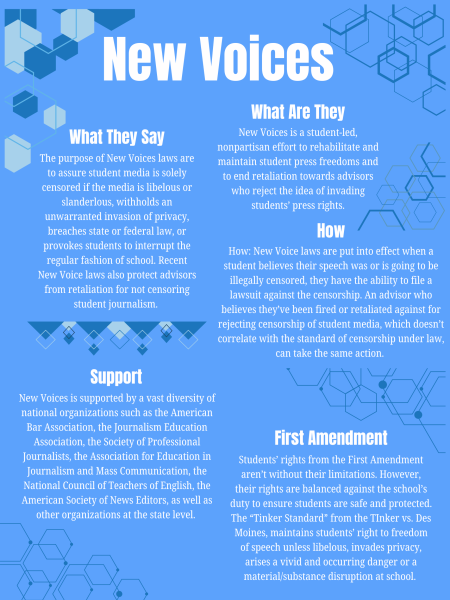
An infographic shows five fast facts about New Voices legislation, according to the Student Press Law Center’s website. Graphic by Maya Pringle
“Requests for legal assistance to the SPLC from high school students and advisers around the country indicate that the Hazelwood decision has had at least one significant effect: a dramatic increase in the amount of student censorship,” the SPLC stated.
In comes the solution: “New Voices” a student-backed grassroots movement to protect the freedoms of student journalists. These laws are written and lobbied for one main reason: to restore student press rights back to what they were before Hazelwood v. Kuhlmeier.
But, it isn’t that simple. To enact “New Voices” laws, they have to follow the same process as any other law in the U.S. and this can take a while. And while these protections are not in place, students will continue to face problems with censorship.
“We’re moving backwards, and I hate that we’re moving backwards. But, this is temporary, and when (an) administration is on their way out we may have a difference of ideologies,” Dr. PJ Cabrera said. “We’re moving backwards so we need to be present, and we need to make sure that we continue to tell our stories.”
Cabrera has seen the effects censorship can have on student media, first as a student journalist then an advisor and presently as a Journalism Professor. In his current position, he encourages students to reach out to the community to garner support.
“Invite a lot of your local politicians into your schools to let them know what you’re doing, and while you have them tell them, educate them on these ‘New Voices’ laws and why they’re important,” Cabrera said. “A lot of it is connecting to other people and then bringing them in.”
A timeline shows the order in which New Voices laws were passed in the United States. Timeline by Lea D’Angelo
In South Carolina, a state without any “New Voice” laws, students run the risk of censorship from school and district administration. For Logan Jones, a junior at Richland Northeast High School, this problem has become increasingly apparent when trying to cover controversial issues like walkouts.
“It’s very important to make sure that everyone has a voice and that the stories that need to get put out are actually getting put out,” Jones said. “Since we’re not a ‘New Voices’ state, it’s very hard to put out stuff like that.”
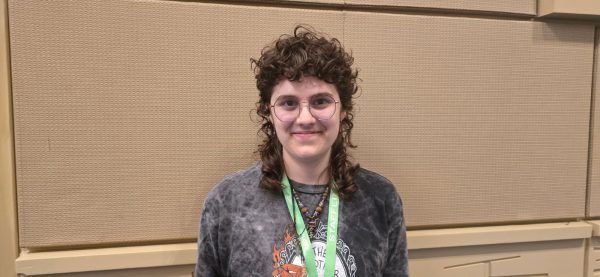
Cedar Shoals High School senior Maggie Gillan poses in the Columbia SC. Metropolitan Convention Center on March 7. Photo by Abby Holloway
Many students without “New Voice” protections have faced similar challenges to Jones. In Georgia, Maggie Gillan, a senior at Cedar Shoals High School has seen their program face limits on what stories are allowed to be written.
“One time we had a walk out at our school and it didn’t go super well and we weren’t allowed to write about it,” Gillan said. “It’s important to cover things, even if they (don’t) look the best for our school. Having (a) ‘New Voices’ law would definitely be great for that.”
Dr. PJ Cabrera, University of Texas at San Antonio Assistant Professor of Instruction talks in the Columbia SC. Metropolitan Convention Center on March 7. Cabrera discussed the New Voices laws being imperative to journalists and should be enacted soon in the states which don’t already have the laws. “Unfortunately, (there are) states that are pushing back on (the New Voices laws), but now (18) states have passed New Voices laws” Cabrera said. “We need to make sure that continues. They’re incredibly powerful and allow storytellers to evolve (into) professional journalists.” Video by Lea D’Angelo
Marissa Herron, a junior at Bullitt East High School has dealt with the struggles of censorship through her time as a student journalist. While she can’t fix the problem overnight, she encourages herself and others to continue reporting on the topics they find important.
“Don’t be afraid to use your voice. Your voice is a powerful tool, and if you use it effectively and efficiently words have a lot of power, and actions can be louder than words,” Herron said. “The more you go above and beyond to push for what you believe in, the more people will be impacted.”
More from Abigail Holloway
More from Lea D’Angelo
More from Maya Pringle
More from Renn Borger